
Why Slippage Kills Scalping EAs and How to Avoid it
Scalping Expert Advisors depend on precision. Many scalping systems aim to capture small price movements of only a few points, which means even minor execution differences can turn a profitable strategy into a losing one.
This is why slippage scalping EA performance is one of the most important factors traders need to understand. A strategy that works perfectly in a backtest may fail in live trading because the real execution price differs from the expected price.
Slippage occurs when an order is filled at a different price than requested. It can happen because of market volatility, broker execution conditions, liquidity changes, or incorrect EA settings.
This guide explains what slippage is, why scalping systems are affected the most, how to reduce slippage forex, and which settings can help improve execution reliability.
What Slippage Is and Why Scalpers Feel It Most
Slippage is the difference between the price a trader expects when placing an order and the actual execution price received.
In normal trading conditions, the difference may be small. However, for scalping EAs, even a fraction of a pip can significantly affect results because these systems depend on frequent small profits.
For example:
- A swing trader targeting 200 pips may barely notice one pip of slippage.
- A scalper targeting 5 pips may lose a large percentage of the expected profit.
This difference explains why scalping EA fails is often related to execution quality rather than strategy logic. You can also explore more details on “what is slippage” article and learn more about why it happens.
How Slippage Happens
The execution process involves several steps:
- The EA detects a trading opportunity.
- The order request is sent to the broker.
- The broker receives and processes the order.
- The order is filled at the available market price.
During this short period, prices may change.
The result can be:
- Better execution than expected
- Worse execution than expected
- Rejection or requote
Why Scalping Strategies Are More Sensitive
Scalping EAs usually have:
- Short holding periods
- Small profit targets
- Many daily trades
- Tight stop losses
Because of this, execution costs become a larger part of overall performance.
| Trading Style | Impact of Slippage |
|---|---|
| Long-term trading | Low impact |
| Swing trading | Moderate impact |
| Day trading | Higher impact |
| Scalping EA | Very high impact |
For scalpers, execution quality is not a secondary issue. It is part of the strategy itself.
Positive vs Negative Slippage Explained
Slippage is not always harmful. It can work in both directions depending on the final execution price.
What Is Positive Slippage?
Positive slippage occurs when an order is executed at a better price than expected.
Examples:
- A buy order is filled lower than requested.
- A sell order is filled higher than requested.
This improves the trading result.
What Is Negative Slippage?
Negative slippage occurs when an order is executed at a worse price.
Examples:
- A buy order is filled higher than expected.
- A sell order is filled lower than expected.
This reduces profit or increases losses.
| Type | Example | Effect |
|---|---|---|
| Positive slippage | Better entry price | Improves results |
| Negative slippage | Worse entry price | Reduces results |
Why Scalpers Mostly Notice Negative Slippage
Although positive slippage can happen, many scalping systems are more affected by negative execution because trades are often opened during fast market conditions.
Common situations include:
- Economic news releases
- Market openings
- Sudden volatility spikes
- Low liquidity periods
A few points of negative slippage repeated across hundreds of trades can remove the entire advantage of a scalping strategy.
Understanding positive negative slippage helps traders evaluate whether their broker and EA settings are realistic.
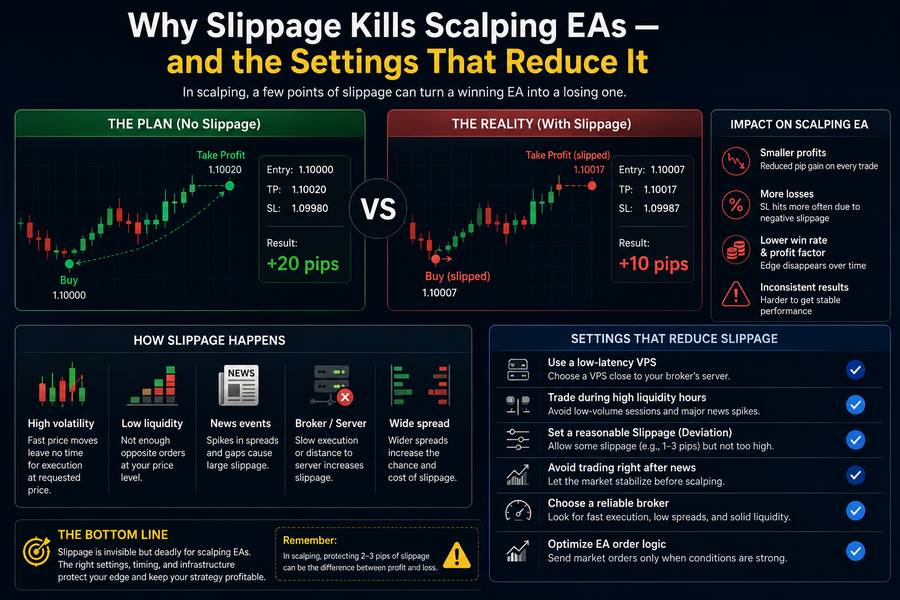
How Small Slippage Destroys a Scalping Edge
A scalping strategy often depends on a very small statistical advantage. The difference between profit and loss may come from only a few points per trade.
This means small execution problems can completely change the outcome.
Consider an EA that:
- Makes 500 trades per month
- Targets 5 points average profit per trade
- Experiences 1 point of additional slippage
That single point affects every trade and can remove a significant portion of the expected return.
The Hidden Cost of Slippage
Slippage affects more than entry price.
It can influence:
- Take-profit execution
- Stop-loss results
- Trade frequency
- Risk-to-reward ratio
- Overall drawdown
A backtest may show a smooth equity curve because it assumes perfect execution. Live trading introduces real market conditions.
This is why traders should include realistic execution assumptions when testing a trading strategy.
Slippage and Backtest Differences
Many scalping EAs perform well in historical testing but fail after deployment because backtests often ignore:
- Real execution delays
- Variable spreads
- Liquidity changes
- Order processing time
The smaller the profit target, the larger the impact of these differences.
Example: Why Scalpers Need Better Execution
Imagine two strategies:
| Strategy | Target Profit | Slippage Impact |
|---|---|---|
| Swing EA | 100 pips | Small |
| Scalping EA | 5 pips | Significant |
The swing strategy has more room to absorb execution differences. The scalper does not.
This is why selecting the right broker, configuring the EA correctly, and monitoring execution quality are essential for automated scalping.
Broker-Side Causes: Liquidity, Model and Execution
Slippage is not always caused by the EA. The broker’s infrastructure and execution model play a major role.
Different brokers can produce very different results using the same scalping system.
Liquidity and Market Conditions
Liquidity determines how easily orders can be filled at the requested price.
During high liquidity periods:
- Spreads are often tighter
- Execution is usually faster
- Slippage may be lower
During low liquidity periods:
- Spreads may increase
- Prices may move quickly
- Slippage becomes more common
Broker Execution Models
Brokers may use different execution methods, including:
- Market execution
- Instant execution
- ECN-style execution
Each model handles price changes differently.
Market execution focuses on filling the order at the available market price, while instant execution may reject orders if the requested price changes.
Understanding market versus instant execution is important when choosing a broker for automated scalping.
Why Broker Selection Matters
A broker suitable for long-term trading may not be ideal for scalping.
Scalping traders should evaluate:
- Average spread
- Execution speed
- Slippage history
- Requote frequency
- Trading restrictions
A reliable scalping broker should provide consistent execution rather than simply advertising low spreads.
Strategy-Side Causes: Entries During News and Spikes
While brokers influence execution quality, the trading strategy itself can also increase slippage risk. Many scalping EAs fail because they enter trades during periods when the market moves too quickly for stable execution.
A strategy may have strong logic, but poor timing can expose it to unnecessary execution problems.
Trading During High-Volatility Events
Economic news releases often create extreme price movements within seconds.
During these periods:
- Spreads can expand
- Liquidity can decrease
- Prices can jump between levels
- Orders may receive worse fills
For scalping systems, these conditions can destroy a small trading advantage.
Examples include:
- Interest rate announcements
- Employment reports
- Inflation data releases
- Central bank statements
A well-designed EA should consider whether trading during these events is appropriate.
Price Spikes and False Signals
Sudden market spikes can trigger scalping entries that would not normally occur under stable conditions.
Common problems include:
- Entering at poor prices
- Increased negative slippage
- Immediate stop-loss activation
- Unexpected spread expansion
Using filters that identify unusual market conditions can help reduce unnecessary exposure.
EA Settings That Reduce Slippage Impact
The right EA settings cannot remove slippage completely, but they can reduce its impact and improve execution consistency.
A good scalping EA should include controls that adapt to real market conditions.
Important Settings to Review
Key settings include:
- Maximum allowed spread
- Maximum deviation
- Trading session filters
- News filters
- Execution filters
- Order retry rules
These settings help the EA avoid situations where execution quality is likely to deteriorate.
| Setting | Purpose |
|---|---|
| Spread filter | Avoid expensive market conditions |
| Max deviation | Control acceptable price movement |
| News filter | Avoid extreme volatility |
| Session filter | Trade during better liquidity |
Using an Execution Filter
An execution filter allows the EA to evaluate market conditions before sending an order.
Examples:
- Check current spread
- Compare current volatility
- Avoid abnormal price movements
- Confirm available liquidity
This creates a more selective trading process.
Instead of entering every signal, the EA only trades when execution conditions are acceptable.
Max Deviation, Order Types and Execution Filters
Execution settings determine how an EA handles price changes between order placement and order filling.
Understanding these options is essential for reducing execution problems.
What Is Maximum Deviation?
The max deviation setting defines how much price movement is acceptable before the order is rejected.
For example:
- Low deviation value: More price protection, but more rejected orders
- High deviation value: More completed trades, but potentially worse prices
The correct setting depends on the strategy and market conditions.
Scalping systems often require careful balancing because they need fast execution without accepting excessive price movement.
Choosing the Right Deviation Setting
There is no universal maximum deviation value.
Factors to consider:
- Currency pair volatility
- Broker execution speed
- Trading session
- Strategy target size
A scalper trading major pairs during liquid hours may use different settings from an EA trading volatile instruments during news events.
Market Orders vs Limit Orders
The choice between order types also affects execution.
| Order Type | Advantage | Limitation |
|---|---|---|
| Market order | Fast execution | More exposure to slippage |
| Limit order | Price control | May not be filled |
A market order prioritizes execution speed, while a limit order prioritizes price control.
Neither is automatically better. The choice depends on the strategy.
This is why understanding market versus instant execution and different order types is important when building automated systems.
Choosing a Broker Suited to Scalping
A good scalping environment requires more than low spreads. Traders need a broker that provides consistent execution and supports their trading style.
The cheapest spread does not always mean the best conditions.
Important Broker Factors
When evaluating a broker for scalping, consider:
- Execution speed
- Average spread
- Commission structure
- Slippage behavior
- Order restrictions
- Server stability
A broker with slightly higher costs but better execution may outperform a broker offering extremely low spreads with poor fills.
ECN-Style Execution for Scalping
Many scalpers prefer brokers offering direct market access or ECN-style conditions because they often provide:
- Faster execution
- Tighter spreads
- Greater transparency
However, traders should evaluate the complete cost, including commissions and execution quality.
Services such as ECN Plus for scalping are designed around traders who prioritize fast and reliable order processing.
Conclusion
Slippage is one of the biggest challenges facing automated scalping systems because these strategies depend on small price movements and precise execution.
A profitable backtest does not guarantee live performance if it ignores real-world execution conditions. Spread changes, market volatility, broker infrastructure, and EA settings all influence final results.
To reduce slippage impact, traders should:
- Choose a broker with reliable execution
- Use realistic max deviation settings
- Add spread and execution filters
- Avoid poor trading conditions
- Test strategies with live market data
A good slippage scalping EA is not only built around entry signals. It must also manage execution risk.
By understanding slippage in trading and optimizing the complete trading environment, traders can improve consistency and reduce the gap between backtested and live results.
Sources and References
- MetaQuotes — MetaTrader 4 and MetaTrader 5 Trading Platform Documentation
- MQL5 Community — Articles on Expert Advisors, execution settings, and automated trading
- Broker execution documentation covering market execution, spreads, and order handling
- Institutional trading resources covering liquidity, order execution, and market microstructure
FAQ
No. Slippage cannot be completely eliminated because markets constantly change and prices can move between order placement and execution.
There is no universal max deviation value because it depends on the trading strategy, currency pair, and broker execution conditions.
Scalping EAs usually require tighter control because they target small profits. However, setting the value too low may cause rejected orders during fast markets.
The best approach is testing different settings under real market conditions.
A faster VPS can reduce network delays, but it cannot remove all sources of slippage.
A VPS closer to the broker server may improve:
Order transmission speed
Connection stability
Execution consistency
However, slippage is also affected by liquidity, spreads, broker execution, and market volatility.
Not always. Market orders provide faster execution but may experience more slippage. Limit orders provide better price control but may not be filled.
The better choice depends on the scalping strategy.
Fast momentum systems often prefer market execution, while strategies that require exact entry prices may benefit from limit orders.
Share
Hot topics

STP, NDD, ECN and DMA: Broker Execution Models Decoded
When picking a forex broker, we don’t just look at the brokerage that has the lowest spreads, bonuses, and other kind of what is apparent for us. There is one...
Read more



Submit comment
Your email address will not be published. Required fields are marked *