
Market Execution vs Instant Execution in Forex
When placing an order in the Forex market, your main concern is likely focused on selecting the right currency pair or the ideal entry point. However, there is another important aspect that new traders tend to forget: how the order is actually executed.
The execution method affects the price you obtain, the time needed to complete your trade, and your overall trading experience. Understanding the difference between Market Execution and Instant Execution will help you make informed decisions during fast-moving market periods.
In this article, we’ll explain both execution types in simple language, compare their strengths and weaknesses, and help you understand which one may suit your trading style.
What Is Order Execution in Forex?
The term order execution refers to the entire process of sending your order to the market and having it completed by your broker. The moment you click on Buy or Sell, your trading platform connects with the broker’s system to process your order.
Although the process usually takes only milliseconds, the order execution mechanisms depend on the execution model provided by your broker. The different execution methods are designed for different trading strategies and market conditions.
For instance, if you plan to buy EUR/USD during an important economic announcement, prices may change multiple times in one second. The execution model determines whether your order is filled instantly at the market price or checked to see whether the requested price is still available.
Understanding how the order execution works is as crucial as understanding spreads, leverage, and risk management. If you are interested in the issue of trading costs, you may find What Is a Floating Spread in Forex helpful, as spreads and order execution often work together during market volatility.
What Is Market Execution?
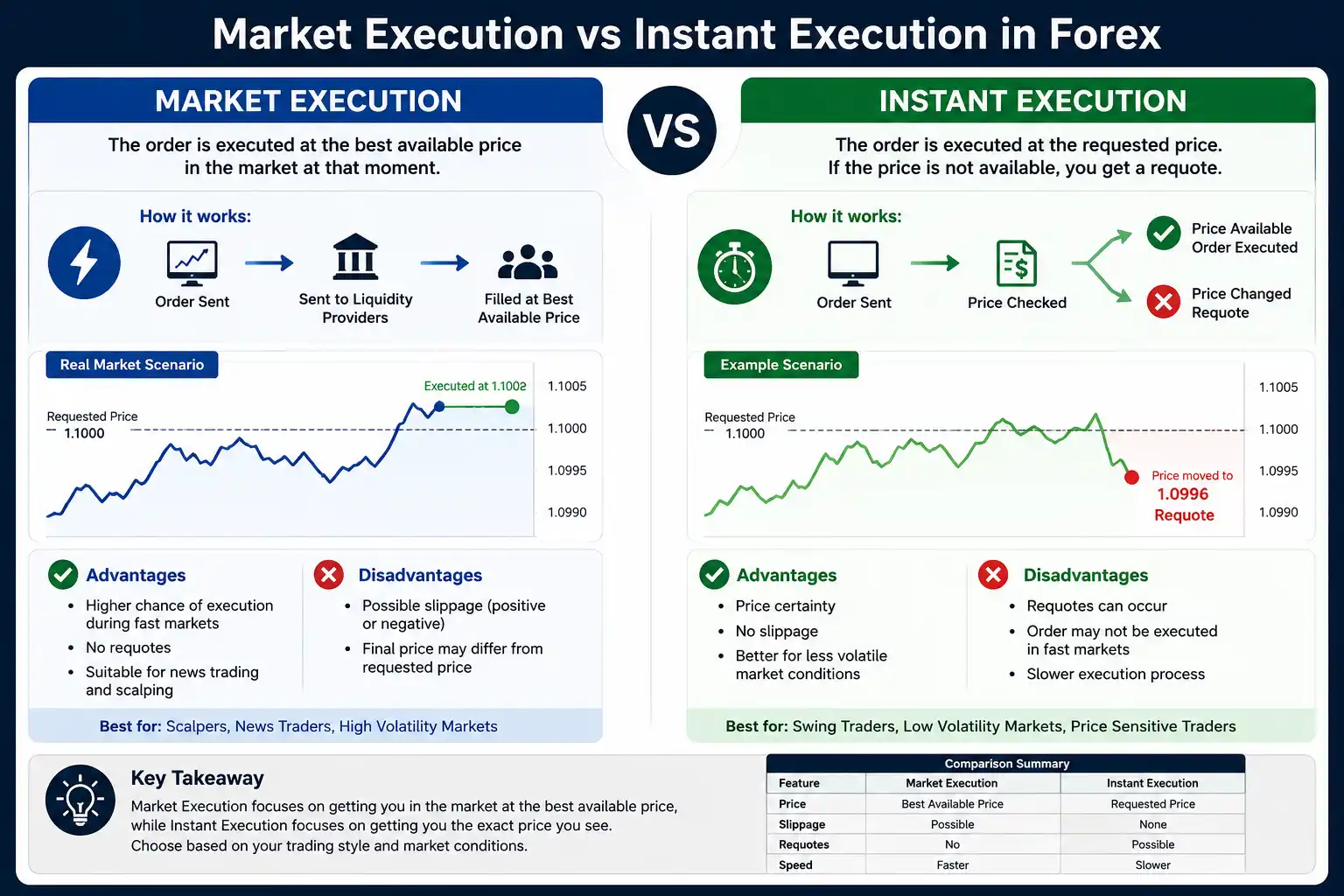
Market execution is a method whereby your broker executes your order at the best available price once your order reaches the market.
In other words, there is no guarantee that you will obtain the exact price you clicked because your order will be active at the current available market price, which could be different if the market moves quickly. This system is highly popular on modern cTrader platforms due to its speed and transparency.
This difference in price is called slippage. Slippage can work against you, but it can also work in your favor if prices move in your favor before your order is filled.
Market execution is widely used by ECN and STP brokers because it reflects real market conditions. If the price has changed, instead of rejecting your order, the system will fill it automatically at the next available price.
Market execution is popular among traders who prioritize fast order execution over receiving an exact quoted price.

What Is Instant Execution?
When the broker executes with the method of instant execution, they provide you with a certain price. As long as the price quoted is available, the broker will fill your order right away. But if the market goes against you while your order is en route to the broker, then the broker’s quote may not hold anymore. In this case, the broker can send a requote, asking whether you would like to accept the new price quote.
This gives traders more confidence because they know the price they are requesting. Consider buying something online at the price that you see on the website. In case the price rises before your payment is cleared, the shop will ask you whether you want to complete the order or not.
Although instant execution aims to provide the requested price, it may result in a longer order execution process during volatile market conditions.
Key Differences Between Market and Instant Execution
There are two methods that have been developed to execute trades in Forex, but these methods differ significantly from each other depending on their functionality and the needs of traders who use them.
Market Execution means that an order will be executed at the current market price once it reaches the broker, which results in a possible price discrepancy when compared to the price when the order was placed, especially if it occurs during a time of high activity. However, the advantage of this method is that the orders will usually be executed fast, and there are no requotes.
In the case of Instant Execution, you request that your order be executed at a particular price, and the broker will try to execute the order at that exact price. However, if the price is changed after the order was placed, the broker may send a requote, which provides an opportunity to the trader either to accept the new price or reject it. This method, in its turn, provides more price assurance, but it also makes the process of trading slower in the case of lively markets.
Thus, neither of these methods can be said to be better than the other. Those traders who consider speed to be more important usually prefer to stick to the market execution method, while those who place the highest value on the exact points of entering the market choose the instant execution method.
The easiest way to understand these execution methods is by comparing their main characteristics.
| Feature | Market Execution | Instant Execution |
| Price guarantee | No | Yes (if available) |
| Requotes | No | Possible |
| Slippage | Possible | Less common |
| Execution speed | Usually very fast | May pause due to requotes |
| Best suited for | Fast-moving markets | Stable market conditions |
| Typical broker type | ECN/STP | Market Maker |
Comparison Chart
Execution Speed
Market Execution ██████████
Instant Execution ████████
Price Certainty
Market Execution ██████
Instant Execution ██████████
Chance of Requotes
Market Execution █
Instant Execution █████████
The comparison shows that neither method is universally better. Each one focuses on a different priority. One emphasizes speed, while the other prioritizes price confirmation.
Advantages and Disadvantages of Market Execution
Like any trading feature, market execution has both strengths and limitations.
Advantages
- Orders are usually processed very quickly.
- No requotes interrupt your trading.
- Works well during highly active market sessions.
- Commonly available with ECN trading environments.
- Suitable for automated trading systems and many cTrader platforms.
Fast execution becomes especially valuable when market prices change every second. Missing an opportunity because of repeated confirmations can sometimes be more costly than accepting a small amount of slippage.
Disadvantages
- Slippage can occur during volatile markets.
- The final execution price may differ from the requested price.
- Beginners may initially find price changes confusing.
Understanding your risk management is important when using this execution model. Learning concepts like What Is a Stop Out also helps traders understand what may happen if market movements become extreme.
Advantages and Disadvantages of Instant Execution
Instant execution also offers several benefits, particularly for traders who prefer greater control over pricing.
Advantages
- Greater certainty about the requested entry price.
- Reduced chance of unexpected execution prices.
- Easier for beginners to understand price confirmation.
- Can provide a more predictable trading experience during stable markets.
Many traders appreciate knowing exactly which price they are trying to enter before committing to the trade.
Disadvantages
- Requotes may occur during volatile conditions.
- Trading opportunities can be missed while confirming a new price.
- Execution may feel slower during major news events.
- Less suitable for strategies that depend on immediate order placement.
For example, if you’re trying to enter a breakout trade during an important economic release, even a short delay caused by a requote could mean entering much later than planned.
Which Execution Type Is Better for Traders?
The answer depends on your trading style, rather than one execution model being objectively better.
Order execution is one of several trading features that users may encounter when trading through brokers like Otet markets. Understanding how it works can help traders make more informed decisions before placing an order.
Market execution is frequently the right option if you trade when there are significant announcements, prefer to use automated techniques, or want quick order processing. If, on the contrary, you care about exact entry at a specified quoted price and mainly trade during stable periods, then instant execution is possibly a more convenient option for you.
Professionals tend to choose brokers by many parameters, not just the execution quality. Regulation, spreads, platforms, customer support, and instruments are of great importance as well. When assessing a broker, execution quality should be looked at in connection with the overall environment, not just as an isolated characteristic.
As you gain more practical experience, you will probably understand that the best method of execution is simply the one that fits your method and enables you to perform risk management well. It is also worth remembering that no execution method can guarantee successful trades on its own. Good trading results come from combining the right execution type with a solid strategy, proper risk management, and consistent practice.
Many experienced traders test both execution methods on a demo account before committing to one in a live environment. This allows them to see how each performs under different market conditions without risking real money. Over time, understanding how your orders are executed can help you build confidence, improve decision-making, and create a trading approach that better matches your personal goals and experience level.
Conclusion
Choosing between market execution and instant execution is not about finding one method that is always better. Instead, it’s about selecting the execution type that best matches your trading style and goals. The purpose of the method is to become acquainted with both kinds of execution and choose the one that suits your trading style.
While market execution is characterized by great speed and continuous processing of orders which guarantees its popularity under high market activity, instant execution is more concerned about confirming the price which is preferred by some traders when the market is less active.
The better you get to know about the order execution, the spreads, and risk management, the greater your confidence will be in your trading decisions. Execution methods may seem to be irrelevant small details that do not matter a lot at first, but over a number of trades performed, they may significantly influence your trading experience.
FAQ
Slippage happens when the market price changes between the moment you place your order and the moment it is executed. High volatility, low liquidity, and major economic news are common reasons. To better understand related trading costs, read What Is a Floating Spread in Forex.
Yes. If the requested price is no longer available when your order reaches the broker, you may receive a requote asking whether you want to accept the updated price. You can also learn more about trading risks by reading What Is a Stop Out.
In most situations, market execution is faster because orders are filled at the best available market price without waiting for confirmation. Platform performance also matters, which is why many traders compare different cTrader platforms before choosing a broker.
Many scalpers prefer market execution because it generally provides quicker order processing and avoids delays caused by requotes. However, execution quality, spreads, and broker reliability all contribute to successful scalping.
Share
Hot topics

STP, NDD, ECN and DMA: Broker Execution Models Decoded
When picking a forex broker, we don’t just look at the brokerage that has the lowest spreads, bonuses, and other kind of what is apparent for us. There is one...
Read more




Submit comment
Your email address will not be published. Required fields are marked *