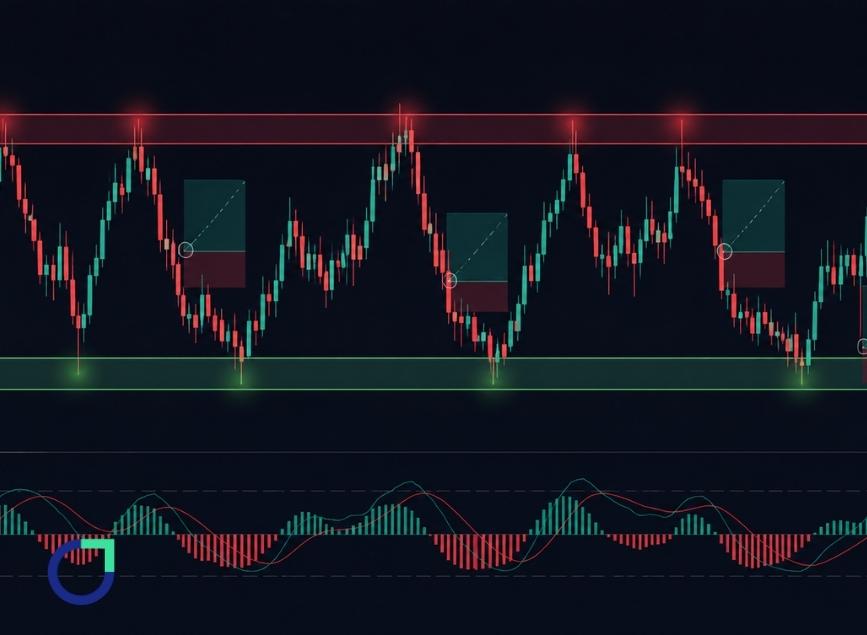
Range trading strategy and when does it work?
There are many markets that are either moving sharply upward or downward. At times, prices fluctuate between two levels. However, range traders have a method to benefit from quieter conditions of trading rather than feeling annoyed.
The range trading strategy is about purchasing near the support and selling near the resistance as long as the market is between two limits. Depending on the market conditions, every strategy possesses its benefits and disadvantages that need to be understood by traders.
In this guide, you will learn the essence of range trading, its advantages, and possible traps in case you are a beginner in technical analysis or searching for a new trading strategy.
What Is Range Trading?
The trading technique called range trading relies on sideways price movements. Instead of looking for strong trending movements, traders operate on the assumption that the price will remain within the same range until the breakout happens.
Support means the minimum price area where buyers take action, and resistance is the maximum price area where sellers take action. Traders tend to buy in the vicinity of support and close their trades near resistance. Some advanced traders may also look for selling opportunities near resistance if the trading environment allows it.
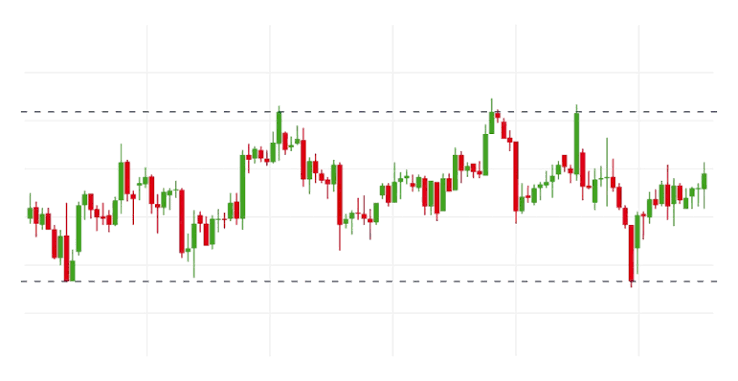
Range trading is common in forex, stocks, commodities, and cryptocurrencies, as all markets have their periods of consolidation. However, the success of range trading techniques depends largely on the ability to determine if a market is indeed ranging as expected or preparing for a breakout.
If you are not an expert yet, you can further improve your knowledge by reading our article on What Is Liquidity in Trading Strategy to understand in which markets support and resistance levels are more respected.
How to Identify a Range-Bound Market?
Identifying whether the market is actually moving sideways can be quite challenging. Beginner traders may mistake a temporary pause in the market for a sideways trading condition.
A range-bound market usually has several common characteristics:
| Characteristic | What You Should Notice |
| Stable highs | Price repeatedly struggles to move above resistance. |
| Stable lows | Buyers repeatedly defend the same support area. |
| Limited volatility | Price movements remain relatively controlled. |
| No clear trend | Higher highs and lower lows are absent. |
Instead of just relying on one incident, gather some evidence to back up the decision. If the level of support and resistance has been hit multiple times by the price without crossing it, then the range identified becomes more significant.
Some traders use both the characteristics of the chart and the Stochastic Indicator to ensure that the market is either overbought or oversold within the range. Though no indicator can guarantee 100% accuracy, the combination of price action interpretation together with the use of trading indicators results in a comparatively high ratio of success.
It is also believed that one must keep a trading journal. If examined closely, the graphs of the market over several months will illustrate that the sideways movements take place much more frequently than one expects.
Key Tools for Range Trading
For the most part, successful range traders don’t rely on just one method of analysis; rather, they often engage in price movement analysis along with using many different forms of technical analysis, giving them at least some reasonable confidence that they will be successful in their trades.
| Tool | Purpose |
| Support and Resistance | Define the boundaries of the trading range. |
| RSI | Measures momentum and possible reversals. |
| Stochastic Indicator | Helps identify potential overbought and oversold conditions. |
| Bollinger Bands | Highlights periods of low and expanding volatility. |
| Volume Analysis | Confirms whether buyers or sellers are becoming stronger. |
In addition to other signals, traders also look for Stochastic Signals before making a trade. When the price reaches a support level, traders may consider entering a position to take advantage of improving momentum.
Success can hardly be achieved by any one method of analysis or indicator. The objective of range trading is not just to be able to make a forecast about the market but rather to increase the odds of making profitable trades. It’s always advisable to get used to using a reliable MetaTrader platform before actually taking any risks.
When Does Range Trading Work Best?
The practice of trading within a defined range proves to be most effective in a flat market where the buying and selling activity of the participants in the market is not skewed in any direction. This allows the price to go through a range of trading patterns corresponding to the boundaries established.
The strategy often works well during:
- Low-volatility market sessions.
- Consolidation after a major trend.
- Periods with limited economic news.
- Markets where institutional activity remains balanced.
The price moves back and forth between the established upper and lower limits, making it possible for traders to take advantage of this kind of trading environment.
Another factor that influences the effectiveness of range trading is market timing. Traders should pay attention to trading sessions, liquidity levels, and overall market sentiment before entering positions. A range that appears reliable during calm periods may become unstable when volatility increases. By combining technical analysis with awareness of market conditions, traders can avoid unnecessary trades and improve their decision-making process.
Understanding when not to trade is equally important as identifying profitable opportunities. Traders should avoid entering positions when market conditions no longer support a reliable range. Once suitable market conditions are identified, some traders find the Stochastic Trading Strategy particularly useful because it combines support and resistance patterns with momentum readings to improve trade timing.
Additionally, reviewing Backtesting Forex Strategies for Higher Accuracy before implementing a strategy can help traders understand how their trading rules have performed under different market conditions.
Risks of Range Trading
Despite the fact that range trading is very easy to understand, it carries risks that should never be ignored.
One of the main issues with range trading is the danger of false breakouts. It is frequent for the price to exceed the support and resistance lines for a moment only to return to the range in no time. Traders, being too fast, may conduct unsuccessful trades because of this.
The second issue is the sudden release of news. Major economic news may instantaneously turn a calm range into an aggressive trend. Bad risk management worsens the situation even more. Traders face risks for every trade. One should always have a backup plan for their actions.
Beginners can also reduce unnecessary mistakes by practicing on a Metatrader5 account before moving to live trading. It provides an opportunity to test risk management and become familiar with different market conditions without risking real funds.
Moreover, failure to control emotions leads to losses. A trader may believe that the currency pair is going to behave in accordance with their past successful trades. In order to avoid losses that occur because of trading decisions based on emotions, traders are recommended to trade in reasonable sizes instead of relying on price movements too much.
Example of a Range Trade
Imagine a currency pair trading between 1.2000 and 1.2100 for two weeks.
Each time the price approaches 1.2000, buyers become active and push the market higher. When the price reaches 1.2100, sellers appear and drive the price back down.
The trader waits calmly instead of pursuing to get into the middle of the price range. When the price comes back to the support, the trader observes bullish candlestick formations together with Stochastic Signals, confirming that momentum is improving before entering the trade.
The trader enters a long position near the support level, places a stop-loss slightly below the range, and sets a profit target just below the resistance level. As time goes on, the price moves upwards and reaches the target. Instead of predicting the breakout, the trader follows the original idea of the trade.
This example highlights an important lesson that successful trading comes with patience and consistency instead of trying to predict sudden price movements. Many brokers like Otet markets offer tools to see the past price movements on the charts so that traders can check out similar situations occurring before they make decisions.
One of the main advantages that range trading has is that it promotes discipline. Instead of pursuing the current market trends and developments, traders become accustomed to waiting for prices to behave the way they need according to their trading plan. The practice of patience is essential because it allows traders to control their emotions and stick to the rules of trading even when waiting for a trading signal takes too much time.
Another important thing to remember is that trading ranges cannot last forever. Think about the market motion in terms of its various phases that include price trend, consolidation, and reversal. This way, a trader who can understand the fact that support and resistance levels may cease to function in the future would act more regularly.
Finally, reviewing previous trades makes it possible for traders to notice the rules or tendencies that worked during their previous trades.
Conclusion
Range trading is a practical strategy for markets that do not show a strong trend in either direction. The goal of the trader using this method is not to follow the momentum but to identify levels of support and resistance while ensuring risk management. As with any trading strategy, range trading has both pros and cons. While it is a very useful tool under quiet and sideways market conditions, strong trends and important news make the method more difficult to use.
Learning to spot a proper environment in which one can use range trading can be much more important than learning something sophisticated. It is possible to become successful at this trading style, provided that the trader has enough experience using this method combined with a risk management strategy.
FAQ
Support and resistance remain the foundation of range trading. Many traders also combine RSI, Bollinger Bands, and momentum indicators to improve entry timing.
Yes. Many beginners find range trading easier to understand because the entry and exit areas are usually well defined. It is recommended to practice on a demo account and follow a clear trading plan before trading with real money.
Look for prices repeatedly bouncing between support and resistance without creating higher highs or lower lows. You can also monitor price movements on your trading platform to identify these patterns more clearly.
False breakouts are generally considered the biggest risk. Practicing on a demo account before trading live can help you recognize these situations more effectively.
Usually, no. Major economic announcements often trigger strong volatility that breaks existing ranges. Before trading during these periods, always check your broker's market conditions.
Share
Hot topics

STP, NDD, ECN and DMA: Broker Execution Models Decoded
When picking a forex broker, we don’t just look at the brokerage that has the lowest spreads, bonuses, and other kind of what is apparent for us. There is one...
Read more




Submit comment
Your email address will not be published. Required fields are marked *