
Significant Decline in Japan’s Trade Deficit in April
Japan’s trade deficit in April 2025 dropped to ¥115.85 billion, compared to ¥504.69 billion in the same month last year. However, the result fell short of market expectations for a ¥227.1 billion surplus. The improvement in the deficit was primarily due to a decline in imports and growth in exports, although the pace of export growth slowed due to U.S. tariffs.
Japan’s Trade Balance – April 2025: Key Figures
| Indicator | Value | YoY Change |
|---|---|---|
| Exports | ¥9,157.16 billion | ▲ 2% (seventh consecutive rise) |
| Imports | ¥9,273.00 billion | ▼ 2% (second annual decline this year) |
| Trade Balance | ¥-115.85 billion | Improved from ¥-504.69 billion |
| Market Forecast | ¥+227.1 billion | Not met |
Educational Note: What Is the Trade Balance and Why Does It Matter?
The trade balance is the difference between a country’s exports and imports over a given period.
- A trade surplus (exports > imports) indicates strong foreign demand and supports economic growth.
- A trade deficit (imports > exports) may point to weak exports or import dependence.
🔍 For Japan, as an export-driven economy, the trade balance plays a crucial role in GDP growth, currency valuation, and monetary policy decisions.
Economic Impact Analysis: Trade Data, Policy Support, and Currency Markets
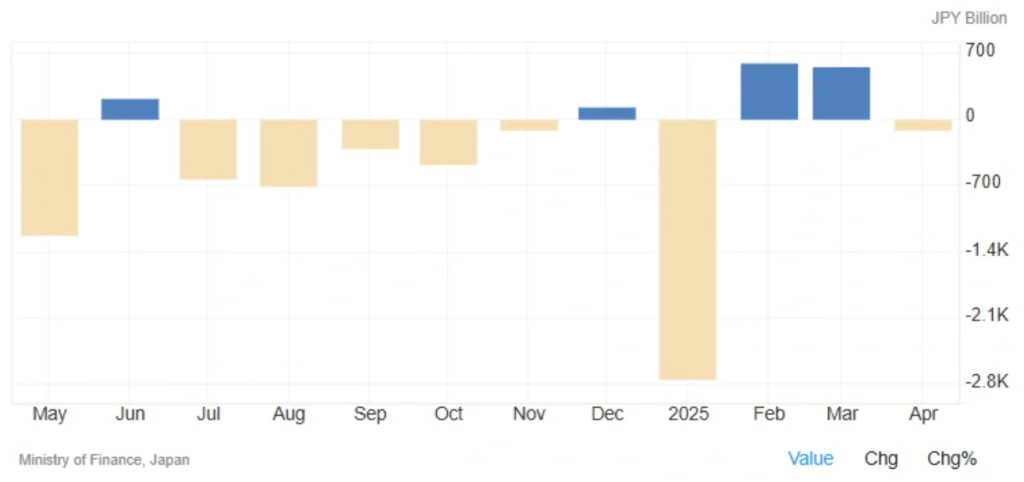
The narrowing of the trade deficit to around ¥116 billion marks a positive shift from last year. However, the failure to achieve the expected surplus raises concerns over the impact of U.S. tariffs.
Exports grew for the seventh consecutive month (2%), though at the slowest pace in this streak, mainly due to the U.S. imposing higher import tariffs on Japanese goods.
Imports declined by 2% in April (following a 1.8% increase in March). This decline was less severe than the 4.5% forecast, reflecting the impact of domestic government support measures, including:
- Fuel subsidies
- Partial coverage of household electricity bills
These measures helped sustain a portion of domestic import demand.
📌 Given the weak external demand and pressure on exports, the Bank of Japan (BoJ) is likely to maintain its supportive policies in the coming months.
Read More: Japan’s Economy Contracts in Q1 2025
Final Summary: Opportunities and Risks
🔹 Opportunities:
- Year-over-year improvement in trade balance signals positive trends for the yen and current account
- Government support policies have partially cushioned import declines
- Export stability despite tough trade conditions is encouraging
🔸 Risks:
- Ongoing U.S. tariff pressure could continue to hamper export growth
- Potential drop in foreign demand from key partners (China, EU)
- Prolonged weak import figures may indicate sluggish domestic consumption
Overall, the April data show Japan’s economy is still striving to maintain trade balance amid geopolitical and tariff-related challenges, increasingly relying on domestic support to stabilize imports.
Share
Hot topics

STP, NDD, ECN and DMA: Broker Execution Models Decoded
When picking a forex broker, we don’t just look at the brokerage that has the lowest spreads, bonuses, and other kind of what is apparent for us. There is one...
Read more




Submit comment
Your email address will not be published. Required fields are marked *