Smart Money Order Blocks: A Complete Guide for Traders
Introduction
When analyzing charts, it becomes clear that price does not move randomly. It often pauses, reverses, and reacts at specific levels repeatedly. These levels are typically referred to as support and resistance zones by most traders, but there is a deeper method for understanding the mechanisms behind these moves.
That’s where smart money concepts come into play. Instead of focusing strictly on indicators or price structure, smart money concepts focus on how large institutions move the market. Banks, hedge funds, liquidity providers, and others leave footprints in the charts, and one of the clearest footprints they leave is through order blocks.
In this article, we will explain all you need to know about smart money order blocks and how to recognize and implement them into your strategy with practical examples.
What is the Smart Money concept?
Smart Money Concepts, known as “SMC” for short, examines how institutional traders operate. These traders have enough capital to significantly influence market prices.
Institutions are different from retail traders in that they can’t enter/exit their trades immediately because their orders are generally much larger than those of a retail trader.
Instead, they build their position over time, usually creating zones where the price reacts strongly. These zones are not random; they are areas where many buy or sell orders were filled.
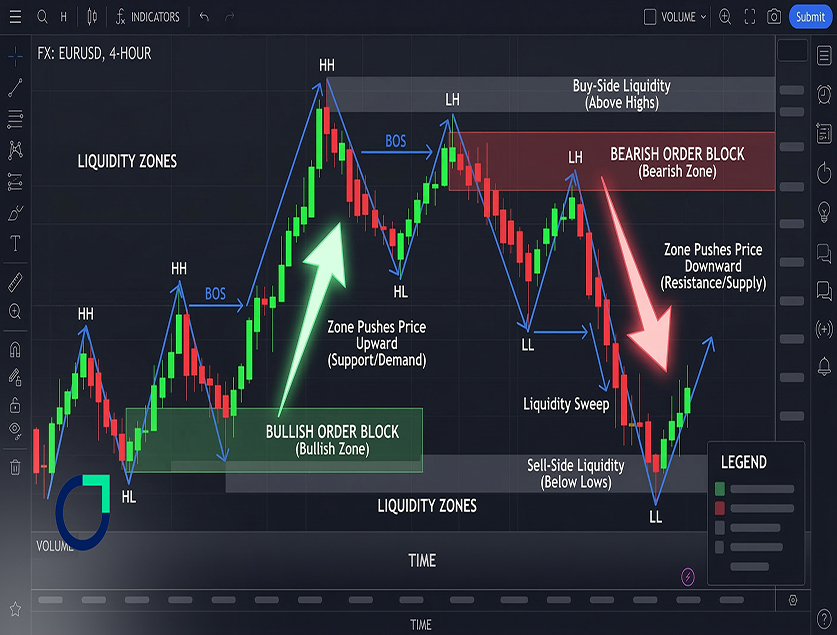
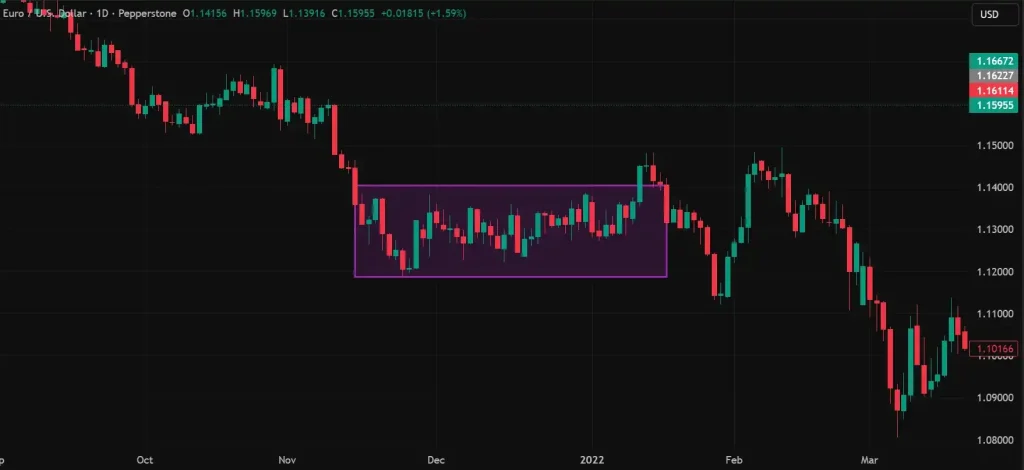
In trading, understanding an order block is key. An order block is the last area where price consolidates (moves in a tight range) or shows an opposite color candle (bearish before a sharp rise, bullish before a sharp fall) before a strong move starts. It marks the place where an institutional trader, or what is called ‘smart money,’ entered their position in the market.
Smart money traders look to enter at the order block, which means they are waiting for the price to move back to that zone so they can enter at a much better entry point and with lower risk.
Have you ever wondered why the price sometimes stops abruptly and reverses direction with no warning? It is likely because it hit an institutional level (an order block). Many traders rely on smart money order blocks to identify high-probability trading zones.
Anatomy of a Smart Money Order Block
To use order blocks correctly, you would first need to understand how they are created. It’s not just the random candlestick or the patterns; it’s also about identifying the intent and structure behind the order blocks.
A typical bullish order block is the last bearish candle preceding a significant upward move. That candle reflects selling pressure before institutions step in and pump the market higher.
Similarly, a bearish order block, on the other hand, is the final bullish candle before a significant downward move. This reflects where buying pressure was absorbed before the price drop.
The core idea is straightforward: institutions create imbalance. When they enter the market, the price quickly moves away from that zone. That rapid movement is your signal.
Here are the main features of a valid order block:
- A strong, impulsive move following the candle
- A clear break in market structure
- Minimal overlap or choppy movement
- Price returning to the same zone later.
Think of it like this. Imagine a large player placing a massive buy order. The price jumps up because of that demand. Later, when the price comes back, the remaining orders might still be there, causing another reaction.
For this reason, many traders like to combine the use of order blocks and trading platforms like a metatrader5 account because they can see the zones they draw from order blocks on the chart and use that to analyse how prices behaved within this zone over time.
Being able to identify this structure is the first step to effectively using order block smart money in your trading.
Classification of Smart Money Order Blocks
Not all order blocks are equal. Some of these zones are stronger than others. Understanding how to classify them can have a large impact on the results you achieve.
1. Bullish Order Blocks
Bullish order blocks form in an uptrend. They occur when the price makes an aggressive move upward following a bearish candle. As such, many traders will attempt to buy when the price returns to these levels.
2. Bearish Order Blocks
Bearish order blocks form in a downtrend. These setups occur when the price makes a significant move downward after the last bullish candle. Many traders will attempt to sell when the price revisits these zones.
3. Breaker Blocks
Some order blocks will fail. In those cases, the zone may flip roles. For example, a bullish order block that breaks may become a resistance point, and vice versa.
4. Mitigation Blocks
Mitigation blocks are areas where price comes back to “mitigate” previous orders. They can act as temporary zones before the price continues moving in the trend direction.
5. High-Probability vs Low-Probability Blocks
Not all of these setups are worth trading. High-quality ones often contain:
- Clear structure break
- Strong momentum
- Alignment with trend
- Confluence with other tools
Lower-quality blocks are commonly found in choppy or sideways markets.
Some traders rely on tools such as the best order block indicator, but keep in mind that no indicator can replace a solid understanding of market structure.
The more you practice identifying these patterns, the more confident you will be in recognizing high-probability opportunities.
Smart Money Order Block Trading Strategy
Now, let’s discuss how to utilize order blocks in trading. Here’s where everything comes together.
The first thing you need to do is determine the market trend. You should look for order blocks to trade in the same direction as the overall market.
Then identify an order block on your chart by locating a strong and fast market movement that breaks the market structure.
As soon as you identify a zone, wait. This is where many traders struggle. Give the market time to return to that zone. Many traders rush into the market when they find an order block.
When the price returns to the order block, see how it reacts. Look for confirmation, like this:
- Rejection wicks
- Engulfing candles
- Market structure shifts on lower timeframes.
After the price moves sharply away from this zone, it confirms the validity of the order block.
Let’s have a simple example:
Assume the price is moving upward. You see a bullish order block. Price moves away sharply, confirming the zone. Later, price returns to the same zone.
Instead of buying instantly, you wait for confirmation. When you notice rejection, you place an order with a stop loss below the zone. This strategy decreases risk while increasing accuracy.
Many traders who use (order block smart money) combine this with liquidity principles. They search for zones where stop losses are likely to be triggered before placing an order.
For example, the price may drop just below the order block, take out stops, and then reverse quickly. This is commonly referred to as a liquidity sweep.
If you’re trading with brokers like Otet Markets, understanding these concepts will help you enhance your trade execution and general decision-making.
Another useful technique is refining entries using lower timeframes. Instead of entering directly at a higher timeframe zone, traders often drop down to smaller timeframes to look for confirmation signals such as a break in structure or a clear rejection. This helps improve entry precision and allows for tighter stop losses, which can significantly improve the overall risk-to-reward ratio.
An additional tip would be to utilize multiple timeframes. Finding order blocks on higher timeframes and refining your entries on lower timeframes will provide you with a clearer view of how the market behaves, as well as help you to avoid being misled by false signals.
Common Mistakes and Risk Management in SMC
Although smart money concepts are very effective in trading, they are not always guaranteed to be risk-free. Many traders who are new to the smart money concept tend to make errors when using it.
To fully understand what is order block, traders need to study how price behaves around institutional zones.
1. Overtrading Every Order Block
Although there are many of these setups within smart money concepts, not all of them are worth trading. Some will be weak; others will have been invalidated. Your focus should be on using the setups that will produce the best quality trades rather than focusing on the number of trades.
2. Ignoring Market Structure
Always use order blocks in conjunction with market structure. If the market is trending down and you trade all the bullish blocks, you could lose money.
3. Entering Without Confirmation
Jumping into trades too quickly can create a potential loss. Give yourself time to confirm that the market is ready for you to enter before doing so.
4. Poor Risk Management
No matter how well your trade setup is, there is a risk of losing money. The best way to limit your losses is to employ proper risk management methods.
A good rule of thumb is to risk a small percentage of your account’s value for each trade. By doing so, you will not lose more than you can afford while trading during a losing streak.
5. Relying Only on Indicators
Tools like the best order block indicator can be helpful, but they should not replace your understanding of price action.
Ultimately, trading is about “reading” the market and not just following the signals generated by your indicators.
6. Emotional Trading
Both fear and greed will lead you to make poor trade decisions. Following your established trading plan is more important than chasing profits.
Discipline and patience are key attributes of a successful trader and play a crucial role in applying smart money concepts effectively.
onclusion
Smart money order blocks offer a more advanced way of understanding the market. Instead of responding to price, you start anticipating where it is going.
Understanding how institutions work provides insight into why the market performs as it does. This does not guarantee that every trade will be profitable. However, it means you are making more competent decisions based on structure, logic, and probability.
Begin with something small. Focus on recognizing clear order blocks, waiting for the price to return, and managing your risk appropriately. Over time, you’ll notice patterns more clearly. What previously seemed random will begin to make sense.
Trading is a skill that grows with practice, just like any other skill.
FAQs
What are Smart Money Order Blocks?
Smart Money Order Blocks are price zones where large institutional traders have placed significant buy or sell orders. These areas often cause strong reactions when prices return to them.
How do Smart Money Order Blocks differ from regular order blocks?
Smart Money Order Blocks focus specifically on institutional activity and market structure. Regular order blocks may not always consider the intent behind price movement or the role of liquidity.
Can Smart Money Order Blocks be used on all timeframes and markets?
Yes, they can be applied to all timeframes and markets, including forex, stocks, and crypto. However, higher timeframes tend to produce more reliable signals.
Should I trade every Smart Money Order Block I find?
No. It’s important to be selective. Focus on high-quality setups that align with market structure, trend, and confirmation signals.
Share
Hot topics

What is a Doji Candlestick? Complete Guide to Trading Indecision Patterns
Introduction If you’ve looked closely at a price chart, you might have spotted candles that stand out from the others. Some have long bodies that indicate powerful buying or selling...
Read more



Submit comment
Your email address will not be published. Required fields are marked *