
What is an Order Block in Trading?
Introduction
While monitoring price charts, you’ll eventually observe that price movements are rarely random. Certain points on the chart often trigger strong reactions, showing where buyers or sellers suddenly step in with significant volume.
Traders generally call these levels support and resistance. Professional traders and institutional analysts tend to focus instead on the specific points where large institutions have entered the market with large orders.
These points are referred to as order blocks.
Understanding what is an order block will change how a trader interprets price action. Rather than following the market price as it moves, the trader will learn to identify potential turning points in advance of the price reaching those areas. Order blocks are considered areas where institutional traders, including banks, hedge funds, and large liquidity providers, have entered the market with significant positions.
Because it is challenging for institutions to execute large trades without impacting the market price, they tend to build their positions over several stages. This multi-stage building process will create distinct “footprints” in the market that the trader can see on their trading chart. When a trader can identify the order blocks on the chart, the chart will begin to make sense.
Combining the concept of an order block with a structured strategy, such as the order block strategy, provides traders with powerful tools for locating high-probability trading opportunities. Before continuing to discuss order blocks, it is essential to understand the rationale behind the creation of these areas by institutions.
The Institutional Logic: Why Order Blocks Form
Many retail traders believe that market movements are caused by news or indicators. While these factors have a role, large institutional orders are often the primary drivers of substantial price changes.
Consider how a bank may place an order worth hundreds of millions of dollars. It cannot just click “buy” or “sell” once to enter the full position immediately. If it did, the market would move sharply against them.
Instead, institutions progressively collect orders. They usually place large positions at certain price levels when liquidity is available. These collected order zones transform into places where the market previously witnessed significant buying or selling pressure.
When prices return to these levels, something intriguing usually occurs.
The market often reacts again.
Why?
Institutional traders typically defend and manage their previous positions. Additionally, other traders who understand these zones often enter trades in these areas. This is why order blocks often act as price magnets. They are simply the traces of institutional activity left on the chart.
Understanding this institutional perspective is crucial to the order block strategy. However, before we explore how to trade them, we need to understand the basic principles that help us identify them.
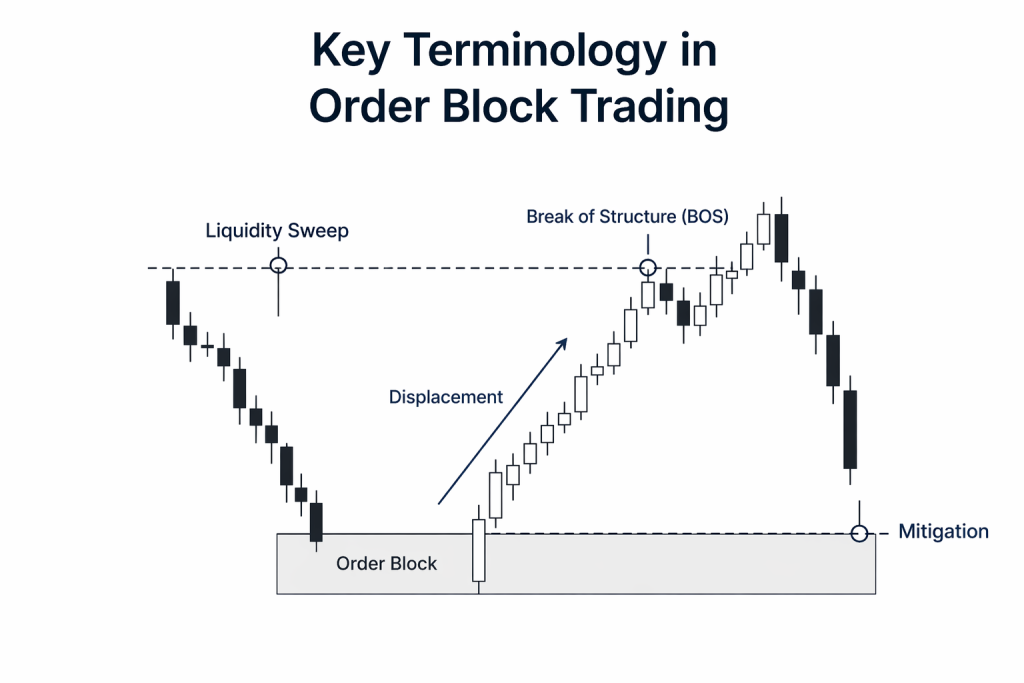
Key Terminology in Order Block Trading
Before traders can effectively identify and trade order blocks, it is important to understand several key concepts used in institutional price action analysis. These terms help explain how market structure shifts, how liquidity is taken, and why certain price zones become significant. Once you understand these concepts, spotting order blocks on a chart becomes much easier.
Break of Structure (BOS)
Break of Structure, often known as BOS, occurs when the market clearly breaks a previous high or low. This event indicates that market control may be changing from buyers to sellers, or vice versa.
For instance, if the price continues to make higher highs and higher lows, the market is in an uptrend. If the price unexpectedly breaks a previous higher low, it may indicate a potential trend shift.
It is also common to see order blocks validated after a break of structure, as the institutional orders placed earlier caused that structural change to occur.
Displacement
The term “displacement” refers to a sharp price movement.
Instead of gradually drifting upward or downward, the market moves sharply in one direction with large candles. Such a type of movement generally suggests a high level of institutional engagement.
Displacement is essential because reliable order blocks frequently precede significant price movements. If a pricing zone causes a sharp move, it indicates that large orders were placed there.
Liquidity Sweep
Financial markets are continuously searching for liquidity.
Many traders set stop losses at obvious levels like previous highs or lows. These places have a high concentration of stop orders. Sometimes the market temporarily exceeds these levels, activating the stops before reverting direction.
This is known as a liquidity sweep. Institutional traders frequently execute liquidity sweeps to obtain the funds required to enter large positions. Order blocks often form immediately following these sweeps.
Mitigation
Mitigation refers to the market’s return to an order block zone. Institutions may revisit these levels to handle leftover orders or fill new positions.
For traders, this recovery opens up new trading opportunities. Rather than joining at random, traders wait for the price to return to the mitigation zone where institutions have already acted.
Anatomy of a Valid Order Block
Not every candle or price zone counts as an order block. A proper order block usually has numerous structural components.
Understanding these components allows traders to avoid misleading signals.
The Origin Candle (Institutional Candle)
Each order block begins with a distinct candle representing institutional participation. This candle often happens just before a significant price movement.
For example, in a bullish scenario, the last bearish candle before a major upward advance is frequently converted into a bullish order block.
This candle illustrates the point at which institutions most likely built positions before forcing prices higher.
isplacement (Price Imbalance)
After the original candle forms, the price often moves sharply in one direction. This displacement suggests a substantial buying or selling pressure.
Without displacement, the candle may not indicate any significant institutional action. A substantial move indicates that the market responded considerably to that price level.
Break of Structure (BOS)
The final confirmation of an order block marks the break of the market structure.
When the price breaks a prior high or low after exiting the order block zone, it demonstrates that the move was most likely started by institutional investors. This structural shift is what provides the order block with its significance.
Types of Order Blocks
Order blocks generally appear in different forms depending on whether institutions are accumulating buy or sell positions. Understanding the different types of order blocks helps traders recognize potential buying and selling zones more clearly on a chart.
- Bullish Order Block
A bullish order block is formed when institutions place buy orders before forcing the market upward. It usually emerges as the last bearish candle before a significant upward trend.
When the price returns to this zone, traders frequently start looking for buying opportunities.
- Bearish Order Block
A bearish order block emerges ahead of a strong downward move. It is often the final bullish candle before substantial selling pressure hits the market.
When the price returns to this zone, traders may consider taking short positions.
- reaker Block
A previous order block may collapse, allowing the market to break through. When the price returns to that area, the level’s role may reverse.
This sort of structure is commonly known as a breaker block. It operates similarly when support turns into resistance and vice versa.
Order Block Invalidation: When Does It Fail?
Not every order block lasts continuously. Markets are dynamic and continually shifting.
An order block becomes invalid when the price breaks through the zone without reacting. This often indicates that institutional orders in that zone have already been filled or absorbed.
Strong momentum shifts can invalidate order blocks rapidly. Traders should always confirm price response before entering an order. Blindly placing orders in every order block might result in unnecessary losses.
How to Identify Order Blocks on a Chart
Identifying order blocks gets simpler with practice. A disciplined method can help traders identify them more regularly.
Step 1: Identify Market Structure
First, start by looking at the overall trend.
Is the market experiencing higher highs and higher lows, or lower highs and lower lows?
Understanding structure helps you identify whether you look at bullish or bearish signs.
Step 2: Look for Strong Price Moves
Next, look for areas where prices fluctuate aggressively.
Large candles or quick movements frequently reflect institutional participation. These points might be suitable starting points for identifying order blocks.
Step 3: Locate the Origin Candle
Locate the last opposing candle before the sharp move.
This candle commonly illustrates the order block. For example, consider the final bearish candle previous to a rapid rise.
Step 4: Confirm Break of Structure
Check to see if the price broke a prior high or low after closing the candle.
If the structure changes, the zone gains significance.
Step 5: Mark the Zone
Draw a zone from the open to the high or low point of the origin candle.
This region becomes the order block.
How to Trade Order Blocks
Once you understand what is an order block, the next step is learning how to trade them properly.
Here is a basic step-by-step process that many traders use.
Step 1: Identify the Higher Timeframe Trend
Begin by looking at wider timeframes, such as the daily or 4-hour charts. This helps to assess the overall market’s direction. Trading with the trend typically enhances the probabilities.
Step 2: Mark Key Order Blocks
Discover potential order blocks in the direction of the trend. Concentrate on zones that experienced significant displacement and structural breakdowns.
Step 3: Wait for Price to Return
Patience is required. Instead of pursuing price, wait for the market to return to the order block zone.
Step 4: Look for Confirmation
Smaller timeframes may generate confirmation signals. These might involve minor structural alterations or momentum shifts.
Step 5: Manage Risk
Always set stop loss and take profit levels. An organized strategy promotes consistency.
Understanding what is a trading setup? is also relevant here. A trading setup is a series of technical circumstances that occur before entering a trade. Order blocks can form a part of a well-organized strategy.
Best Timeframes for Trading Order Blocks
Order blocks might occur at any timeframe. However, bigger timeframes tend to provide more consistent zones. Daily and 4-hour charts frequently show institutional activity more clearly.
Lower timeframes, such as the 5-minute or 15-minute chart, might still be vital for providing accurate entries. Many traders use different timeframes to enhance their analysis.
Platforms like the MetaTrader platform make it simple to switch between chart intervals and highlight significant zones.
Real-World Examples (Forex, Gold, and Indices)
To better understand how order blocks behave in practice, let’s look at real-world examples across different financial markets.
- Order Block in Forex Markets
Forex markets are one of the most common areas in which traders use order block principles. Currency pairs like EUR/USD and GBP/USD usually display obvious institutional zones.
These markets are extremely liquid, allowing major investors to enter and exit positions quickly. The forex market is often considered the Best market to trade for beginners because of its liquidity and accessibility.
Traders who focus on price action often analyze markets through brokers such as otetmarkets, using real charts to better understand how institutional levels like order blocks influence price movement.
- Order Block in Gold (XAUUSD)
Gold is known for its strong reactions throughout important institutional levels. Because gold draws institutional and macroeconomic traders, price adjustments can be volatile. Order blocks in gold frequently cause big reversals or continuation patterns.
However, volatility is higher, thus risk management is even more crucial.
- Order Block in Indices (NASDAQ, S&P 500)
Stock indices such as NASDAQ and the S&P 500 also adhere to institutional zones. These markets capture the movements of whole industries and enormous institutional holdings.
Order blocks on indices tend to occur during important economic events or following significant institutional positioning. Because these markets are extensively traded by institutions, order block responses can be quite precise.
Common Mistakes to Avoid in Order Block Trading
One of the most common mistakes traders make is marking too many order blocks. Not every candle is an institutional activity. “Less is more.” Quality over quantity.
Another mistake is ignoring market structure. Order blocks must be analyzed with trend and structure. Without it, your signals are unreliable.
Overtrading, just because an order block is there, that doesn’t mean it must be traded. Waiting for confirmation often leads to better outcomes.
Weak risk management can ruin a perfect strategy. No strategy ever works 100 percent of the time.
Risk Management When Trading Order Blocks
The difference between a new trader and a professional trader is risk management. While an order block may provide high-probability setups, losses can still happen. A trader should set their stop loss every time they enter a trade.
Position sizing is equally as important; many experienced traders will typically only risk a small percentage of their account in any single trade, helping ensure that their capital will not be eliminated by multiple consecutive losses.
Consistency rather than winning one trade is what matters most.
Conclusion
Order blocks are an interesting tool to explore how institutional traders engage with the market. Rather than relying simply on indications, traders learn to analyze price movement and liquidity.
Order blocks alone won’t determine trade success. Traders should use order blocks with proper analysis of market structure, risk management, and patience.
By learning what is an order block, traders will be able to identify the footprints of large market participants in the market.
Order block zones are areas where the price may react again in the future. Like any other trading concept, order blocks should be used with other trading tools such as strong market structure analysis, risk management techniques, and patience.
Solely using order blocks will not create a successful trading strategy. Success in trading comes from understanding how the pieces of the market relate to one another.
Order blocks can become a valuable trading tool for traders who continue their education and improve their skills through practice.
FAQ
Which timeframe is most reliable for order blocks?
Higher timeframes, such as the daily and 4-hour charts, are generally more reliable because they reflect broader institutional activity.
However, lower timeframes can still be useful for precise trade entries.
Should I trade every order block I see?
No.
Quality matters more than quantity. Traders should focus only on order blocks that align with market structure, strong displacement, and clear confirmation signals.
Do order blocks work in Forex, Crypto, and Stocks?
Yes.
Order blocks are based on market structure and institutional behavior, which exist in all financial markets.
However, liquidity and volatility can affect how clearly these zones appear.
Share
Hot topics

STP, NDD, ECN and DMA: Broker Execution Models Decoded
When picking a forex broker, we don’t just look at the brokerage that has the lowest spreads, bonuses, and other kind of what is apparent for us. There is one...
Read more




Submit comment
Your email address will not be published. Required fields are marked *