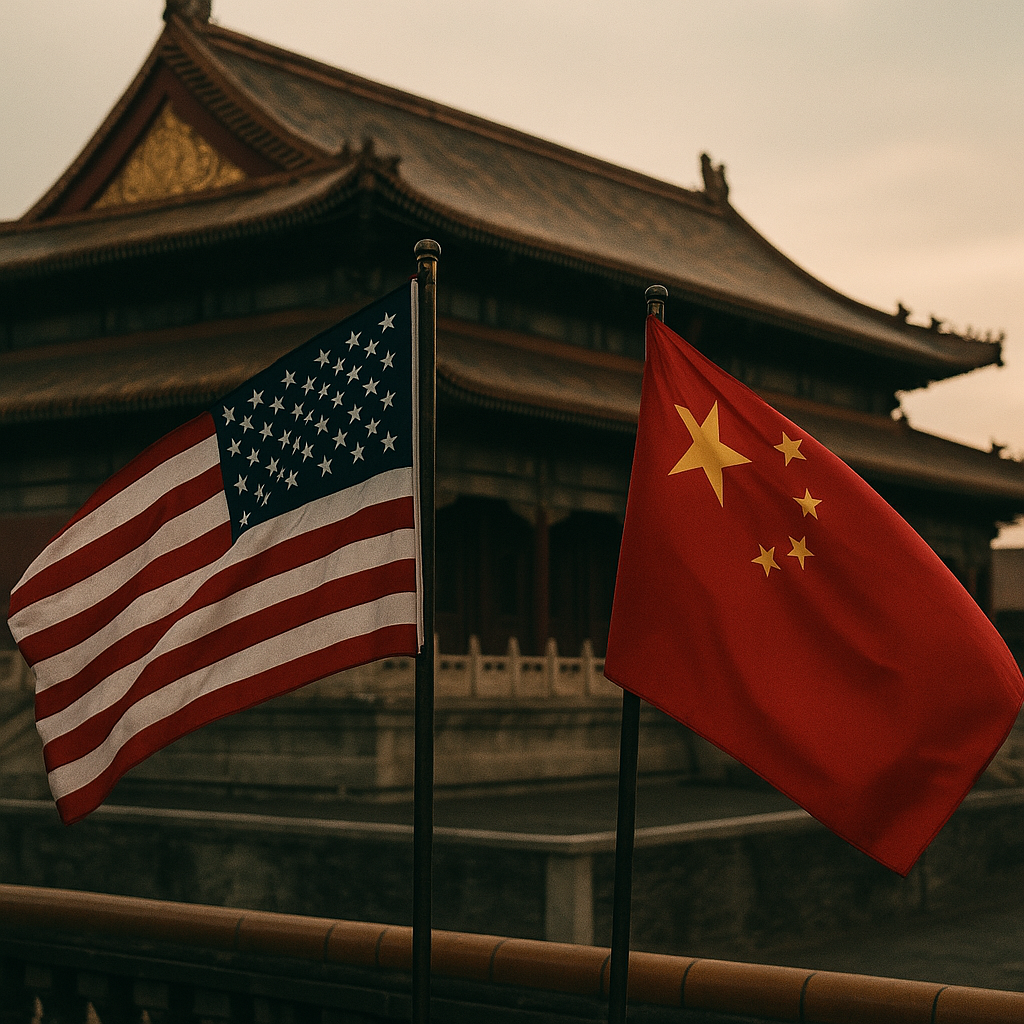
Trump and Xi Open High-Stakes Beijing Summit Focused on Trade, Taiwan, Security
Summit Opens With Focus on Strategic Rivalry and Cooperation
Trump and Xi met Thursday morning at the Great Hall of the People, marking the first visit to China by a sitting U.S. president in nearly a decade. According to official broadcast footage, Trump said the U.S.-China relationship was going to be “better than ever before” and noted that the two leaders have known each other personally for longer than any other U.S. or Chinese president.
Xi highlighted the global attention on the summit and framed a key question as whether the two countries could avoid the so-called “Thucydides Trap,” a reference to historical tensions between a rising power and an established one that have often ended in war. In remarks carried by CCTV’s official English translation, Xi also asked whether the U.S. and China could meet major challenges together for global stability and work toward “a brighter future” for humanity.
The summit agenda is expected to include trade, tariffs, Taiwan and Iran, with multiple discussions scheduled through midday Friday. Trump’s program also includes a visit to Beijing’s Temple of Heaven and a state banquet.
Trade Tensions, Taiwan and Global Implications
Harvard professor Graham Allison, who popularized the Thucydides Trap concept, told CNBC’s “Squawk Box Asia” he expects the trade truce reached by Trump and Xi at their meeting in South Korea last fall to become a formal agreement. The current talks take place after an escalation in trade tensions and U.S. restrictions on Chinese technology.
Scott Kennedy, senior adviser and trustee chair in Chinese Business and Economics at the Center for Strategic and International Studies, said China enters this meeting “far more confident than in 2017,” noting that Xi has “pushed back and neutralized much of Trump’s actions” over the last year. China was the first major economy to retaliate against Trump’s “Liberation Day” tariffs in April 2025. Kennedy added that, although expectations for a “grand bargain” are low, the opening ceremony and remarks underscore how consequential the relationship is for global commerce and security.
Xi described Taiwan as the most important issue for U.S.-China relations, warning that mishandling it could push ties to a “dangerous” place, according to state media. Beijing considers Taiwan part of its territory, while the island’s ruling party rejects that claim.
Xi is expected to reciprocate with a visit to the U.S., and the leaders could also meet on the sidelines of APEC and G20 events later in the year. The U.S. delegation in Beijing includes Secretary of State Marco Rubio and business leaders such as Tesla’s Elon Musk, Apple’s Tim Cook and Nvidia’s Jensen Huang.
FAQ
What are the main topics on the agenda for the Trump-Xi summit in Beijing?
The summit is expected to focus on trade, tariffs, Taiwan, Iran and broader issues of commerce and security between the U.S. and China.
Why is the concept of the Thucydides Trap relevant to this meeting?
Xi referenced the Thucydides Trap to frame the challenge of managing tensions between a rising and an established power, and whether the U.S. and China can avoid conflict while addressing global stability.
How has China responded to recent U.S. trade actions?
China was the first major economy to retaliate against Trump’s “Liberation Day” tariffs in April 2025, and analysts say Beijing now approaches the relationship with more confidence than in 2017.
Who is part of the U.S. delegation accompanying Trump?
The U.S. contingent includes Secretary of State Marco Rubio and business executives such as Elon Musk of Tesla, Tim Cook of Apple and Jensen Huang of Nvidia.
Share
Hot topics

STP, NDD, ECN and DMA: Broker Execution Models Decoded
When picking a forex broker, we don’t just look at the brokerage that has the lowest spreads, bonuses, and other kind of what is apparent for us. There is one...
Read more
Submit comment
Your email address will not be published. Required fields are marked *