
How Market Makers Operate in Forex Trading
Forex is the name given to the world’s largest financial market. Daily transactions take place globally between banks, institutions, brokers, firms, and retailers.
Trillions of dollars are exchanged daily between banks, organizations, brokers, businesses, and retail traders. However, there is a structure behind all those transactions that maintains price movements smoothly and ensures that buyers and sellers can trade almost any time.
Market makers play a major role in that system. As a trader, when you place a trade, you may wonder who took the opposite side of your trade and continue to see prices swing despite there being a lack of sellers or buyers. The answer is the way market makers operate within the forex market.
Beginner traders may read the term “market maker” and think about manipulation, unfair trading practices, or both. The truth is that the role of market makers is much more complicated than just good or bad. They are simply one of the mechanisms that keep the forex market functioning. In this article from otet, we will discuss how market makers operate in forex trading, why they exist, how they manage risk, and how they make money.
What Is a Market Maker in Forex?
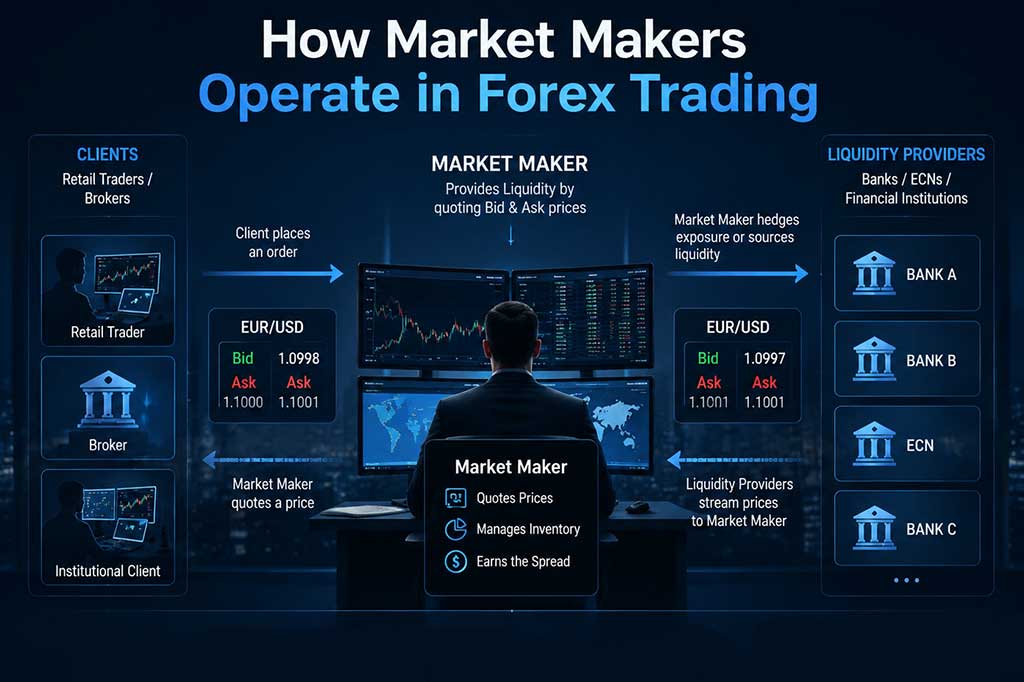
The term ‘forex market maker’ refers to a financial institution, broker, or liquidity provider that consistently both ‘buys’ and ‘sells’ quotes for currency pairs. To put it simply, they are creating a ‘marketplace’ that allows traders to buy or sell instantaneously, without having to wait for another retail trader to take the opposing side.
The best way to understand how a forex market maker operates is to think of a forex market maker as resembling a currency exchange booth at an airport. When you approach the booth, you will notice that there are two rates at which you can exchange your currency:
| Action | Price |
| Buy EUR/USD | 1.1052 |
| Sell EUR/USD | 1.1050 |
The exchange office acts like a market maker by being willing to both buy and sell at almost the same time. Forex market makers do something similar, but on a much larger and more sophisticated scale. In order to facilitate smooth trade across market sessions, they offer continuous pricing.
For this reason, traders rarely encounter periods of time when they can’t open or close a position under normal market conditions.
Most educational sources discussing the forex market makers only address brokers; however, the forex market makers model consists of various participants, such as banks, prime brokers, hedge funds, electronic liquidity providers, and dealing desks. Some brokers are also market makers, while others provide access to external liquidity.
Why Market Makers Exist in Forex Markets
Without market makers, the forex market would become slower and less efficient. The main reason that market makers exist is due to liquidity.
Liquidity refers to how easily you can trade an asset without causing a significant price shift. When there are not enough active traders at a given time, it can be very challenging to execute trades, as the spread will continue to widen.
Many traders using the MetaTrader platform never realize how much market makers influence execution and pricing behind the scenes.
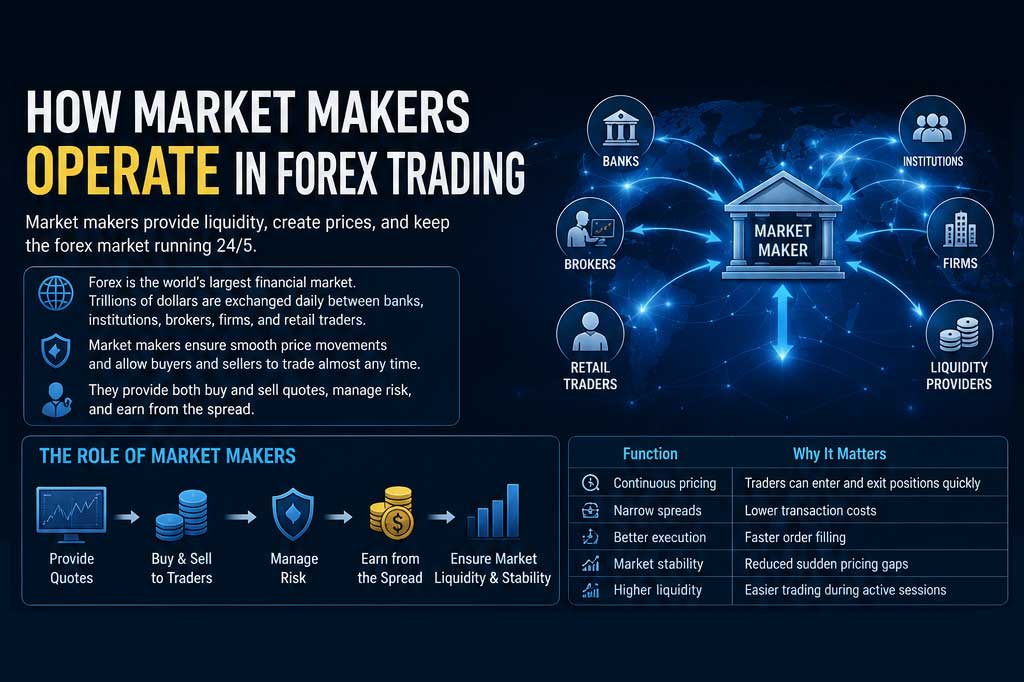
Many traders search for “What is liquidity in forex strategy” when trying to improve execution quality. Market makers help to solve the above issue by providing a continuous stream of tradable prices. Here are some of the main reasons why market makers are important:
| Function | Why It Matters |
| Continuous pricing | Traders can enter and exit positions quickly |
| Narrow spreads | Lower transaction costs |
| Better execution | Faster order filling |
| Market stability | Reduced sudden pricing gaps |
| Higher liquidity | Easier trading during active sessions |
Consider highly traded pairs like GBP/USD or EUR/USD.
Despite the millions of traders participating daily, the market still needs institutions that are prepared to consistently maintain active bid and ask prices.
During the main economic reports, market makers become even more important because volatility increases rapidly.
However, traders should be aware that liquidity conditions are vulnerable to change. During high-impact news releases, spreads may widen because market makers are protecting themselves from higher risk.
How Forex Market Makers Work
In general, market makers consistently provide two prices:
- Bid price (where they buy)
- Ask price (where they sell)
The difference between these prices is known as the spread. The spread is simply the gap between the bid (buy) price and ask (sell) price set by market makers.
This is directly related to the concept of “what is spread trading” because spreads are one of the most significant transaction fees in forex.
For example:
| Currency Pair | Bid | Ask | Spread |
| EUR/USD | 1.1050 | 1.1052 | 2 pips |
If a trader buys EUR/USD at 1.1052 and immediately sells, they would likely receive 1.1050. This small difference between buying and selling prices creates revenue for market-makers. The process works rapidly by using automated systems or pricing engines.
A simplified version of the process is outlined like this:
Liquidity Providers → Market Maker → Broker → Trader
Or sometimes:
Trader → Broker Acting as Market Maker
In the modern market, forex prices are constantly changing literally every millisecond. For example, market makers update their prices based on:
- Supply and demand
- News events
- Volatility
- Institutional order flow
- Liquidity conditions
The following diagram is a simple representation of how market makers typically operate.
MARKET MAKER FLOW
Buyers Enter Market
↓
Market Maker Quotes
Bid & Ask Prices
↓
Sellers Enter Market
↓
Spread Captured on Trades
↓
Risk Managed Internally or Through Hedging
Many traders researching how market makers work in forex are amazed to see how heavily automated the process has become. Today, algorithms and high-frequency systems manage a significant percentage of market-making operations.
The most standard source of income is the spread. Every time a trader buys or sells, the market maker captures small differences between bid and ask prices. Individually, their spreads seem small. But when millions of transactions take place daily, those small numbers become substantial. For example:
| Daily Trades | Average Spread Revenue |
| 10,000 trades | Small |
| 100,000 trades | Moderate |
| Millions of trades | Very large |
Some market makers may also profit from:
- Commissions
- Order flow arrangements
- Swap fees
- Internal risk management efficiencies
Understanding that market makers do not always trade against their clients. The common misconception is that every profitable trader will result in the broker taking a loss. The truth is that a sophisticated broker will often hedge their exposure externally. Yet, some dealing-desk brokers may internalize risk when the client position is balanced. This is why execution models vary among brokers. For example:
| Broker Type | Main Execution Style |
| ECN Broker | External liquidity routing |
| STP Broker | Straight-through processing |
| Market Maker Broker | Internal pricing/dealing desk |
Some traders choose ECN-style execution, while others prefer market makers, because spreads might be steadier during calmer sessions. When researching brokers such as Otet broker, traders often compare spreads, execution, and liquidity quality.
Role of Liquidity in Market Making
Liquidity is the foundation of market making. What Is Liquidity in Forex Strategy?
Without liquidity, prices are unstable, and the costs of trading become excessive. Market makers are continually monitoring liquidity across different currency pairs. Major pairs, such as EUR/USD, typically have high liquidity due to high institutional participation. Exotic pairs typically have lower liquidity, leading to wider spreads. Here is a simple comparison:
| Pair Type | Liquidity Level | Typical Spread |
| Major Pairs | Very High | Low |
| Minor Pairs | Medium | Moderate |
| Exotic Pairs | Lower | Higher |
Liquidity also changes depending on trading sessions. For example:
| Trading Session | Liquidity |
| London Session | High |
| New York Session | High |
| Asian Session | Moderate |
| Holiday Periods | Lower |
This is one of the reasons experienced traders pay special attention to session overlap. The London-New York overlap usually offers the most liquidity and tightest spreads. If you’ve ever traded during a major news event, you might have observed spreads widening unexpectedly. This occurs as market makers adjust to rapidly changing risk conditions.
Many beginner guides under the topic “Forex market makers explained” focus mainly on spreads and brokers rather than the full liquidity system.
How Market Makers Manage Risk
Market makers cannot just quote prices endlessly without having proper control of their exposure. If they fail to manage risk effectively, massive market moves could result in significant losses. That is why risk management is essential to any market-making operation.
Inventory Risk
Inventory risk happens the moment the market maker has accumulated too much exposure in one direction. For instance, imagine thousands of traders suddenly decide to buy EUR/USD. The market maker may temporarily take a significant short position against those trades.
If EUR/USD keeps rising aggressively, the exposure becomes threatening. To deal with this issue, market makers are constantly rebalancing positions. They may:
- Adjust spreads
- Change pricing
- Reduce exposure externally
- Offset positions with liquidity providers.
This process happens continuously throughout the trading day.
Hedging Strategies
Hedging is one of the most used tools by market makers. If exposure becomes too large, then the market maker can hedge risk with another institution or market. For example:
Retail Traders Buy EUR/USD
↓
Market Maker Accumulates Short Exposure
↓
Market Maker Buys EUR/USD from Bank
↓
Risk Reduced
This enables the market maker to continue providing liquidity while reducing directional exposure. Hedging can happen through:
- Spot forex
- Futures markets
- Options markets
- Cross-currency exposure balancing
Sophisticated institutions mostly use automated hedging systems that react in seconds.
Internal Netting
Internal netting is another commonly used risk management technique. Imagine:
- Trader A buys EUR/USD.
- Trader B sells EUR/USD.
Rather than sending both trades externally, the market maker offsets these transactions internally. This reduces costs and external exposure. Here is a simplified example:
| Trader | Position |
| Trader A | Buy 1 lot EUR/USD |
| Trader B | Sell 1 lot EUR/USD |
Net exposure:
1 Buy – 1 Sell = Neutral Exposure
This is one of the reasons why market makers can handle huge volumes so efficiently. The more balanced the client flow, the simpler risk management becomes.
Real Example of Market Maker Operation
Let’s look at the simple scenario below:
Imagine it’s the London session and EUR/USD is trading actively. A market maker quotes:
| Bid | Ask |
| 1.1050 | 1.1052 |
Suddenly:
- 300 traders buy EUR/USD
- 180 traders sell EUR/USD
The market maker now has excessive short exposure since more traders are buying than selling. To manage the imbalance, the market maker may:
- Slightly widen spreads
- Adjust quoted prices
- Hedge externally with a liquidity provider
- Offset some positions internally.
At the same time, the market maker continues to provide quotes, ensuring that trade activity remains active. This entire process can happen in seconds.
Modern forex systems are extremely quick, and most traders do not notice the underlying mechanics. That is why understanding how market makers perform in forex allows traders to better comprehend price movement, spread changes, and execution behavior.
Conclusion
Market makers play an important role in maintaining the forex market active, liquid, and accessible.
Without them, traders are likely to encounter slower execution, greater price gaps, and wider spreads.
Many traders have a negative view of market makers; the reality is more balanced. Their major responsibility is to provide liquidity and ensure continued trading conditions.
Understanding how they operate enables traders to make better decisions when it comes to:
- Broker selection
- Trading sessions
- Spread behavior
- Liquidity conditions
- Execution quality
It also helps to clear up some of the misunderstandings about forex pricing. The more you understand market structure, the easier it is to trade according to realistic expectations rather than myths or rumors.
Whether you are just a casual trader or even an expert, understanding how market makers operate will give you a much clearer view of the forex market itself.
FAQ
A market maker is a financial institution or broker that continuously provides buy and sell prices for currency pairs. Their role is to maintain liquidity and allow traders to execute trades quickly.
You can also read more about market structure and liquidity in our internal guide on What Is Liquidity in Forex?
A broker acts as an intermediary between traders and the market, while a market maker actively provides pricing and liquidity.
Some brokers operate purely as intermediaries, while others function as market makers themselves.
Yes, market makers are completely legal in forex trading and are widely used throughout the industry.
Many regulated brokers and institutions operate using market-making models. The important factor is whether the broker follows proper regulatory standards, transparent pricing practices, and fair execution policies.
Share
Hot topics

STP, NDD, ECN and DMA: Broker Execution Models Decoded
When picking a forex broker, we don’t just look at the brokerage that has the lowest spreads, bonuses, and other kind of what is apparent for us. There is one...
Read more

Submit comment
Your email address will not be published. Required fields are marked *