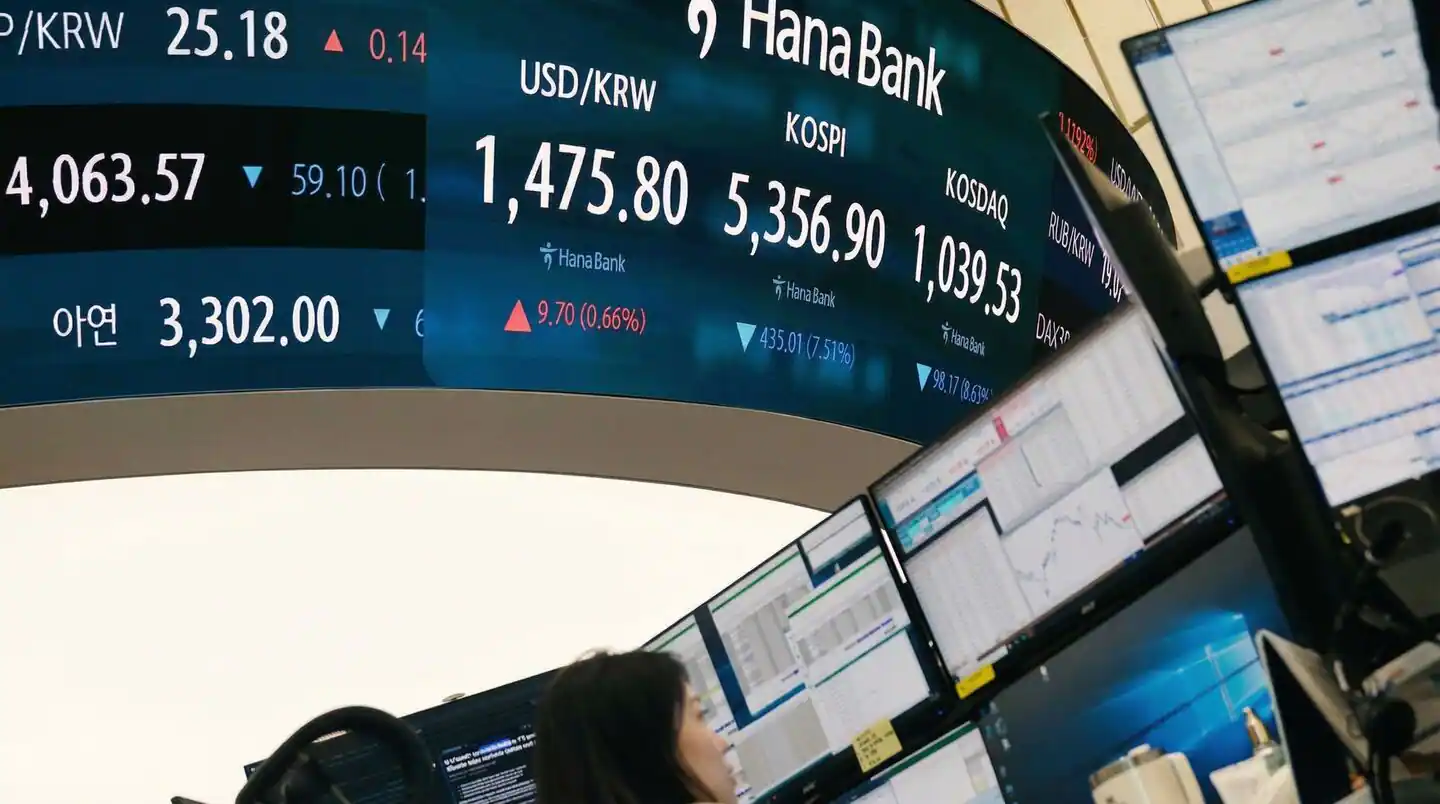
Asian Stocks Retreat as Fresh U.S. Strikes on Iran Revive Geopolitical Risks
Asian Equities Pull Back from Recent Highs
Asian markets retreated on Thursday following reports that the United States had conducted fresh military strikes on Iran on Wednesday, marking a second round of strikes this week. The renewed tensions followed U.S. President Donald Trump’s dismissal of reports that Iran and Oman would jointly oversee shipping through the Strait of Hormuz under a proposed peace arrangement.
Japan’s Nikkei 225 eased 0.1% to 64,921.1 points, after reaching a record high of 66,428.81 points in the previous session. The broader TOPIX index edged down 0.2%. South Korea’s KOSPI fell 1.1% to 8,139.21 points after hitting a new record of 8,457.09 on Wednesday, as chipmakers and AI-linked stocks paused following a strong rally and investors trimmed risk exposure.
Hong Kong’s Hang Seng index declined nearly 2%, pressured by weakness in technology shares. On the mainland, China’s Shanghai Composite slipped 0.4%, while the blue-chip Shanghai Shenzhen CSI 300 dropped 1.1%. Singapore’s Straits Times Index lost 0.7%, futures tied to India’s Nifty 50 edged down 0.3%, and Australia’s S&P/ASX 200 also fell 1.1%.
Wall Street’s major indexes had closed at all-time highs overnight on hopes of easing Middle East tensions and lower oil prices, but those expectations were challenged by the latest developments. U.S. stock futures were little changed during Asian hours on Thursday.
Oil Prices Rebound and Focus Shifts to U.S. PCE Data
Oil prices rebounded more than 2% following the U.S. strikes on Iran, reversing part of Wednesday’s steep decline. Brent crude traded near $97 a barrel, while U.S. West Texas Intermediate crude climbed above $90, as markets reassessed the risks to energy supply stemming from the conflict.
Investors are now focused on the release of U.S. PCE price index data later on Thursday, the Federal Reserve’s preferred inflation gauge. Markets are concerned that persistently high energy prices linked to the Iran conflict could complicate the Fed’s policy outlook and potentially result in an interest rate hike this year. This uncertainty contributed to profit-taking in recent outperformers, particularly in semiconductor and AI-related stocks in South Korea, where heavyweight chipmakers came under mild pressure.
FAQ
What triggered the decline in Asian stock markets on Thursday?
The decline was driven by renewed geopolitical tensions after fresh U.S. military strikes on Iran and by investor caution ahead of U.S. PCE inflation data.
How did major Asian indexes perform?
Japan’s Nikkei 225 fell 0.1% and TOPIX 0.2%, South Korea’s KOSPI dropped 1.1%, Hong Kong’s Hang Seng lost nearly 2%, China’s Shanghai Composite slipped 0.4% and CSI 300 fell 1.1%, Singapore’s Straits Times Index declined 0.7%, Nifty 50 futures edged down 0.3%, and Australia’s S&P/ASX 200 fell 1.1%.
What happened to oil prices after the U.S. strikes on Iran?
Oil prices rebounded more than 2%, with Brent crude trading near $97 a barrel and U.S. West Texas Intermediate moving above $90.
Why is the U.S. PCE price index important for markets?
The PCE price index is the Federal Reserve’s preferred measure of inflation, and its readings can influence expectations for future interest rate decisions, including the possibility of a rate hike.
Share
Hot topics

STP, NDD, ECN and DMA: Broker Execution Models Decoded
When picking a forex broker, we don’t just look at the brokerage that has the lowest spreads, bonuses, and other kind of what is apparent for us. There is one...
Read more




Submit comment
Your email address will not be published. Required fields are marked *