
What is the Risk-to-Reward Ratio? Complete Guide for Traders
If you have ever asked yourself, ‘Is this trade really worth the risk?’ then you are already starting to think like an experienced trader.
Trading is not just about finding the best entry points or trying to figure out which way the price is going to move. It’s about considering your potential gains versus your potential losses. This highlights the concept of “risk-to-reward”.
Many beginner traders are focused solely on their winning trades. However, experienced traders look beyond that to how much they are risking in relation to how much they hope to make. A simple shift in your mindset from “What will I earn?” to “How much am I risking in relation to what I hope to earn?” can drastically affect your trading results.
We will explain everything in this article in a clear, practical way. No complicated math or confusing theories. Just real knowledge you can put to use.
By the end of this guide, you will have a thorough understanding of risk reward meaning and how to apply it when making your own trading decisions.
What is the Risk-to-Reward Ratio (RR)?
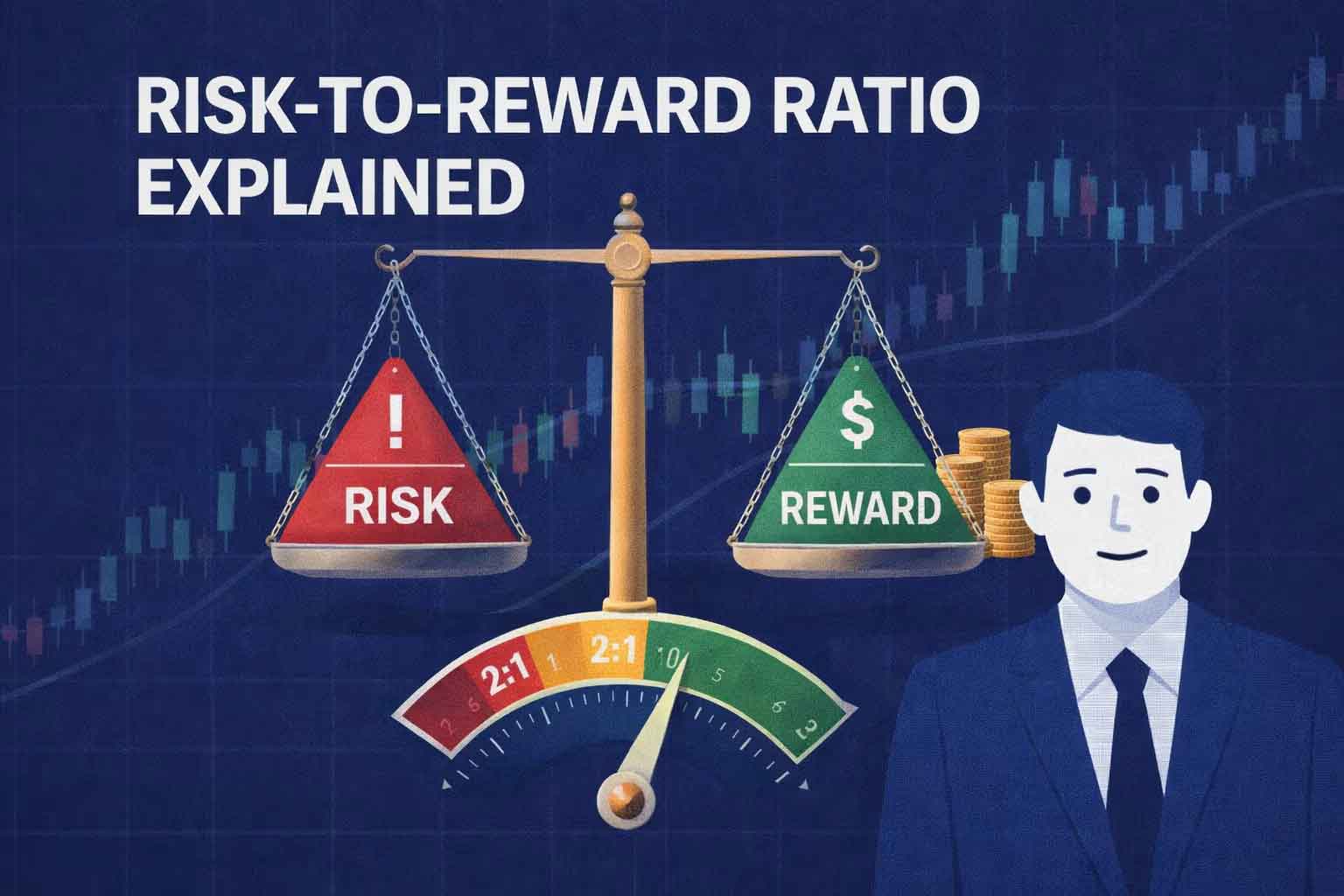
Let’s start with a basic explanation of the risk-to-reward ratio. The risk-to-reward ratio compares how much you risk on a trade to how much you expect to gain.
For example, if you put in $10 with the possibility of making $20, your risk-reward ratio is 1:2. You’re risking one to make two. This is commonly referred to as risk to reward forex, and it is one of the most significant trading concepts.
Think of it as a business opportunity. Would you accept a deal that allows you to lose $100 or gain $300? Most people would answer yes. That’s because the potential profit outweighs the potential risk.
Trading functions in the same way. Instead of just considering whether you will win this trade, you should also consider whether it is a good decision to take this trade based on the risk and reward. This can lead to a mindset change.
Another way to look at it is in terms of opportunity. Every trade represents an opportunity. However, all opportunities are not created equal. Some may have a small upside, but they carry a lot of risks. On the other hand, others may have limited risk but a strong potential.
The idea is to focus on high-quality setups where the reward outweighs the risk. This is the basis for RR ratio trading.
How to Calculate Risk Reward Ratio
Let’s make it practical now.
To calculate risk reward, you simply need three things:
- Entry price
- Stop-loss (where you exit if wrong)
- Take-profit (where you exit if right)
Here’s a simple example.
You enter a trade at 1.2000.
- Your stop-loss is at 1.1980 → that’s 20 pips risk.
- Your take-profit is at 1.2040 → that’s 40 pips reward.
Now divide reward by risk:
40 ÷ 20 = 2
So your risk-to-reward ratio is 1:2.
The approach above allows you to determine your risk reward before entering a trade rather than after you’ve entered the trade.
This step is very important because once you’ve entered a trade, your emotions usually take control of what you do. But, before opening a position, you can think clearly and logically.
Although many trading platforms automatically show this information for you, even if they didn’t, you can still do it manually.
A small tip: always determine your stop-loss before doing anything else. This protects your capital. Once you have set your stop-loss, determine realistic take-profit levels based on the market structure.
In order to minimize risk, traders implement the 1% rule in forex risk management, in which traders limit the risk percentage they are willing to take on each trade.
It is also important to remember that your stop-loss and take-profit should not be random numbers. They should be based on logical levels in the market. When your levels make sense technically, your calculated risk reward becomes more reliable and meaningful in real trading conditions.
When you combine position sizing with RR, you’re creating a system that produces stable trading performance.
Why RR Is Important in Trading
Here’s where things get interesting.
You do not have to win every trade to be profitable, but actually, it is possible to lose more trades than you win and still make money. That might seem strange at first. Yet it makes sense once you grasp the risk reward meaning.
Let’s say:
- You win 4 trades and lose 6 trades.
- Your RR is 1:3
That means:
- Losses: 6 × 1 = -6 units
- Wins: 4 × 3 = +12 units
Total: +6 units profit
Even with a lower win rate in trading, you remain profitable. This is why relying solely on accuracy is misleading.
Many beginner traders are so focused on being right all of the time that they forget there are other factors that contribute to their overall profit. However, professionals prioritize profits over excellence.
RR helps you overcome losing streaks. It also reduces mental pressure. By concentrating on taking good trades rather than on winning trades, you will build a much stronger sense of discipline.
When you establish your risk and reward in advance, you will be less likely to:
- Move your stop-loss emotionally.
- Close trades too early
- Overtrade
The above factors are what we call trading risk management, which is the key to achieving long-term success in trading.
Best Risk-to-Reward Ratios Used by Traders
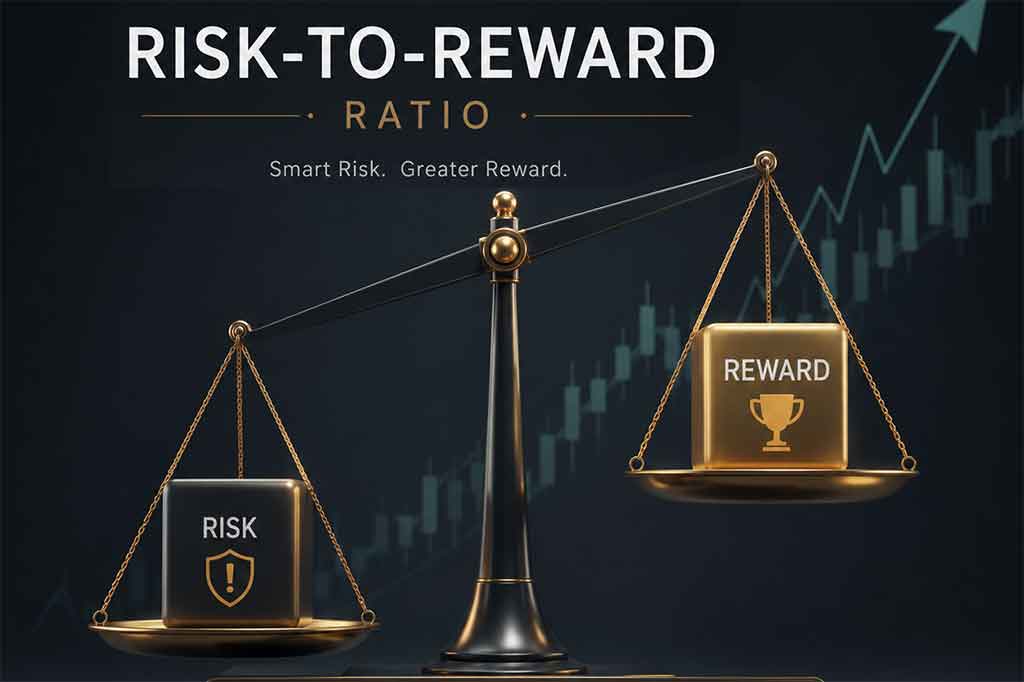
There’s no single perfect ratio. But there are common ranges that traders use. Some traders like to use ratios of:
- 1:1 (risk equals reward)
- 1:2 (risk 1, gain 2)
- 1:3 (risk 1, gain 3)
The majority of traders believe that a 1:2 or higher ratio provides the best risk/reward ratio for consistent trades. The reason is simple: it gives you room for mistakes.
Let’s consider a simple scenario:
To gain a profit using a 1:1 ratio, you need to win more than half of your trades. But if you’re using a 1:2 ratio, then you’ll only need to win around one-third of your trades to break even, which is a big difference. Some traders aim for 1:3 or higher.
But here’s the catch. It’s much more difficult to find high RR setups because the market doesn’t always provide perfect market conditions.
If you’re forcing yourself to take very high-risk-to-reward trades, you may end up making low-quality trades. So it’s all about finding the balance between the two.
One more practical tip is to regularly review your trades and evaluate them through the lens of RR. Rather than simply focusing on whether a trade was a win or a loss, ask yourself whether the decision-making process throughout the trade followed your predetermined risk/reward ratio, and if so, what that ratio was.
Did you have a clearly defined entry point? Did you stick to both your stop-loss and take-profit points? This form of review can enhance your skill development as opposed to relying solely on the tracking of your trading results.
A better way to approach RR is to establish a target based on market structure. Look for support, resistance, and liquidity zones that provide good reference points for taking profits.
For example, the Otet Market shows clear levels where price reacts, which helps traders identify support and resistance levels and act logically.
The key takeaway? Avoid chasing the highest RR. Concentrate on consistent, repeatable conditions.
How RR Works with Win Rate
In this section, we are going to consider the following two concepts:
- Risk-to-Reward (R/R)
- Win Rate (W/R)
Both of these concepts work together as a system. Looking at them together can give you a clearer understanding of how they perform.
Think of it like this: High win rate + low RR or low win rate + high RR
Both can be profitable.
For example:
- Trader A: 70% win rate, 1:1 RR
- Trader B: 40% win rate, 1:3 RR
Both can make money.
Trader A had a higher volume of winning trades but smaller profit amounts. On the other hand, trader B, had a lower volume of winning trades but bigger ones.
There is no right or wrong here; only what resonates with your personality. Some traders prefer to take quick and consistent small profits, whereas others may prefer to wait for bigger moves before taking a trade.
But here’s something important to remember. If you do not understand this relationship, you might think your strategy is failing when it is actually performing well.
For example, if you are using a high RR system, losing streaks is normal. That’s part of the game. Understanding this helps you remain calm and consistent. This is also where people start looking for a so-called risk free strategy.
The truth is that there is no risk free strategy in trading. Risk is always a part of trading. Hence, here the goal is to intelligently manage risk, not to remove it.
Risk Management Using RR
Let’s put everything back together.
Risk-to-reward is more than simply a number; it’s a tool. When used appropriately, it becomes part of a bigger system. That system is designed to manage trading risks.
Let’s break it down into simple steps.
- First, determine your risk per trade.
This is when guidelines like the 1% rule in forex risk management come into play. If you have $1,000 on your account, you risk $10 per trade. With this strategy, you keep your losses to a minimum, a specific percentage, and manageable.
- Second, choose trades with a favorable RR.
Do not enter at random. Look for scenarios in which the profit justifies the risk.
- Third, stick with your plan.
This is where most traders fail; they either move their stops, close their trades early, or hold onto losing positions for too long. RR is only effective if you follow it continuously.
- Fourth, think long-term.
One trade doesn’t matter. However, when you look at 50 or 100 trades, this is where the risk-to-reward ratio shows its true power.
Here is a simple example:
Imagine you take 100 trades:
Risk per trade: 1%
RR: 1:2
Win rate: 40%
You would continue to make a profit. That’s the beauty of it. It turns trading into a numbers game—controlled, structured, and logical.
Tracking your performance through risk-to-reward allows you to clearly see what is profit in forex; it also allows you to think of it in terms of “R” (risk units), instead of in dollars, which eliminates the emotional component.
Many traders never think about how risk-to-reward fits in with actual market conditions when they learn about it. Although you may plan to always take trades with a 1:2 or 1:3 ratio, the reality is different.
The market does not always provide clean setups. Sometimes price is choppy, levels are unclear, or your ideal take-profit target is simply too far to be realistic. Because of this, it is important for you to have flexibility with your trading.
Traders who understand RR do not force trades just to meet a specific ratio. Instead, they look at the market first, analyze what they see, and then decide if the current market opportunity meets their criteria before taking a trade.
One of the main ways that RR affects you emotionally is that you become more patient with your trades because you have created a positive risk/reward structure for yourself. Therefore, you will not feel the need to constantly interfere with your trades by closing your trade before it hits your target or moving your stops.
As time passes and you grow accustomed to using a RR structure, this creates a much calmer mindset for trading, as you will learn to rely on your system rather than acting out of instinct every time there is a small price change.
Tracking trade activity based on the R value rather than monetary value is another method of improving consistency. For example, saying you made 2R is often more meaningful than saying you made $200.
This small shift helps you stay consistent regardless of account size. Whether you trade a $1,000 or $10,000 account, the same logic applies.
This is also why many professional traders use R multiples, rather than the dollar amount, to keep their trading decisions as neutral and objective as possible.
Finally, remember that the RR ratio is not just a formula for coming up with a plan to succeed; it is just one part of the puzzle. You cannot expect to become a profitable trader if all that you focus on is the risk-to-reward ratio without having a well-thought-out strategy and maintaining good discipline and consistency.
However, once you have a deep understanding of how to apply this tool, it will become one of your strongest assets in trading.
Conclusion
The RR concept may appear straightforward; however, it has significant implications for your approach to trading. With RR, you shift from chasing wins to focusing on high-quality trades.
Rather than letting emotion dictate your trading decisions, you follow a logical approach based on planning rather than emotion. Finally, rather than relying on luck, you develop a sound trading system.
Many traders fail because they cannot effectively manage risk, not because they do not understand the markets. RR can be a tool that offers structure and consistency to your trading, while also protecting your capital.
If you take away one thing from this guide, let it be that you do not have to be right every time. The key is managing the potential risk versus the potential reward of each trade. Managing risk versus reward is what differentiates beginner traders from professionals.
FAQ
A good ratio depends on your strategy, but many traders aim for at least 1:2. This means you risk 1 unit to make 2. It allows profitability even with a lower win rate.
Yes, 1:2 is widely considered a strong and balanced ratio. It provides enough reward compared to risk while still being realistic to achieve in most market conditions.
Professional traders define their risk and reward before entering a trade. They only take setups that meet their criteria and follow their plan consistently. RR becomes part of their overall trading risk management system.
Yes, absolutely. If your RR is high enough (like 1:3), you can lose more trades than you win and still be profitable. This is why understanding both RR and win rate in trading is essential.
Share
Hot topics

STP, NDD, ECN and DMA: Broker Execution Models Decoded
When picking a forex broker, we don’t just look at the brokerage that has the lowest spreads, bonuses, and other kind of what is apparent for us. There is one...
Read more


Submit comment
Your email address will not be published. Required fields are marked *