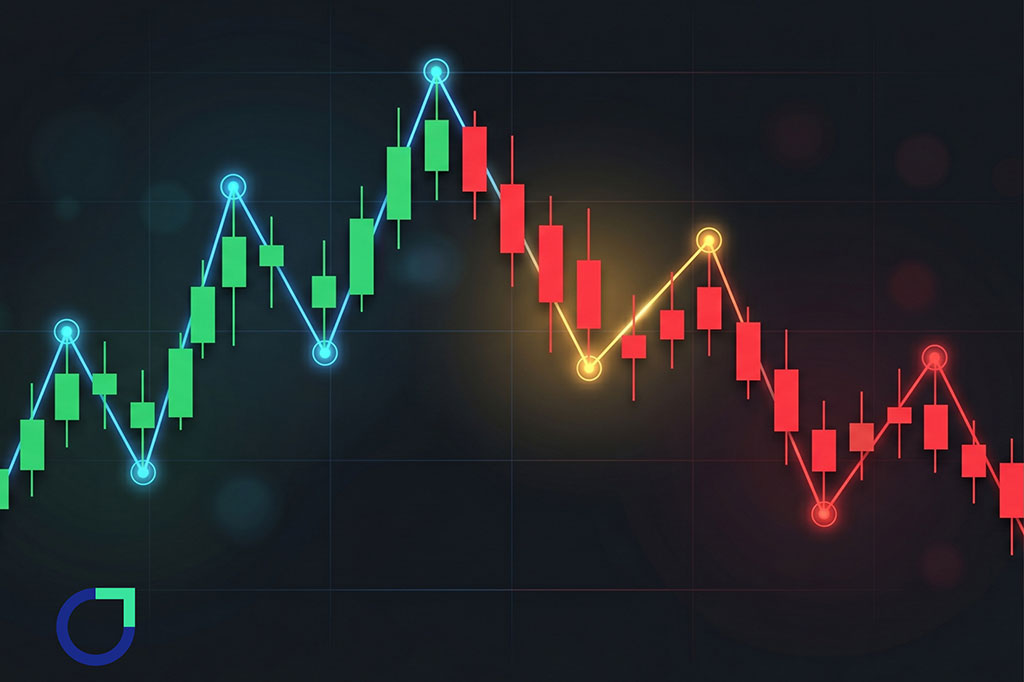
How to Identify Market Structure in Forex Trading
If you’ve ever looked at a chart and felt like price was moving randomly, you’re not alone. Many beginners start trading without truly understanding what they’re seeing. The truth is, the market is not random it follows patterns. And one of the most important patterns you can learn is forex market structure.
Market structure is like the language of the market. Once you understand it, charts start to make sense. Instead of guessing where price might go, you begin to see the logic behind every move. It’s not about predicting perfectly it’s about reading what’s already happening.
Think of it this way: imagine walking into a city without knowing the roads. You might get somewhere, but it will be slow and confusing. Market structure is like having a map. It shows you where price has been and gives you clues about where it might go next.
This concept is especially important if you want to move beyond basic trading. Many traders rely on indicators, but indicators are just reflections of price. Market structure, on the other hand, comes directly from price itself. That’s why it’s a core part of trading with price action.
Before going deeper, it’s helpful to understand the bigger picture. If you’re new, learning what is forex gives you a strong foundation. Once you understand how the market works, structure becomes much easier to read.
You’ll also notice that structure connects closely with trend trading strategies in forex. Trends don’t just appear randomly they are built through structure. Understanding this helps you trade with the market instead of against it.
Another important point is that structure helps define what is a trading setup. Without structure, a setup is just a guess. With structure, it becomes a logical decision based on clear behavior. Even your trading platform or broker, like Otet, can influence how clearly you see structure through chart quality and execution speed.Your skill at reading the same structure will improve with good resources even though the structure doesn’t change on its own.
In this manual, we will provide detailed, practical steps for you to follow as you hone your skill; no prior experience is necessary, just the time and desire to acquire them. At the completion of this manual, you will be able to interpret the price movements in the charts and determine the reason behind them, as well as use this information in your trading activity.
What Is Market Structure in Forex?
The way prices change over time is known as market structure. Market structure displays the highs and lows formed on a chart as well as what type of trend the market has. Examples of trends include sideways, reversing and trending in one direction.
Forex market structure is the most foundational component of price movement; every candle is part of this structure. When you zoom out to look at the candles as a whole, they create patterns, or stories, over time.
Market structure helps bring order to what appears to be chaos because there are repeated patterns within price movement. When you are able to recognize these repeating patterns, it becomes much easier to trade successfully.
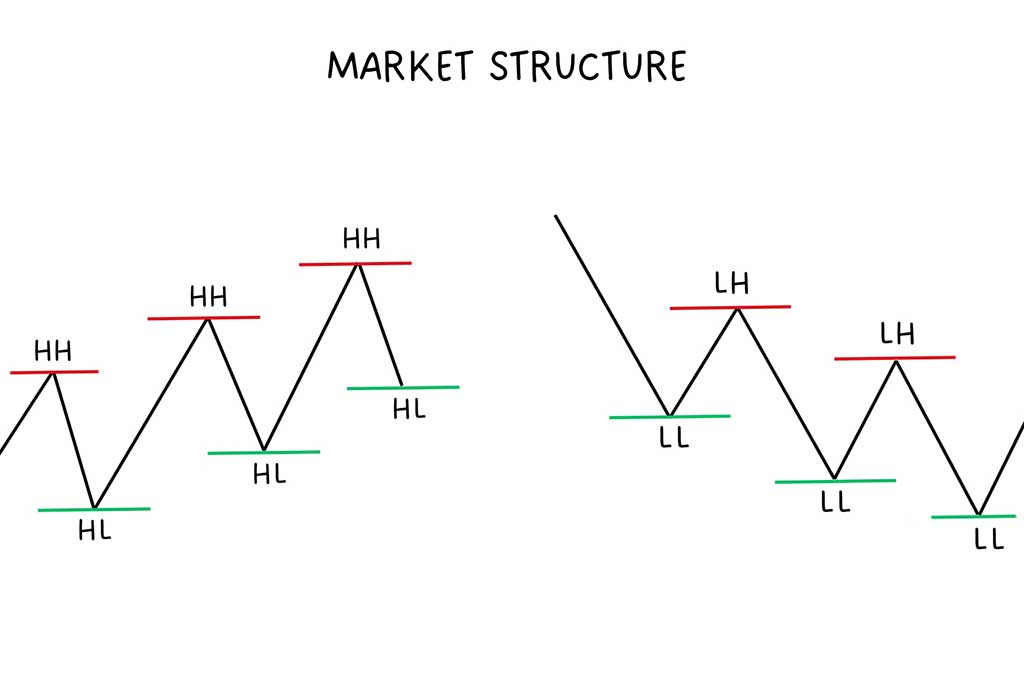
In an uptrend, prices create higher highs and higher lows with each successive move. Conversely, in a downtrend lower highs and lower lows are being created with each subsequent move. This demonstrates who has control of the market; buyers or sellers.
This is the power of using market structure when trading. Rather than reacting to every price change within a single bar (candle), you would wait for price to confirm previous trend direction through other bar formations within market structure before placing any trades.
Without understanding the greater context of market structure, most of the time, a single price movement does not provide much meaning on its own but can carry much meaning in relation to other past or future price movements.
Market structure also helps reduce emotional decisions. Instead of chasing price, you wait for the market to confirm its direction. It exists across all timeframes. A market can be bullish on a higher timeframe but bearish on a lower one. Understanding both gives you a better perspective. For beginners, the best approach is to start simple. Focus on identifying trends first, then build your knowledge step by step.
Understanding Higher Highs and Lower Lows
If market structure is the language of the market, then higher highs and lower lows are its basic words. Once you understand this, everything becomes easier. In an uptrend, the market forms a higher high higher lows pattern, meaning price continues to push upward while maintaining strong structure.. This means each move upward is stronger than the previous one, and pullbacks don’t go too far.
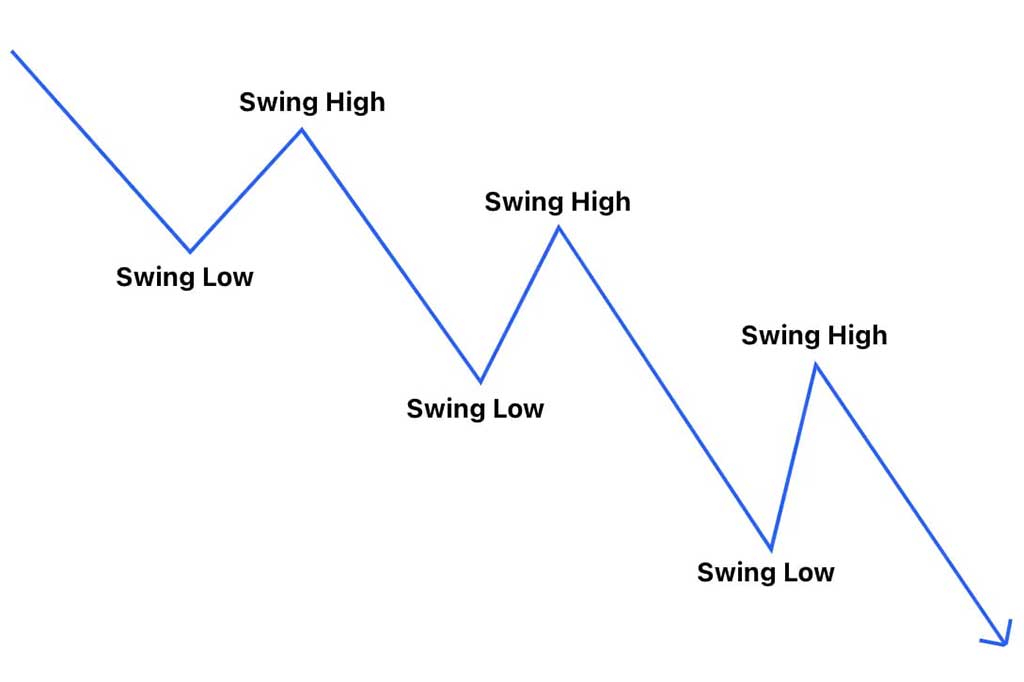
This pattern shows that buyers are in control. Every dip is followed by another push upward. In a downtrend, the opposite happens. Price forms lower highs and lower lows, showing that sellers are in control.
This is the foundation of trend structure forex. Instead of guessing direction, you observe what price is doing. Imagine climbing a hill. If each step takes you higher, you’re moving up. If each step takes you lower, you’re going down. The market behaves the same way.
Trends don’t move in straight lines. Pullbacks are normal and help confirm the trend’s strength. Beginners often mistake pullbacks for reversals. But structure helps you see the difference. Marking highs and lows on your chart can help you understand patterns more clearly. Over time, you’ll naturally recognize these movements without needing to mark them.
Trend Structure vs Range Market
Not every market is trending. Sometimes price moves sideways, and this is where many traders struggle. There are two main conditions: trending and ranging. A trend moves in one direction, while a range moves sideways between levels. Understanding this is key to structure trading. Using the wrong approach in the wrong market leads to losses.
In a trending market, price follows a pattern of highs and lows. In a range, it moves back and forth between support and resistance. Think of a range like a ball bouncing between two walls. Price moves up and down without breaking out. Recognizing the trend structure forex helps you decide how to trade.
In trends, you follow the direction. In ranges, you trade the boundaries. Many beginners lose money by forcing trades in a range, expecting a breakout that never comes. Markets can shift from range to trend. These transitions often lead to strong moves. Understanding this shift gives you an advantage.
Market Structure Break Explained
A market structure break happens when price stops following its previous pattern. In an uptrend, this means price fails to make a higher high and breaks below a previous low. In a downtrend, it means price breaks above a previous high.
This signals a potential shift in direction. Not every break leads to a reversal, but it tells you that something has changed.
This is closely linked to a trend reversal structure. When a break is followed by new patterns, it often confirms a reversal. Beginners often react too quickly. They see a break and assume a full reversal. But experienced traders wait for confirmation. Watching how price behaves after the break gives valuable clues. Structure breaks act like warning signals, telling you to pay attention.
How to Use Market Structure for Entries
It is one thing to comprehend market structure; however, the act of conducting trades using that knowledge is where we begin to truly put the theory into real-time decision making. Once you understand the market structure, begin with the easy part: determining direction. Before contemplating entries, ask yourself if the market is trending or in a range – that sets up your bias and prevents you from trading contrary to the flow of the market.
Once you know the direction, the next step is patience. Many beginners rush into trades as soon as they see movement. But experienced traders wait for price to come to them. This is a key part of structure trading. For example, in an uptrend, you don’t want to buy at the top. Instead, you wait for a pullback. This pullback often forms a higher low, which aligns with the overall structure.
This is where entries become logical. Instead of guessing, you’re entering based on a pattern that has already been established. The market shows you its direction first, then gives you an opportunity.
A good way to think about it is like catching a wave. You don’t jump in randomly you wait for the right moment when the wave is forming. Market structure helps you recognize that moment. Another important tool is the market structure break. When a break happens, it can signal a shift in direction. Traders often wait for this break and then look for entries in the new direction. For example, if the market was trending down and then breaks structure upward, you might start looking for buying opportunities instead of selling.
You can also combine this with pullbacks. After a structure break, price often retraces before continuing. These retracements can provide cleaner and safer entry points. Risk management is also easier with structure. You can place your stop loss beyond a key level, such as a previous high or low. This gives your trade a logical point of invalidation.
Another helpful tip is to use multiple timeframes. A higher timeframe can show you the overall direction, while a lower timeframe can help you fine-tune your entry. With the method of confirming a small timeframe versus sticking with a larger timeframe, you will have an increased level of accuracy. Don’t just jump into a trade because you think it’s a good set up. Wait until all the necessary confirmation has arrived and then enter based on your larger timeframe.
This is where understanding what is a trading setup becomes important. A proper setup is built on confirmation, structure, and patience rather than emotion.
Also be mindful that not all set ups will be ‘perfect’. The market may not provide an ideal point for entry, but that is fine. This could mean that the market was not ready to make an indication, and that is a normal part of the trading process.
Over time you will begin to develop a level of trust in your analysis; you will come to realize that the majority of good entries are derived from proper setup and patience, and very rarely from impulse and/or gut instinct.
Many traders improve consistency by combining trading with price action and trend trading strategies in forex instead of relying only on indicators.
In short, understanding market structure will enable you, as a trader, to enter the market with purpose. As you make decisions regarding your trades based on market structure and price action, your trading activity will become more predictable and controllable than impulsive or emotional.
Common Mistakes in Structure Analysis
Many traders understand structure but apply it incorrectly. One mistake is overcomplicating charts. Too many lines create confusion.
Another is focusing on small movements instead of the bigger picture. Ignoring timeframe context leads to wrong decisions. Misreading a trend reversal structure too early is also common. Chasing trades after a move is another mistake.
Bias can blind traders to what the chart is showing. Pullbacks are often mistaken for reversals. Some rely too much on indicators and ignore structure. Not waiting for confirmation leads to poor entries.
This usually happens when traders do not fully understand what is forex and how market behavior changes across different conditions.
Emotions like fear and impatience also play a role. Keeping things simple and reviewing trades helps improve over time.
Conclusion
Market structure turns confusion into clarity. It helps you understand what the market is doing and why. Instead of guessing, you follow patterns and logic. With practice, structure becomes second nature. It improves patience, discipline, and consistency. In the long run, it’s one of the most valuable skills a trader can develop.
FAQ
It helps you understand direction and make logical decisions instead of emotional ones.
Look for a structure break followed by a new pattern of highs and lows.
It’s when the market stops following its current pattern, signaling a possible change.
Higher timeframes show the bigger picture, while lower ones help with entries.
Share
Hot topics

STP, NDD, ECN and DMA: Broker Execution Models Decoded
When picking a forex broker, we don’t just look at the brokerage that has the lowest spreads, bonuses, and other kind of what is apparent for us. There is one...
Read more




Submit comment
Your email address will not be published. Required fields are marked *