
What Is Entry Confirmation in Trading?
If you’ve ever entered a position too early and had the market turn against you, you’re not alone. It’s one of the most common situations traders face, especially at the beginning. The market appears ready and aligned, but then unexpectedly falters.
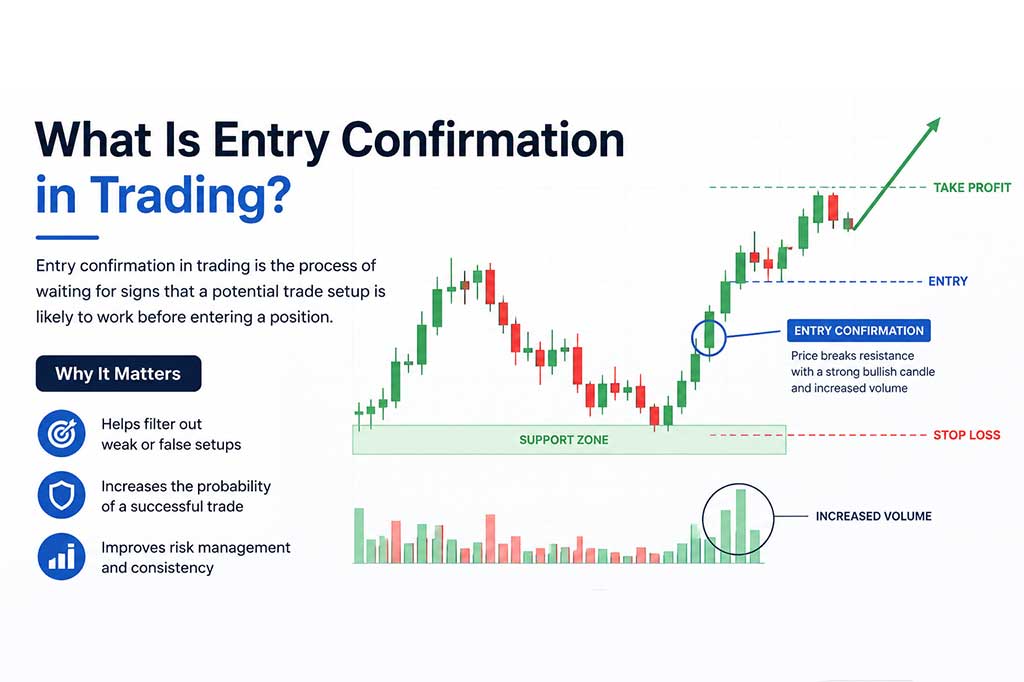
This is where entry confirmation comes into action, and it plays a key role before entering a trade. Instead of entering a trade based on emotion or a simple idea, entry confirmation helps traders slow down and review their analysis to validate their trades before risking their capital.
Basically, entry confirmation is the process of waiting for the market to “agree” with your assumption before taking action. It isn’t about being late; it’s about being smarter about when to trade.
Whether you use indicators, read candlestick charts, or any other trading system you follow, entry confirmation gives you additional confidence in your analysis and decision-making.
In this article, we break down what entry confirmation means, why it is important, and how to use entry confirmation in your trading. Additionally, you will learn some practical entry confirmation tips, common entry confirmation mistakes, and ways to improve your entry confirmations over time.
What Does Entry Confirmation Mean?
Entry confirmation is the method of verifying a trade’s validity before entering. Instead of immediately executing a trade based on a single signal, traders wait and seek out more signals that support their analysis of the trade idea.
Consider it like double-checking directions before taking a turn. You might believe you’re on the correct track, but confirmation assures you don’t make an unnecessary error.
In forex trading, traders usually combine a variety of methods, such as price patterns, indicators, or support and resistance levels, to confirm their trade setups. This is where terms like confirmation entry forex and entry signal forex become important, as they indicate the point where a trader identifies that a trade setup is strong enough.
For example, you may see a potential buy trade at a support level. However, instead of entering immediately, you wait for a bullish candlestick pattern or a breakout. That additional signal is your confirmation.
The basic principle is to never make a decision based on one piece of information. Allow the market to demonstrate that your concept has a greater likelihood of success.
Why Confirmation Is Important in Trading
One of the most significant advantages of confirmation is that it increases your win rate in trading. Filtering out poor setups results in fewer but higher-quality trades. Over time, this can significantly improve your overall performance.
Emotional control is also a benefit of confirmation. The clearer the confirmation process, the less likely you are to trade out of emotion, such as impulse or fear of missing out. You will trade according to a plan, not react to each movement of the market.
Confirmation also helps traders avoid false signals. The market can create fake breakouts and misleading patterns. Without confirmation, it can be very easy to get caught in these moves.
In action, traders employ confirmation strategies to enhance consistency. Whether it’s waiting for a candle to close, reviewing various timeframes, or combining indicators, these strategies provide structure and discipline.
Finally, confirmation isn’t about being perfect; it’s about stacking the odds in your favor.
Price Action Confirmation Techniques
Price action is the preferred method by many traders when confirming their trade entries. Traders who use price action trading do not use a lot of technical indicators to make their trade decisions; instead, they learn to read the raw movement of the market.
Price action traders look for patterns such as pin bars, engulfing candles, and breakouts. These patterns serve as indicators that the market is responding to key levels.
For example, suppose the price reaches a strong support level. Instead of entering the trade right away, you wait for a bullish engulfing candle. This candle indicates that buyers are stepping in, providing clearer signals to enter.
Another common form of confirmation in price action trading is a retest. Most of the time, after a price breakout, the price will come back to test the breakout level before it continues moving forward; this process is referred to as a retest, and it can serve as a good confirmation point for many traders.
Many traders also use support & resistance zones to confirm price action moves; when price reacts strongly at these levels, it provides additional evidence that the market respects them.
Using price action to confirm keeps things simple and visual. You are not using sophisticated formulae; instead, you are simply observing how prices react.
Many traders prefer this strategy because it closely matches how the market actually moves. When utilized properly, it is straightforward, adaptable, and successful.
Indicator-Based Confirmation Methods
While price action is solid, many traders also utilize indicators to validate their trades. Indicators can help provide more clarity, especially for those who favor structured systems.
Many traders rely on trade confirmation signals to validate whether a setup is strong enough before entering the market.
The most popular tools that are used are moving averages, RSI, MACD, and stochastic oscillators. Each one of these tools helps a trader identify if the setup is valid.
For example, if you’re considering a buy position, you might wait for the RSI to exit oversold territory. This indicates to you that this setup is more likely to be a valid buy opportunity, and adds extra confidence to your decision.
Another example could be using a moving average. When the price is above a key moving average and pulls back, a trader may look for a bounce from that area as confirmation.
Some traders search for tools that are considered to be “the best indicator” for entry confirmation, or look for the best buy and sell signal indicator that helps them make their decisions easier. While these tools can be beneficial, they should not be used blindly and should not be relied on completely.
Indicators should complement your analysis, but should not be the sole basis of your analysis. When used alongside price action and market structure, indicators will help you to be more accurate with your entry timing.
The biggest key is to keep your charts uncluttered. If you have too many indicators on your chart, it is more likely that you will have confusion, rather than clarity. It is important to keep your chart setup simple and focused.
Combining Confluence for Strong Entries
Confluence is one of the most effective methods for confirming a trade. This involves merging multiple signals that all point in the same direction. Combining multiple factors is often considered the best entry confirmation approach used by experienced traders.
For example, suppose the price is at a support level, establishing a bullish pattern, and the RSI indicates oversold scenarios. Each of these signs is useful on its own, but when combined, they make an even stronger statement.
This combination of signals is what traders call confirmation, and it’s not about finding the perfect signal, but having several pieces of evidence aligned together.
Confluence can incorporate technical features such as trend direction, important levels, indicators, and even longer-term analysis. The more closely these parameters are linked, the stronger your setup gets.
There are a couple of points here to make:
- You do not need to have 10 confirmations before you enter a trade; sometimes you can have two or three strong signals in your favour.
- If you build a trading system based on confluence, you will become more consistent over time, and you will learn what combinations work best for you as a trader.
As with all aspects of trading, there is no way to guarantee 100% accuracy in any one trade, but by using confluence, you will be able to make better-informed decisions with more clarity and confidence. This layered approach creates stronger signal confirmation and improves decision-making.
Mistakes in Entry Confirmation
While confirmation is useful, it isn’t always used properly. Many traders make mistakes that reduce their effectiveness.
Overconfirmation is a typical mistake. Waiting for too many signals can lead to missed opportunities. By the time everything comes together, the trade may have already ended.
Another challenge is relying on lagging indicators. Some indicators react slowly, resulting in late entries. This lowers your risk/reward ratio.
Ignoring market context is also problematic. Confirmation signals should be considered in context. A strong signal in a weak market environment may not be reliable.
Some traders confuse noise and confirmation. Just because multiple indicators are producing signals does not imply that they are relevant.
It’s also important to avoid relying on any single platform or tool without fully understanding how it works. Even if you use Otet, it’s still important to take the time to understand its features and trading conditions. A platform can provide important tools and signals, but your success is always determined by how well you apply them within your own strategy.
Finally, emotional trading may override confirmation. If you are impatient or afraid of missing out, you may skip the entire process.
The idea is to use confirmation as a guide, not a crutch. Keep it simple and logical, and in line with your overall strategy.
Conclusion
The primary benefit of entry confirmation is that it allows traders to make more informed decisions when determining where to enter or exit a trade. Entry confirmation doesn’t complicate your trading strategy; instead, it eliminates some of the risks associated with impulsively entering a new trade.
By waiting for an entry confirmation before executing a trade, you can avoid entering into impulsive trades, allow the market to determine if your entry point is valid, and prevent you from making wrong decisions. As you build a consistent entry confirmation process over time, your trading results will become increasingly consistent, and you will have greater confidence in your trading.
Regardless of whether you use price action, indicators, or both together, developing a process and following through with it is essential. Keep it simple, test it extensively, and maintain discipline.
While trading will always involve some element of uncertainty, implementing an entry confirmation strategy can allow for greater control over that uncertainty and increase the potential for successful trades.
Over time, traders who focus on confirmation tend to develop more patience and discipline. Instead of chasing every opportunity, they become more selective and strategic. This shift in mindset often separates consistent traders from those who struggle. Entry confirmation is not just a technical tool—it’s a habit that shapes how you approach the market.
FAQ
Confirmation in forex trading refers to the process of validating a trade idea using additional signals or evidence before entering a position. It helps traders reduce risk and improve decision-making.
While it’s not strictly necessary, entry confirmation is highly recommended. It helps filter out weak setups and increases the likelihood of making better trades.
There is no single strongest signal. The most effective approach is combining multiple factors, such as price action, indicators, and market structure, to create confluence.
Yes, but it’s riskier. Trading without confirmation often leads to impulsive decisions and lower consistency. Using confirmation helps create a more structured and reliable approach.
Share
Hot topics

STP, NDD, ECN and DMA: Broker Execution Models Decoded
When picking a forex broker, we don’t just look at the brokerage that has the lowest spreads, bonuses, and other kind of what is apparent for us. There is one...
Read more




Submit comment
Your email address will not be published. Required fields are marked *