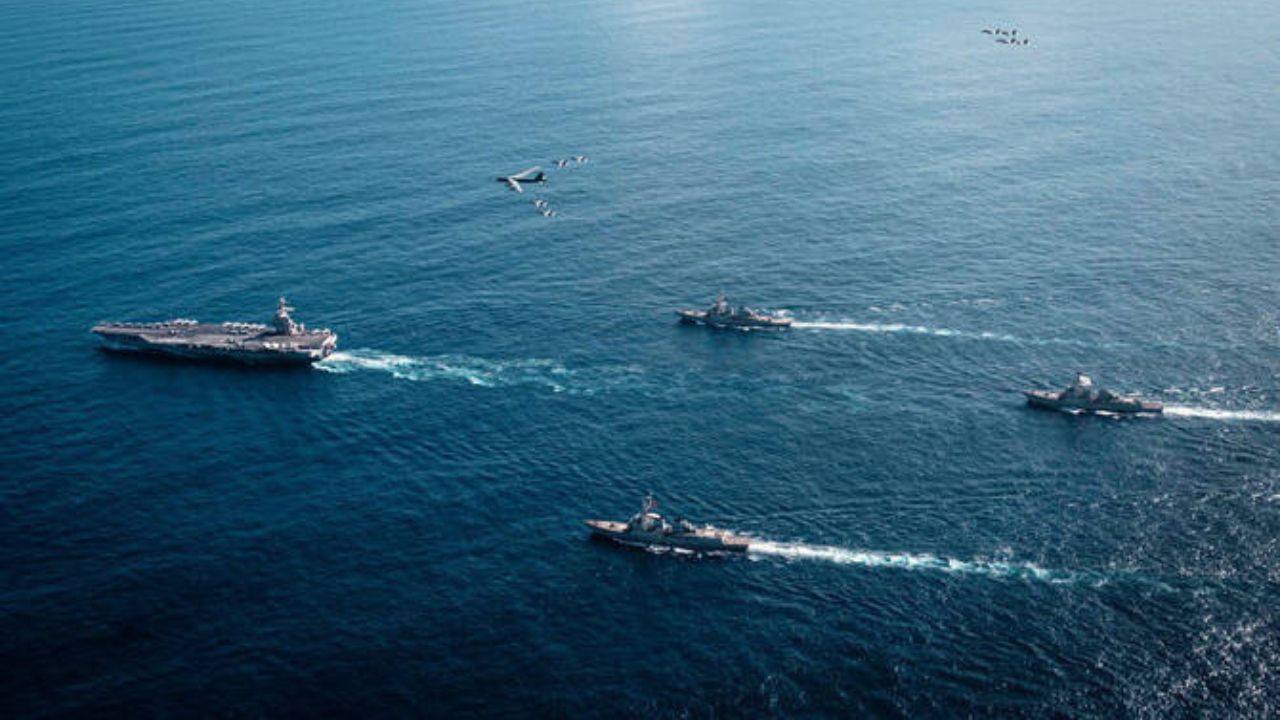
U.S. Naval Blockade Fully Cuts Off Iranian Sea Trade, Centcom Says
U.S. Blockade Halts Iranian Maritime Trade
Centcom stated late Tuesday that U.S. forces have established a blockade that has “completely cut off” Iran’s international sea trade, which accounts for about 90% of the country’s economy. Centcom commander Brad Cooper said the blockade was fully implemented within 36 hours of President Trump’s order and that U.S. forces “have completely halted economic trade going in and out of Iran by sea.”
More than 90% of Iran’s $109.7 billion in annual seaborne trade passes through the Strait of Hormuz. According to the information provided, Iran lacks any significant alternative trade routes, and the blockade is estimated to inflict approximately $435 million per day in combined economic damage.
The operation, which took effect Monday during a shaky two-week ceasefire, involves over 10,000 U.S. troops, more than a dozen Navy ships, and fighter jets deployed in the Gulf of Oman and the Arabian Sea. In the first 24 hours of enforcement, no ships passed through the blockade, and six merchant vessels were ordered to turn back.
Maritime intelligence firm Windward, however, identified at least two vessels that transited the Strait of Hormuz on the first full day of active U.S. enforcement, including the U.S.-sanctioned Chinese-owned tanker Rich Starry, which exited the Gulf on Tuesday.
Energy Market and Global Economic Context
Iran has choked the Strait of Hormuz in response to joint U.S.-Israeli strikes on Iranian territory that began on February 28. Before the war, the strait carried about one-fifth of the world’s oil supplies. The U.S. naval blockade could further disrupt energy flows through this key waterway and strain Washington’s relations with major importers such as China and India.
China on Tuesday described the U.S. blockade of Iranian ports as a “dangerous and irresponsible act.” At the same time, the International Monetary Fund (IMF) lowered its global growth forecast for 2026 to 3.1%, from 3.3% in January, and warned that the world was drifting toward an “adverse scenario” in which oil prices could remain around $100 per barrel.
Despite these risks, signals of a potential diplomatic resolution to the Middle East conflict have eased some pressure in oil markets. U.S. crude oil futures for May delivery fell 0.88% to $90.4 per barrel.
FAQ
What actions has the U.S. taken against Iran’s maritime trade?
The U.S. has instituted a naval blockade of Iranian ports that Centcom says has “completely” halted economic trade going in and out of Iran by sea, effectively cutting off international maritime trade that accounts for about 90% of Iran’s economy.
How large is Iran’s seaborne trade and what is the estimated economic impact of the blockade?
Iran’s annual seaborne trade is valued at $109.7 billion, with more than 90% transiting the Strait of Hormuz. The blockade is estimated to cause approximately $435 million per day in combined economic damage.
How might the blockade affect global energy markets?
The Strait of Hormuz previously carried about one-fifth of global oil supplies, and both Iran’s choking of the strait and the U.S. naval blockade could further disrupt energy flows. The IMF has warned of an “adverse scenario” in which oil prices could remain around $100 per barrel, although recent diplomatic signals have coincided with a decline in U.S. crude futures to $90.4 per barrel.
Share
Hot topics

STP, NDD, ECN and DMA: Broker Execution Models Decoded
When picking a forex broker, we don’t just look at the brokerage that has the lowest spreads, bonuses, and other kind of what is apparent for us. There is one...
Read more



Submit comment
Your email address will not be published. Required fields are marked *