
What Is Smart Money Concept (SMC) in Trading?
Introduction
If you’ve been trading for a while, you’ve probably had this moment: you enter a trade with confidence, everything looks perfect, and then suddenly the market moves against you only to go in your original direction right after your stop-loss is hit.It feels personal. Almost like the market is watching your trades.But here’s the reality: it’s not about you. It’s about how the market is structured.
This is exactly where Smart Money Concept, or SMC, starts to make sense. Instead of treating the market like a random system, SMC looks at it as a place controlled at least partially by large players.These players are not guessing. They’re executing strategies with purpose.
Once you start understanding this, everything changes. Charts stop looking chaotic. Price movements start telling a story.
What is Smart Money Concept in Trading?
Smart Money Concept is built on one core idea: institutions move the market.
These institutions include banks, hedge funds, and large financial entities. They have access to deep liquidity, advanced tools, and most importantly, large capital.Because of their size, they can’t trade like retail traders. They can’t just enter a full position instantly. If they try, the price will move against them.
So what do they do?
They create conditions where they can enter trades efficiently. And that usually involves liquidity.Liquidity is where orders exist. And in most cases, retail traders unknowingly provide that liquidity.
This is why many traders start exploring SMC trading it gives a different perspective. Instead of reacting, you begin to anticipate.
You stop thinking, “Where should I enter?” and start thinking, “What are institutions doing here?”
That shift alone can completely change your trading mindset.
How Institutional Traders Move the Market
Let’s make this practical.
Imagine a large bank wants to buy a huge amount of a currency pair. They need sellers to fill that order.But sellers don’t just appear randomly. They need to be triggered.
So institutions often push price toward areas where traders have placed stop-losses. These areas are full of pending orders.Once those stops are triggered, liquidity floods the market.That’s when institutions step in.
This is why you often see price break a level, only to reverse immediately after. It’s not a mistake. It’s part of the process.
This behavior is very visible in markets like smart money forex, where liquidity flows are constantly shifting.Once you understand this, you stop chasing breakouts blindly.Instead, you wait. You observe. You let the market show its intention first.

Smart Money vs Retail Traders
One of the biggest mistakes traders make is assuming everyone trades the same way.
Retail traders usually follow common strategies. Support and resistance, trendlines, indicators these are all widely used.The problem is, when too many traders do the same thing, their behavior becomes predictable.And predictable behavior creates opportunity for institutions.
For example, if most traders place stop-losses below a support level, institutions may push price down to trigger those stops before reversing.Retail traders often call this “manipulation.”But in reality, it’s just how liquidity works.
Another key difference is mindset.
Retail traders often rush into trades. They feel like they might miss out.Institutions don’t think that way. They wait for the right setup. They think in terms of probability, not emotion.
If you want to improve, you don’t need to become an institution. But you do need to start thinking more like one.
Key Components of Smart Money (Liquidity, Order Blocks, Structure)
To understand SMC properly, you need to break it into simple pieces.
First, liquidity.
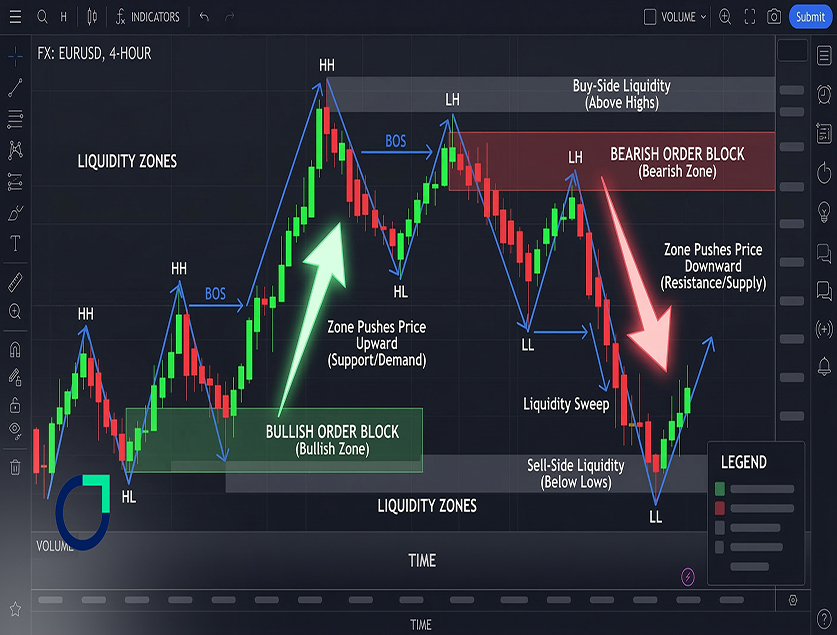
Liquidity is where orders are sitting in the market. These are usually found above highs and below lows.Many traders build their entire understanding around liquidity in forex strategy because it explains why price moves the way it does.
Next, order blocks.
Order blocks are areas where institutions have previously placed large orders. These zones often act as strong reaction points.
If you’re new to this, it’s important to understand what is order block, because it’s one of the core tools in identifying smart money activity.
Then we have market structure.
This is simply the direction of the market. Is it making higher highs? Lower lows?
Structure helps you stay aligned with the overall trend instead of fighting against it.
When you combine these three liquidity, order blocks, and structure you start to see the market differently.Not as random movement, but as a system driven by intent.
This is what many traders refer to as a smart money strategy.
How to Identify Smart Money Behavior in Charts
Now let’s bring everything together.
Charts are not random. They’re a visual representation of decisions made by traders especially large ones.
One of the best ways to read these decisions is through trading with price action.Instead of relying on indicators, you focus on how price behaves.Look for strong moves. Sudden spikes or drops often indicate institutional involvement.
Pay attention to fake breakouts. When price breaks a level and quickly reverses, it’s usually a sign of liquidity being taken.
Another important concept is imbalance.Rapid movement in prices can leave behind spaces where not much business was done. Such spaces may be re-assessed at a later time. You will also notice certain ways things develop over time in the markets. This isn’t because the market is fixed but rather, the actions that create the market are always being done in about the same way.
And this applies across different markets, whether you’re trading forex or something like Otet Market.
The principles don’t change.
Common Mistakes in Smart Money Trading
Like any approach, SMC has a learning curve.
One of the biggest mistakes is trying to learn everything at once.There are many concepts, and it’s easy to get overwhelmed.
Start simple. Focus on one idea at a time.Another mistake is impatience.Many traders see a setup forming and jump in too early. But timing matters.
Waiting for confirmation can make a huge difference.Some traders also assume every move is manipulation.That’s not true. Sometimes the market is reacting to external factors like news.And this is where understanding the difference between SMC and approaches like news trading becomes important.Risk management is another area where many traders struggle.Even if your analysis is correct, trades can still fail.Protecting your capital is what keeps you in the game.Finally, don’t skip the basics.
Before diving deep into advanced concepts, make sure you understand what is forex and how does it work.Without that foundation, everything else becomes harder.
Conclusion
Smart Money Concept is not a magic formula.It doesn’t guarantee profits. It doesn’t predict every move.What it does is give you a clearer understanding of how the market works.It helps you see beyond indicators and focus on what actually drives price.You learn why some price levels are more reactive than others and become patient due to knowing the reasons behind these prices. As a result, you wait for trades instead of chasing trades. The change from a reactionary to intentional trader is what separates the successful from the unsuccessful traders.
FAQs
What is Smart Money Concept in simple terms?
Smart Money Concept is a way of understanding the market by focusing on how large institutions trade. It helps traders identify where big players are likely entering or exiting positions.
Is Smart Money Concept profitable for beginners?
It can be, but it requires practice and patience. Beginners should focus on understanding the basics before expecting consistent results.
Do institutions really manipulate price?
Institutions don’t manipulate the market illegally, but they do move price strategically to access liquidity. This often creates patterns that traders can learn to recognize.
What markets work best with SMC?
SMC works in all liquid markets, including forex, futures, and crypto. As long as institutions are active, the concepts remain relevant.
Share
Hot topics
Smart Money Order Blocks: A Complete Guide for Traders
Introduction When analyzing charts, it becomes clear that price does not move randomly. It often pauses, reverses, and reacts at specific levels repeatedly. These levels are typically referred to as...
Read more




Submit comment
Your email address will not be published. Required fields are marked *