The Best Indicators for Trading in Forex
Introduction
Every trader remembers the first time they used a trading platform chart. At first, it looks simple—a price simply moving up and down—but the more you watch, the more questions arise. Why did the price reverse suddenly? Why did it break out after being in range for hours?
Price charts alone sometimes lack context; this is where indicators help by clarifying market activity, predicting trends, and assisting decision-making.
Forex indicators utilize past price data to create visual representations, helping traders determine momentum, volatility, or turning points. A common mistake new traders make is loading their charts with too many indicators, which often creates confusion rather than clarity.
This guide will go through the most common indicators you’d use when trading forex. You’ll figure out how they work, when to utilize them, and how to avoid typical mistakes when adopting them into your trading strategy.
What Are Forex Indicators?
Forex indicators are mathematical calculations based on previous price, volume, and volatility data. They are shown directly on charts, allowing traders to assess market trends. Indicators do not predict the future but highlight trends that historically precede certain behaviors.
An indicator may help show whether the market is moving upward, if it is losing momentum, or if it’s beginning a sideways phase. Most trading systems automatically offer a large library of indicators. Platforms like the Metatrader 5 allow traders to quickly add dozens of features to their charts.
Some indicators appear directly on the price chart, while others are displayed in a separate panel below it. Understanding how these tools behave is important if you want to utilize the best forex indicators strategically rather than at random.
Can You Trade Forex Without Indicators?
Yes, many traders trade without indicators at all.
This is usually referred to as price action trading. Price action traders will trade based only on chart patterns, support and resistance levels, and candlestick patterns.
For instance, a trader may recognize a breakout from a consolidation zone or a rejection from a strong level of resistance. But, indicators can also enhance what is already visible on a trader’s chart.
As well, using indicators can make decision-making easier for beginner traders who are still trying to figure out how markets move. Most of the time, experienced traders combine price action with a few carefully chosen trading indicators for additional confirmation before placing an order.
The key idea is that indicators should enhance your analysis rather than replace it.
Types of Forex Indicators
Forex indicators can be categorized based on the sort of information they give.
– Trend Indicators
Trend indicators assist traders in determining the market’s direction. They respond to a simple question: Is the market moving up, down, or sideways?
Examples include moving averages and the ADX indicator.
– Momentum Indicators
Momentum indicators measure the strength of price movements. These indicators can help traders determine if the market is overbought or oversold.
The stochastic oscillator and RSI are two common examples.
– Volatility Indicators
Volatility indicators measure how much the price moves around over a given timeframe. High volatility often indicates higher price changes.
Bollinger Bands and ATR are good examples of volatility indicators.
– Support and Resistance Indicators
Some indicators are designed to detect possible support and resistance levels. This category includes tools such as Fibonacci retracements and pivot points.
Indicator Classification Table
| Category | Purpose | Examples |
| Trend Indicators | Identify market direction | Moving Averages, ADX |
| Momentum Indicators | Measure strength of movement | RSI, Stochastic |
| Volatility Indicators | Measure price fluctuation | ATR, Bollinger Bands |
| Support & Resistance Indicators | Identify price reaction zones | Fibonacci, Pivot Points |
Choosing Indicators Based on Market Conditions
Not all indicators perform effectively in every market condition. A successful strategy in a trending market may fail in a ranging market.
Understanding when to use particular tools is an important skill.
Best Indicators for Trending Markets
A trending market is one that is moving consistently in one direction. Price movement indicators work best in these markets.
Moving averages are one of the most often used methods for spotting trends. Traders commonly combine two moving averages to determine trend direction and possible crossover indications.
Best Indicators for Ranging Markets
The market moves between support and resistance without a clear trend. Oscillators often perform well under these settings since they indicate overbought and oversold levels.
Indicators such as RSI and the stochastic oscillator can assist in identifying potential reversal points within the range.
Best Indicators for Volatile Markets
When markets become extremely volatile, price fluctuations become unexpected. Volatility indicators such as ATR and Bollinger Bands help traders assess the magnitude of price fluctuations and adjust their risk management accordingly.
Top 10 Best Forex Trading Indicators
There are many indicators available on the platforms, but just a few are widely trusted by traders in various markets.
Here are some of the most common:
– Moving Averages (SMA & EMA)
Moving averages smooth the price data and make trends easier to spot. The Simple Moving Average (SMA) determines the average closing price over a certain number of periods.
The Exponential Moving Average gives more weight to the most recent price data.
Relative Strength Index (RSI)
The RSI measures the speed and change of price movements.
The values range from 0 to 100. Traders often classify readings above 70 as overbought and readings below 30 as oversold.
Bollinger Bands
Bollinger Bands are a moving average with upper and lower bands depending on standard deviation.
They assist in visualizing volatility and possible breakout spots. When the bands widen, volatility rises. When they contract, volatility drops.
MACD (Moving Average Convergence Divergence)
MACD is a trend-following momentum indicator. It depicts the connection between two moving averages and incorporates a histogram to illustrate momentum fluctuations.
Many traders utilize MACD crossings to identify probable entry points.
Average True Range (ATR)
Instead of measuring direction, ATR measures market volatility. Many traders rely on ATR to help with positioning stop losses based on price momentum.
Fibonacci Retracement & Extension
Fibonacci levels enable traders to find possible retracement zones during a trend.
Common Fibonacci levels are 38.2%, 50%, and 61.8%, which are typically aligned with support and/or resistance levels.
Stochastic Oscillator
The stochastic indicator compares the closing price to a range of prices over time. It assists traders in spotting potential market turning points.
Average Directional Index (ADX)
It measures trend strength.
Strong trends are often indicated by values greater than 25. A range market is often defined by values less than 20.
Ichimoku Cloud
The Ichimoku is a complete trading framework; it includes different components to show trend direction, support/resistance, and potential entry points.
At first, it may seem complicated and difficult to use, but many traders find it to be very helpful.
Pivot Points
It calculates key price levels based on previous trading sessions. Used by institutional traders to help identify support/resistance zones.
Quick Comparison Table
| Indicator | Type | Main Use |
| Moving Averages | Trend | Identify direction |
| RSI | Momentum | Overbought / oversold |
| Bollinger Bands | Volatility | Breakout signals |
| MACD | Momentum | Trend confirmation |
| ATR | Volatility | Stop loss distance |
| Fibonacci | Support/Resistance | Retracement zones |
| Stochastic | Momentum | Reversal signals |
| ADX | Trend Strength | Trend confirmation |
| Ichimoku | Multi-purpose | Complete system |
| Pivot Points | Support/Resistance | Intraday levels |
These are often considered among the Top 10 forex indicators used by traders worldwide.
Best Indicator Settings for Different Timeframes
Different trading styles require different indicator settings.
Scalping
Short-term traders often use faster indicator settings.For example, a 9-period EMA or 5-period RSI reacts quickly to price changes.
Day Trading
Day traders usually prefer balanced settings such as a 14-period RSI or a 20-period moving average.
These provide a good mix of responsiveness and reliability.
Swing Trading
Swing traders focus on longer trends.
Indicators like the 50-period or 200-period moving average are commonly used.
Risk Management Using Technical Indicators
Indicators assist traders in finding potential trade opportunities as well as in managing risk. For instance, ATR (Average True Range) can be used to determine appropriate stop-loss levels based on current market momentum, while moving averages help determine invalidation points and round out potential trade ideas where the idea is no longer valid.
Many traders choose to use an indicator in conjunction with position-sizing rules so as to protect trading capital; therefore, risk management must remain the priority for every trader.
Another helpful habit for traders is to test indicators in a demo environment before relying on them in live markets. Demo trading allows you to observe how indicators behave during different market conditions without risking real money. By practicing with historical charts and simulated trades, traders can learn how indicators react during trends, consolidations, and sudden volatility.
The best buy and sell signal indicator cannot guarantee profits without having proper risk management. Some traders also combine ATR with risk-reward ratios to determine whether a trade is worth taking. If the potential reward is not at least twice the risk, experienced traders often skip the trade entirely.
Pros and Cons of Using Forex Indicators
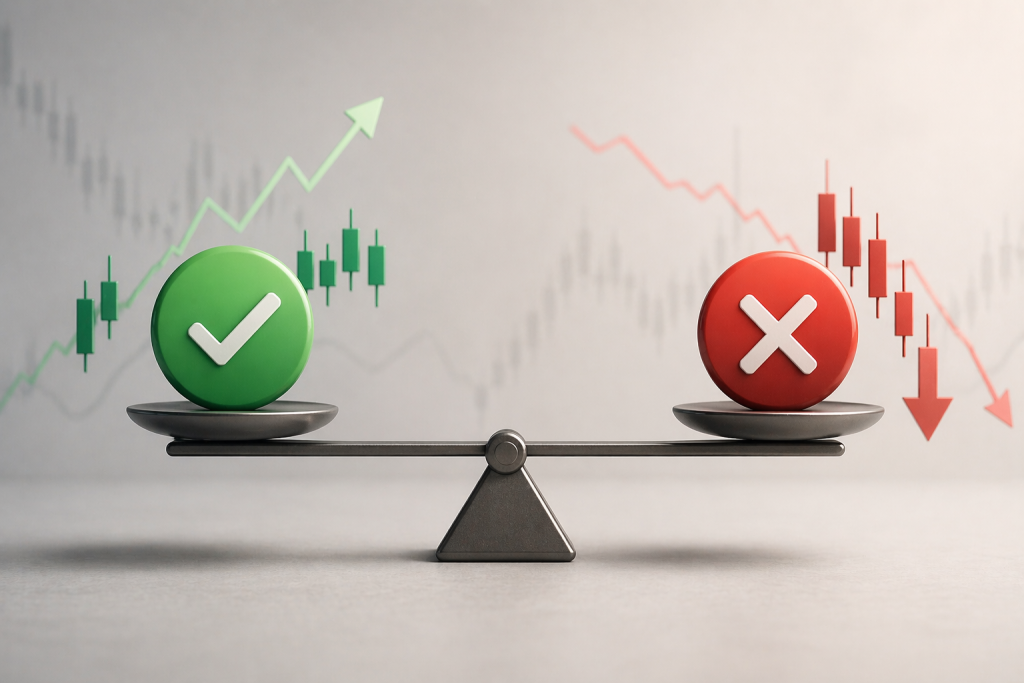
Advantages
Indicators make complex market data easier to read and interpret. They also give visual signals that are easier to read than the raw price information.
For beginner traders, indicators can help them to observe and understand how the market behaves.
Disadvantages
Indicators calculate historical price data, so they react to the price instead of predicting it.
Using too many indicators at the same time can create too many conflicting signals and confuse traders.
Common Mistakes When Using Forex Indicators
One of the most common mistakes traders make is indicator overload. Adding too many indicators to a chart can produce conflicting signals. Relying only on indicators without comprehending market structure is another mistake traders make.
Over time, keeping a simple trading journal alongside indicator analysis can also reveal patterns in decision-making, helping traders refine their approach and avoid repeating common mistakes. Price analysis should be supplemented, not replaced, by indicators.
Inconsistent methods might result from traders who often alter indicator settings after losing trades.
Best Indicator for Beginners in Forex
Simplicity can be the best strategy for beginners.
RSI and moving averages are both the simplest indicators to comprehend. They are accessible on nearly all trading platforms and offer clear signals.
Many new traders begin by combining one momentum indicator with a moving average. They eventually learn how various indicators interact with market conditions over time.
Educational resources from trading platforms or brokers such as Otet markets often introduce new traders to these tools through demo environments.
How Many Indicators Should You Use on One Chart?
Many professional traders generally agree on using two or three indicators at most, while there is no set rule.
Using one trend and one momentum indicator usually provides sufficient information for decision-making. The goal is not to find a perfect indicator but to understand how different tools complement each other within a trading strategy.
Using clearly defined and well-signaled charts will provide more useful information to a trader than dozens of indicator-filled charts.
Remember that indicators are instruments that facilitate decision-making, not an alternative to trading experience.
Conclusion
Indicators help traders analyze the forex market. They convert raw pricing data into signals that can be more easily analyzed. However, the key to success is not just identifying the Best forex indicators, but also understanding how and when to apply them.
Different indicators perform better in different market conditions, and combining a few complementary tools often provides better results than depending on a single indicator. Successful traders consider indicators as part of a broader strategy that involves price analysis, risk management, and discipline.
Traders should also remember that indicators work best when they are combined with patience and consistent practice. Watching how indicators behave during different market conditions—trends, ranges, and volatile sessions—helps build experience. Over time, traders begin to recognize patterns faster and use indicators more confidently when making trading decisions.
The real power of indicators comes with experience. As traders spend more time analyzing charts, they gradually learn which tools fit their strategy and which ones simply add noise.
FAQ
What is the most accurate forex indicator?
There is no single indicator that is always accurate. Indicators such as moving averages, RSI, and MACD are widely used, but their effectiveness depends on market conditions and how traders apply them.
What is the best forex indicator for beginners?
Moving averages and RSI are among the most beginner-friendly indicators because they are easy to understand and provide clear signals.
Do I need indicators to trade forex successfully?
No. Some traders rely entirely on price action. However, many traders use trading indicators to confirm signals and improve their analysis.
Share
Hot topics

The Best Buy and Sell Signal Indicator
Introduction If you’ve spent any time trading, you’ve likely faced the classic dilemma: the market moves, and you wonder whether to buy, sell, or wait. Traders try many methods to...
Read more



Submit comment
Your email address will not be published. Required fields are marked *