
How to Trade Using Smart Money Strategy Step by Step
Introduction
If you’ve ever felt like the market moves just to stop you out, you’re not imagining things. Many traders go through that exact phase. You follow a setup, enter confidently, and suddenly price turns against you only to move in your original direction later.
Most novice traders experience this level of frustration due to not having a complete comprehension of the market’s inner workings. Novice traders typically pay more attention to various indicators or patterns in the market and miss out on most of the fundamental mechanics that ultimately drive price.
The Smart Money Concepts approach to the market will help you reframe your thoughts on how to trade. That is to say, you’ll go from reacting to price movements to understanding the reasons why there is a price movement. You will stop guessing where the market might be going and start analysing the market’s intentions.
Consider this new way of analyzing your trades to be like learning how to play a game that you have been playing without the knowledge of the rules of that game. After you develop an understanding of the game and its rules, your decision-making process now becomes more systematic and less emotional.
Understanding the Smart Money Trading Model
Before we start going through the steps, we need to explain how this method works at its base level.
Institutional finance players (banks, hedge funds, etc.) are classified as smart money participants in the stock market (or any market, for that matter). They account for a large percentage of the volume traded on all exchanges, so their trades make conspicuous footprints on charts.
Unlike retail traders, they can’t simply enter or exit trades instantly. Their orders are too large. Because of this, they need liquidity, and they often create conditions in the market to find it.
This is why price sometimes behaves in ways that seem confusing. Breakouts fail. Trends reverse suddenly. Support and resistance don’t always hold.
When you begin to study smart money vs retail traders, you’ll notice a clear difference in behavior. Retail traders often react, while institutions plan.
Understanding how smart money works helps you see the market from a completely different angle. You stop chasing price and start observing it.
At its core, this is an institutional trading strategy built around liquidity, structure, and timing.
Step 1: Identifying Market Structure
The first step in Smart Money trading is understanding market structure.
Market structure simply refers to the direction of price. Is the market trending upward, downward, or moving sideways?
In an uptrend, price forms higher highs and higher lows. In a downtrend, it creates lower highs and lower lows. This might sound basic, but it’s one of the most important concepts.
Many traders skip this step and jump straight into entries. That’s where problems begin.
If you trade against the overall structure, you’re essentially fighting the market. Even a good setup can fail if it goes against the dominant trend.
A simple way to approach this is by looking at higher timeframes first. Identify the main direction, then move to lower timeframes for entries.
If you’re unsure about where to start, learning what is a trading setup can help you understand how structure fits into the bigger picture.
Once you align your trades with structure, everything becomes more consistent.
Step 2: Liquidity Zones and Key Levels
After understanding structure, the next step is identifying liquidity.
Liquidity is where orders are concentrated. These are areas where traders have placed stop-losses or pending orders.
Typically, liquidity sits above highs and below lows. These zones attract price because they provide the volume institutions need.
This is one of the most misunderstood parts of trading. Many traders think price moves randomly, but in reality, it often moves toward liquidity.
For example, if there’s a clear high on the chart, many traders will place stop-losses above it. Institutions may push price toward that level to trigger those stops.
Once liquidity is taken, price often reverses.
This is why understanding liquidity is essential. It helps you anticipate movement instead of reacting to it.
Many traders who explore the best forex trading strategy eventually realize that liquidity plays a central role in price behavior.
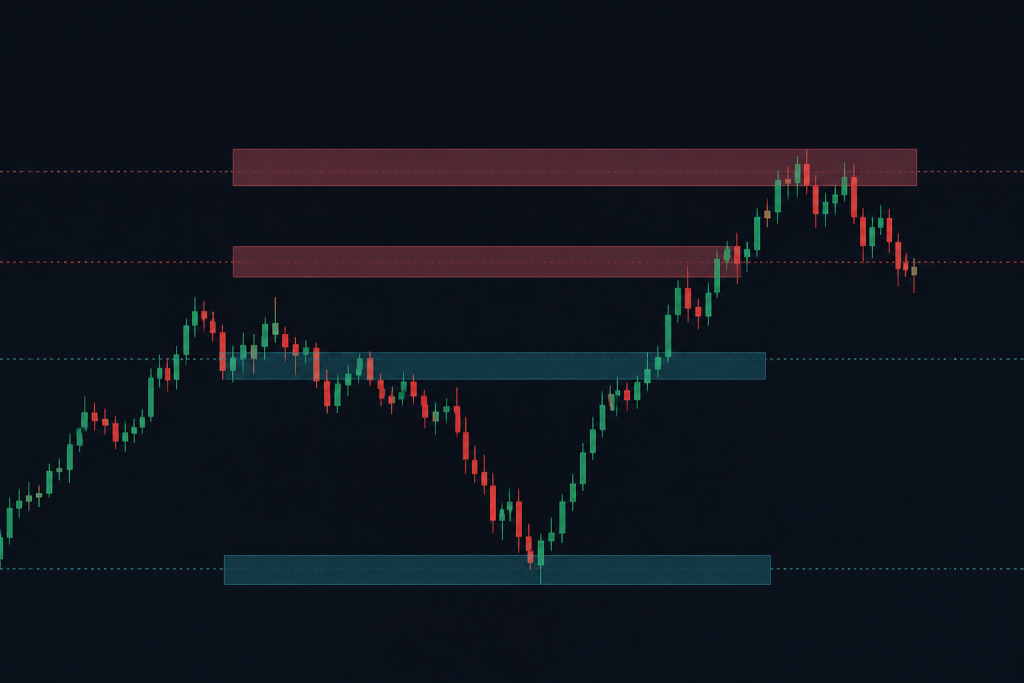
Step 3: Finding Order Blocks
Now that you understand liquidity, the next step is identifying order blocks.
Order blocks are areas where institutions have placed large orders in the past. These zones often act as strong reaction points in the market.
You can think of them as footprints left behind by smart money.
When price returns to these areas, it often reacts again. This is because institutions may still have unfilled orders in those zones.
The key is not just spotting order blocks, but understanding their context.
Are they aligned with the overall trend? Are they near liquidity zones? These factors increase their reliability.
Order blocks are not magic levels. They work best when combined with structure and liquidity.
When all these elements align, you start to see high-probability setups.
Step 4: Entry Confirmation Techniques
Once you’ve identified structure, liquidity, and order blocks, the next step is timing your entry.
This is where many traders struggle. They see a good level but enter too early or too late.
One of the most effective approaches is trading with price action.
Instead of guessing, you wait for confirmation. This could be a shift in structure, a rejection candle, or a break of a minor trend.
The idea is to let the market show its intention before you commit.
For example, if price reaches an order block, don’t enter immediately. Wait to see how it reacts.
Does it reject the level? Does it break structure in your favor? These are clues.
If you’re new, focus on simplicity. You don’t need complex rules. Just observe how price behaves at key areas.
This step is where patience becomes critical. The best trades often come to those who wait.
Step 5: Risk Management in Smart Money Trading
Even the best strategy won’t work without proper risk management.
This is where many traders fail, not because their analysis is wrong, but because their risk is poorly managed.
Start by deciding how much you’re willing to risk per trade. Many traders stick to 1% or 2% of their account.
Next, place your stop-loss logically. In SMC, stops are often placed beyond liquidity zones or structure levels.
This makes sense because if price moves beyond those levels, your trade idea is likely invalid.
Position sizing is also important. Don’t risk too much on a single trade, even if it looks perfect.
Consistency matters more than one big win.
If you’re just starting out, it’s also worth exploring the best market to trade for beginners, as different markets have different levels of volatility and behavior.
Finally, always remember that losses are part of the process. The goal is not to avoid losses, but to manage them effectively.
Conclusion
Smart Money Concept trading does not look for a flawless trading system. The Smart Money Concept is about understanding true market function. Once you look for ways to analyze structure, liquidity, and institutions’ actions, you will see the patterns much better than most people.
This does not mean every time you make a trade, you will be successful; however, it does increase the number of informed trades versus uninformed. Your confidence grows over time due to the trade you decide to take. When you make trades with intent versus reactively, you separate yourself from the traders who struggle.
Whether you’re trading forex, crypto, or even exploring markets like Otet, the principles remain the same.
Keep it simple. Stay patient. Focus on learning, not rushing.
FAQs
What is the best entry method in Smart Money?
The best entry method is waiting for confirmation at key levels. This often includes a reaction at an order block combined with a shift in structure.
Do I need indicators for SMC trading?
No, SMC focuses mainly on price action. Indicators can be used, but they are not necessary.
What timeframe is best for Smart Money strategy?
Higher timeframes are better for identifying structure, while lower timeframes are used for entries. Combining both gives better results.
How accurate is Smart Money trading?
It’s not 100% accurate, but it can be highly effective when applied correctly with proper risk management and patience.
Share
Hot topics

STP, NDD, ECN and DMA: Broker Execution Models Decoded
When picking a forex broker, we don’t just look at the brokerage that has the lowest spreads, bonuses, and other kind of what is apparent for us. There is one...
Read more




Submit comment
Your email address will not be published. Required fields are marked *