
What Is Order Flow Trading and How It Works
If you’ve been curious about why the stock market has sudden swings in price without any kind of information that indicates why so many traders use charts and indicators to trade yet often have a sense that they are missing something even as they look at the chart…what they are missing is what’s happening behind the scenes. This is especially true in currency markets, where order flow forex dynamics drive price movement in ways that no indicator can fully capture. While some traders focus on concepts like what is spread trading, order flow looks deeper into the actual buying and selling activity behind every move. This is where order flow comes into play.
Order flow is the actual buying and selling that’s going on in the market when the trader is looking at the market. Rather than simply looking at price after it’s moved, you attempt to grasp why it has moved during the period – this change will totally alter your understanding of the market.
At its core, order flow forex is about tracking how orders enter and exit the market. Every price move happens because someone is buying or selling. Once you understand this, charts stop feeling random and start feeling logical.
Think of it like watching a busy marketplace. Prices don’t change randomly people are actively negotiating, buying, and selling. When buyers become aggressive, price rises. When sellers dominate, price falls.
This concept connects closely with what is liquidity in trading. Liquidity is what allows orders to be executed, and order flow shows how that liquidity is being used in real time. It’s also different from approaches like what is spread trading, which focus on price differences. Order flow goes deeper by focusing on the transactions themselves.
Before going further, your trading environment matters. Understanding what is forex broker is important because execution speed and data quality directly impact how you read order flow. Some traders still combine this approach with tools like best forex indicators, but the main idea is to rely less on lagging signals and more on real-time information. Your broker, such as Otet Markets, can also affect your ability to apply order flow strategies effectively, especially when precision matters.
What Is Order Flow in Trading?
Order flow is the real-time stream of buy and sell orders entering the market. Instead of focusing only on price after it moves, you look at the activity that causes the move. Every price change happens because orders are matched. A buyer agrees to a price, and a seller accepts it. This interaction is what moves the market.
This is where order flow analysis becomes useful. Traders study the size, speed, and direction of orders to understand who is in control. For example, aggressive buyers push price higher by accepting current offers, while passive sellers may absorb that buying pressure. Another key concept is imbalance. When buy orders significantly outweigh sell orders, price tends to move upward and vice versa.
Order flow also connects closely with liquidity. Large players need enough orders to execute trades without disrupting price too much. This is why price often moves toward areas where orders are clustered.
Order flow doesn’t replace charts it enhances them. You still use structure and levels, but now you understand what’s happening at those levels. Tools like footprint charts and DOM help visualize this activity. Over time, patterns emerge, and you begin to recognize how the market reacts under different conditions.
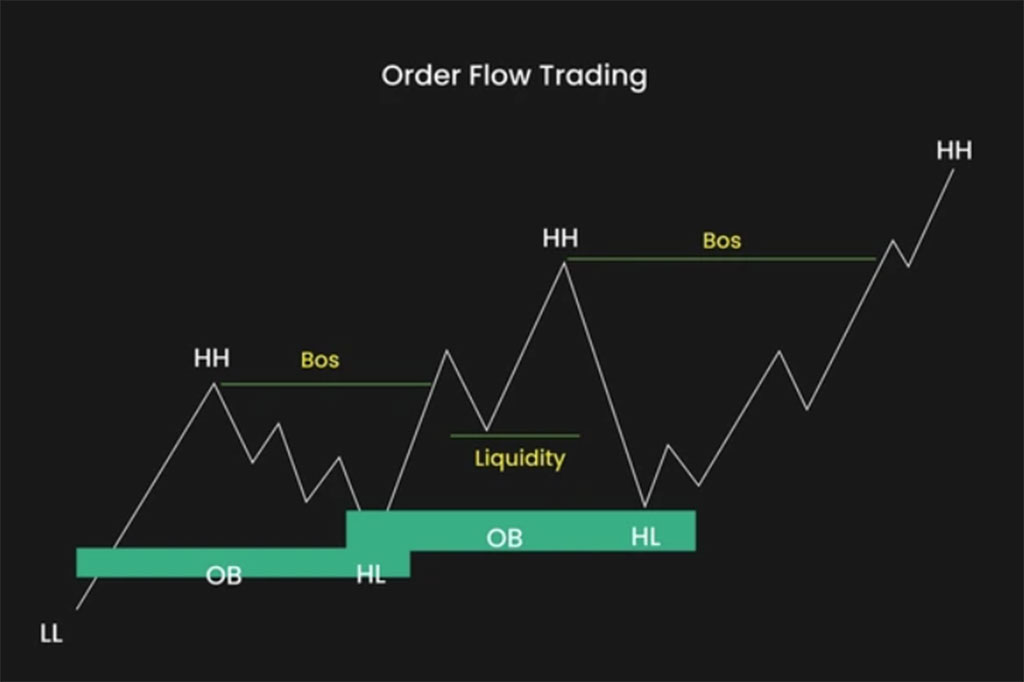
How Institutions Use Order Flow
Institutions don’t trade like retail traders. Their size forces them to approach the market differently. Large players rely heavily on institutional order flow to enter and exit positions efficiently.
They cannot place all their orders at once. Instead, they build positions gradually in areas with enough liquidity. This is why order flow helps you understand where institutions might be active.
For example, if price stops rising despite strong buying, it may indicate that large sellers are absorbing those orders.
Institutions also use order flow to manage risk and avoid slippage. They often move price toward liquidity zones to fill their positions. This is closely connected to what is liquidity in trading, since liquidity determines how easily large institutions can execute massive orders without causing major price disruption.
This behavior is part of how markets function at a deeper level. Understanding it gives you insight into the forces driving price movement.
Order Flow vs Price Action
There’s a point in your trading journey where you’re probably going to think, “Should I be looking at Order Flow or Price Action?” The truth is there is no competition between them. Both are observing the same markets but from different perspectives.
Price Action will show you what has happened. Price Action will give you a very clean representation of the price chart (highs, lows, trends and key levels). Because of this, many traders prefer trading with Price Action because it is easy to read and has a visual component and is straightforward to understand.
Order Flow will show you what is happening right now. Order Flow provides an opportunity to witness exactly how buyers and sellers are interacting in the real-time. It also allows you to observe the conflict between buyers and sellers, as it is taking place, rather than waiting until it has happened (for confirmation).
For example, you could look at a football game by observing the final scores and highlights (Price Action) or you could watch a football game live (Order Flow) and witness each pass, tackle, and momentum shift.
This difference is why many traders gravitate to Flow Trading. They simply want more detail, more context and more information regarding the movement of price.
Another key difference is time. Price Action often requires some sort of confirmation – you need to wait for the candle to close or create a candlestick (to make sure that the price level or pattern has broken) before taking a trade. With Order Flow, however, you can begin to see potential trades before that move becomes visible on the Price Chart or before the price level or pattern has closed on the Price Chart.
That said, that doesn’t automatically put it above all other ways of reading Order Flow – many traders who are new to trading often struggle to read Order Flow efficiently; whilst some newer traders might have difficulty; the volatility of the information displayed can seem excessive and therefore may take longer to lead your intuition to quality relationships that you’ve created between the market and price.
Unlike Order Flow, Price Action is less complex to learn and use; therefore you are provided with defined structural levels to assist you in understanding where a security is heading without creating too much disturbance in the market.
This is where the idea of volume vs order flow becomes important. Volume shows how much trading activity has occurred, while order flow shows how that activity is happening who is pushing, who is absorbing, and where the pressure is.
In practice, many traders combine both approaches. They use price action to identify key levels and trends, then use order flow to refine their entries.
For example, you might see price approaching a strong support level. Price action tells you it’s an important zone. Order flow then shows you whether buyers are actually stepping in.
This combination can improve your decision-making. You’re not relying on one perspective you’re using both to confirm each other.
It also highlights why understanding what is forex broker matters, because order flow traders depend heavily on accurate execution speeds, spreads, and reliable market data when making fast decisions.
Another important point is simplicity. You don’t need to choose one and ignore the other. Instead, you can use price action as your foundation and add order flow as a tool.
Over time, you’ll develop your own balance. Some traders rely more on price action, others more on order flow. What matters is consistency.
In simple terms, price action shows the result, and order flow shows the process. Understanding both gives you a deeper view of the market.
Reading Market Volume and Flow
Now that you know how to differentiate between price action and order flow and you also know how to read the various elements of each type of data you can now take the next step and learn how to read the order flow data itself. This is where it becomes more practical to start using these forms of data in order to gain an advantage in trading.
At first, there may seem like an overwhelming amount of data when looking at order flow because of the fast-moving numbers and how often they change. But essentially you’re only need to answer one question when determining who has a better order flow; ‘who has control – buyers or sellers?’
That brings us to the point of using order flow analysis to answer that question based on patterns in the data as opposed to solely looking at numbers. Are there a significant number of buy orders versus sell orders? Is there an overwhelming number of sell orders? These types of small clues give you larger clues as it relates to how price will move.
One area to use with order flow analysis is to look for imbalances between buying and selling orders. When there are many more buy orders than sell orders in the market price will typically tend to rise, while when there is a large imbalance between selling and buying order, prices typically drop. Being able to identify these imbalances will help you anticipate future price movement.
Another key element is absorption. This happens when one side of the market absorbs the other. For example, buyers keep pushing price up, but it doesn’t move much. This can mean large sellers are quietly holding the level.
This is often a sign of potential reversal. Even though it looks like buying pressure is strong, the lack of movement tells you something else is happening behind the scenes.
Understanding the relationship between volume vs order flow also helps here. Volume tells you how much trading activity has happened, while order flow shows how that activity is distributed between buyers and sellers.
For example, high volume with little price movement often signals absorption. High volume with strong movement suggests momentum.
Another helpful tool is the footprint chart. It shows you where trades are happening within each candle, giving you a deeper view of market activity.
You might also use the Depth of Market (DOM), which displays pending orders. This helps you see where liquidity is sitting and how it might affect price movement.
At first, you don’t need to use every tool. Focus on simple observations: where is pressure building, and where is it slowing down?
It’s also important to combine this with structure. Order flow alone can be noisy, but when you use it around key levels, it becomes much more meaningful.
For example, if price reaches a strong resistance level and you see selling pressure increasing, that’s a stronger signal than just looking at the level alone.
Another tip is to be patient. Order flow changes quickly, and reacting too fast can lead to mistakes. Wait for clear patterns to form before making decisions.
Over time, your ability to read flow will improve. You’ll start to recognize familiar behaviors and react with more confidence.
In simple terms, reading volume and flow is about understanding the battle between buyers and sellers. Once you see that battle clearly, the market becomes much easier to interpret.
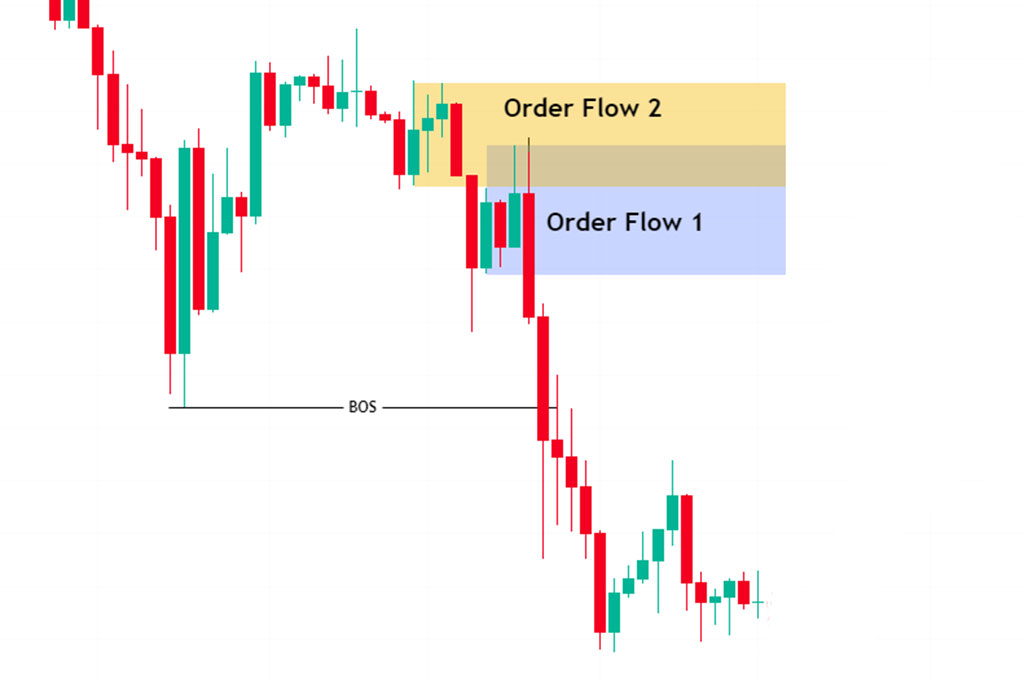
Order Flow Trading Strategies
A good order flow strategy starts with identifying key levels. Once price reaches those levels, you observe real-time behavior. In trending markets, strong order flow confirms continuation.
In reversal setups, absorption or imbalance can signal a turning point. This is where flow trading becomes practical you react to what the market shows.
Waiting for confirmation improves timing and reduces risk. Combining order flow with structure creates a balanced approach. Over time, consistency becomes the key to success.
Many traders also combine order flow analysis with best forex indicators to help confirm momentum, trends, or potential reversals before entering trades.
Limitations of Order Flow Trading
Order flow is powerful, but it has limitations. It can be complex and overwhelming for beginners. Data quality varies depending on your broker.
Forex markets are decentralized, so order flow data may be incomplete. Overanalysis can also become a problem.
Order flow requires time, practice, and discipline. It should be used alongside structure, not as a replacement. Understanding its limits helps you use it more effectively.
Conclusion
The order flow trading method provides a more in-depth understanding of the marketplace than simply reacting to price movements; however, using order flow allows us to better understand what causes those price movements by looking at the buying and selling of assets to give us insights into how the market is behaving, something many traders don’t see.
While order flow is an enhancement of other methods and does not replace them, it is important to develop your skill at using order flow as part of your trading methodology by continuously practicing, remaining patient, and exhibiting self-discipline.
FAQ
Yes, with proper discipline and risk management, it can be effective.
Yes, especially in futures markets, though access in forex is more limited.
Footprint charts, DOM, and volume analysis tools are commonly used.
It can be challenging, but beginners can learn it step by step with practice.
Share
Hot topics

STP, NDD, ECN and DMA: Broker Execution Models Decoded
When picking a forex broker, we don’t just look at the brokerage that has the lowest spreads, bonuses, and other kind of what is apparent for us. There is one...
Read more




Submit comment
Your email address will not be published. Required fields are marked *