
ICT vs Smart Money: What’s the Real Difference?
Introduction
If you’ve been learning trading for a while, you’ve probably seen traders debating ICT and Smart Money concepts. At first, they seem almost identical. Both talk about institutions, liquidity, and how the market is “manipulated.” So naturally, many beginners ask the same question: are they actually different, or just two names for the same idea?
This is where things get interesting. While ICT and Smart Money share the same foundation, they are not exactly the same. One is more structured, the other more flexible. One gives you a detailed roadmap, while the other gives you a broader way of thinking about the market.
People get confused because smart money is based on ICT. So, smart money is actually different from ICT when traders are comparing smart money vs ICT. When looking at these two terms together, you have to consider them from a general philosophy (smart money) and a specific system (ICT).
An analogy would be if you are learning how to drive; smart money is understanding the roads (how traffic works) traffic patterns, and traffic behavior. While ICT is having an instructor tell you exactly when and how to make a left turn, stop, and accelerate.
The other reason this subject is important is that your strategy directly influences your perception of the market; some traders like structure and rules; others prefer flexibility and interpretation.
This article is not about choosing a side. This article will assist you in understanding both clearly enough so that you can determine which one works best with your personality and trading style.
It’s also worth noting that both approaches can be combined with tools like best forex indicators, even though they mainly rely on price action.
Your trading environment also matters. Choosing a reliable broker like Otet Market can affect execution quality, spreads, and overall trading experience.
And if you’ve explored different approaches like lit style in forex, you’ll notice that trading strategies keep evolving. ICT and SMC are simply two of the most popular frameworks today.
What Is ICT Trading Strategy?
The ICT trading strategy is a price action–based approach that focuses on understanding how institutional traders move the market, rather than relying on traditional indicators or random signals.
Instead of asking “what is price doing?”, ICT teaches you to ask “why is price moving this way?” This shift in thinking helps you see the market more clearly.
A key idea in the ICT trading strategy is liquidity. The market constantly searches for areas where orders are sitting usually stop losses or pending entries.
This explains why price often behaves in confusing ways. For example, it may break a level, trigger stops, and then reverse. This is often a liquidity grab, not a random move.
Market structure is another important part. ICT traders study how price forms higher highs, lower lows, and structure breaks to understand direction.
Timing also plays a major role. ICT focuses on high-activity sessions where institutional traders are most active.
The strategy also includes tools like fair value gaps and order blocks, which help traders find precise entry points.
This structured approach is what defines ICT. It gives traders a clear framework to follow instead of relying on guesswork.
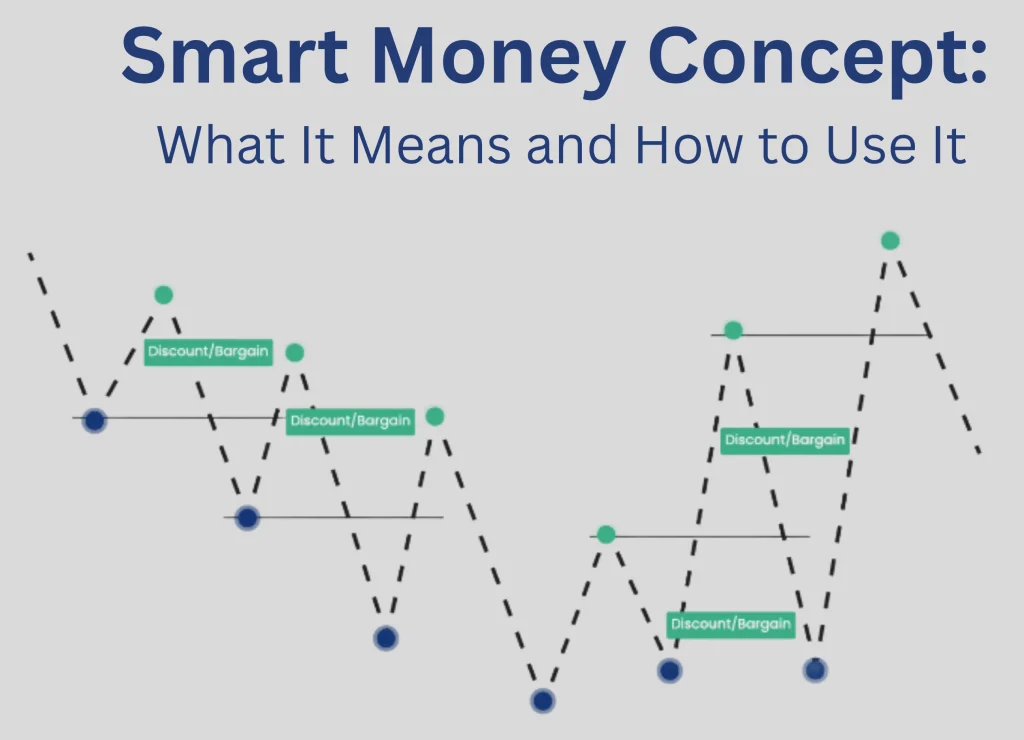
What Is Smart Money Concept?
The Smart Money Concept, often called SMC, is a way of understanding how financial markets really operate behind the scenes. Instead of focusing on indicators or simple patterns, it looks at how large institutions like banks and hedge funds move price.
The smart money principle is founded on one basic idea: that it is large players (not retail traders) that drive the market. These institutions have enough capital at their disposal to cause price changes and their actions can be discerned on the charts.
For many novice traders this is an epiphany because they no longer guess at random but rather use price behaviour in conjunction with level analysis to anticipate future price movement. Hence, you begin to notice that the majority of price movements are done with forethought as opposed to serendipitously.
One of the most important elements in SMC is liquidity. Just like in ICT, the market moves toward areas where orders are concentrated. These areas often include equal highs, equal lows, and obvious support or resistance zones.
For example, when many traders place stop losses above a resistance level, that area becomes a liquidity pool. Price may move upward to trigger those stops before reversing. This behavior is a core part of how smart money operates.
Another key concept is accumulation and distribution. Institutions don’t enter trades all at once. Instead, they build positions over time. During this process, price may move sideways, creating what looks like a range to retail traders.
Once enough liquidity is collected, the market often makes a strong move in one direction. This is when traders start noticing trends, but by then, institutions are already positioned.
SMC also focuses heavily on market structure. Just like ICT, it uses higher highs, lower lows, and breaks of structure to understand direction. However, it tends to be more flexible in interpretation.
SMC’s flexibility is a key advantage. Instead of having rigid rules to follow, traders should learn how to assess market opportunities in terms of context and modify their trades accordingly. For some traders, using this method may be more intuitive.
However, this same flexibility can be problematic for new traders as there are no exact rules to follow. As such, it may be easy to misinterpret price movement. Traders can properly interpret price movement by looking at the same chart but coming to different conclusions.
These types of comparisons often lead to discussions around the differences between the ICT and Smart Money Concepts. While the ICT provides a larger amount of structure in terms of how you should trade, the SMC offers more room for individual interpretation.
An additional aspect of SMC includes understanding market manipulation. The price on the chart can sometimes move in a way that causes retail traders to buy into a false breakout before moving back in line with what the underlying trend was or continue moving against the overall direction of the trend. To avoid making poor trading decisions, it is important to recognize these types of traps.
For example, when looking at a chart, a trader may notice a breakout followed by a quick reversal and assume that this was an indication that the earlier breakout was false when it may have only been a tactical method of obtaining liquidity prior to continuing along with the trend.
By recognizing this type of market behaviour, a trader can change their reaction to the market and instead of simply reacting to a chart they will be able to anticipate price movements based on overall market activity.
Some traders use a combination of tools or indicators along with their SMC strategy to assist in confirmation or validation, however, the actual core of SMC is solely based on price alone and therefore adaptable to any level of trader or trading style.
In summary, SMC allows for traders to analyse price behaviour from a deeper level instead of only looking at the surface level and also to understand what the motivation behind the movement in price was. SMC provides the foundation for traders to evolve from being reactive traders to being forecast traders.
Similarities Between ICT and SMC
ICT and Smart Money Concept share many core ideas, which is why they often feel similar.
Both focus on institutional behavior and how large players move the market.
Liquidity is central to both approaches. Price moves toward areas where orders are sitting.
Both methods use market structure to determine direction and identify opportunities.
They also recognize manipulation moves designed to trap retail traders before continuing.
This is why comparisons like smart money vs ICT are so common. They are built on the same foundation.
Both approaches rely on price action rather than indicators.
They also encourage patience, waiting for high-probability setups instead of trading constantly.
In simple terms, they are speaking the same language but with slightly different styles.
Key Differences in Approach
The main difference ICT and SMC comes down to structure and execution style.
ICT is highly structured. It provides clear rules, entry models, and timing strategies.
SMC is more flexible. It gives you concepts but allows you to interpret the market freely.
This is why many traders compare ICT vs SMC forex when choosing a strategy.
ICT focuses on precise entries, often using defined models and timing windows.
SMC traders may enter based on general ideas rather than strict rules.
Learning style also differs. ICT may feel complex at first but becomes consistent over time.
SMC is easier to grasp initially but may lack clarity for beginners.
This leads to the common question: which is better ICT or SMC? The answer depends on your personality and learning style.
Which Strategy Is Better for Beginners?
For beginners, simplicity is key. You need a method that helps you understand the market without overwhelming you.
SMC is often easier to start with because it focuses on general concepts.
However, ICT offers more structure, which can help beginners avoid confusion.
This makes it more of a trading styles comparison than a competition.
If you prefer clear rules, ICT might be better. If you prefer flexibility, SMC may suit you more.
A practical approach is to learn SMC first, then use ICT for precise entries.
Consistency is more important than the strategy itself. Stick with one approach long enough to understand it.
Risk management and patience are essential regardless of the method you choose.
How to Combine ICT and SMC
By now, you’ve probably noticed something important ICT and Smart Money Concept are not competitors. They are actually very compatible. When used together, they can create a much stronger and more complete trading approach.
Think of SMC as your foundation. It helps you understand the overall behavior of the market how liquidity works, how institutions operate, and why price moves the way it does. This gives you the big picture.
Then comes ICT. This is where you refine your execution. ICT takes those broad ideas and turns them into specific entry models, timing windows, and structured setups. It adds precision to your decisions.
This combination is what many traders are really looking for when they explore ICT strategy vs smart money. Instead of choosing one over the other, you can use both to complement each other.
A simple way to combine them is to start with SMC for analysis. Look at the market and identify key liquidity areas, structure direction, and potential manipulation zones.
Once you have that context, switch to ICT for execution. Wait for a liquidity sweep, a shift in structure, and a clear entry model. This helps you avoid entering trades too early.
For example, let’s say SMC shows that price is approaching a strong liquidity zone. Instead of jumping into a trade immediately, you wait. Then, using ICT, you look for confirmation like a structure break or a fair value gap entry.
This approach helps reduce false signals. You’re not just guessing based on a general idea you’re waiting for the market to confirm your analysis.
Another benefit of combining both is confidence. When two methods point to the same idea, it strengthens your decision-making. You’re no longer relying on a single perspective.
SMC gives you the ability to be flexible. For instance, if market conditions change, you can still execute trades and manage the order flow in a structured way by utilizing SMC concepts and maintaining your structured execution through ICT. It is crucial, however, that you do not overcomplicate your decision-making process by combining strategies. Instead of combining all your strategies together, the objective is to create a developed and straightforward method of making decisions.
The key is to start small; have SMC determine direction then execute your trade using the simplest ICT trade entry model. As you continue to build experience, you can develop more complex approaches.
Another tool available to you for building experience with the SMC/ICT concept is to review your trades and how the two methods worked together. Did you identify the liquidity level correctly? Did your entry fit within the parameters of the ICT model? Using this information to reflect upon allows you to make faster progress.
Over time, you’ll naturally develop your own style. Some traders lean more toward ICT, while others rely more on SMC. The balance is different for everyone.
In simple terms, SMC tells you what the market is doing, and ICT shows you how to trade it. When you combine both, you get a clearer, more structured approach.
Conclusion
Many modern SMC concepts overlap with ICT principles.; however, they both share a common theme: All market participants (particularly large institutions) have some level of control over the market.
Structured execution models, precision, and structure are all benefits you will receive from ICT, whereas Smart Money provides you with flexibility and increased knowledge of the underlying behavior of the market.
When you compare Smart Money vs ICT, many times traders believe them to be oppositional; however, they are two levels of the same idea (one level having a more detailed definition than the other).
The best place for a beginner to start is by learning first and refining your execution later. Do not be in a hurry to jump to the more complicated parts of trading, rather take the time to build your foundational knowledge over time.
In time you will discover what is best for you. Some traders may want to create strict rules under which they will trade, while others want to be free to trade as they desire. There are no right or wrong answers to this question, just many different answers.
Ultimately, whichever way you decide to go about it, remain consistent and manage your risks appropriately, while also continuing to learn from your trades.
Both Smart Money and ICT can be great tools in helping you become a successful trader, provided you maintain the patience and practice necessary.
FAQs
Are ICT and Smart Money the same?
No, ICT is a structured system, while SMC is a broader concept.
Which is more profitable ICT or SMC?
Both can be profitable with proper risk management and consistency.
Can I use both strategies together?
Yes, combining them is often the most effective approach.
Which one is easier to learn?
SMC is easier at first, but ICT provides more structure once mastered.
Share
Hot topics

STP, NDD, ECN and DMA: Broker Execution Models Decoded
When picking a forex broker, we don’t just look at the brokerage that has the lowest spreads, bonuses, and other kind of what is apparent for us. There is one...
Read more




Submit comment
Your email address will not be published. Required fields are marked *