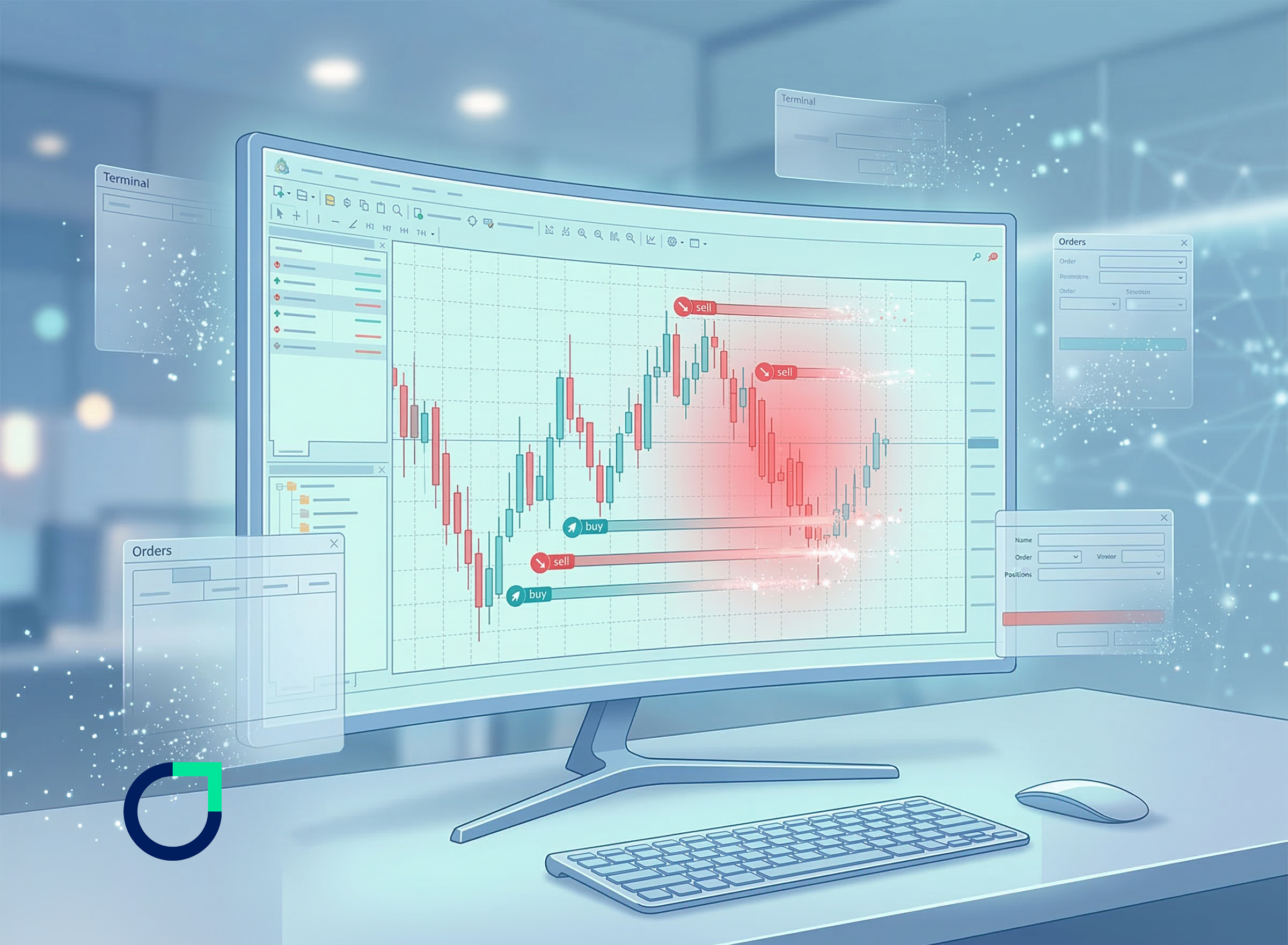
What is a Stop Out in Trading?
Introduction
If you’ve been trading for some time, you’ve likely heard experienced traders mention margin protection. This area is often overlooked when opening a trading account. Many novice traders focus on strategies, indicators, and pinpointing ideal trade entries.
However, there is something more important behind each trade: risk control.
Consider opening many positions at once. Everything seems perfect at first, but suddenly the market moves rapidly against you. The automatic closing of these positions is referred to as stop out. Understanding how stop outs work is essential for any trader looking to succeed long-term.
This article discusses how stop outs are implemented, why brokers will stop out trades, and how to prevent them from occurring in your own account. Finally, you will have a better grasp of how stop outs impact your trading and how to manage your account effectively so as to reduce the risk associated with stop outs.
Stop Out Meaning
A Stop out is a mechanism brokers use to prevent traders from falling into a negative balance. When the equity in your trading account goes below a certain percentage of the margin needed to open your positions, the broker will automatically start closing your trades without asking permission.
It is a way to protect both the broker and the trader from large losses. Most brokers define this as a percentage of the margin level. Once your margin level is below the stop-out level, the system will close your positions, starting with the most unprofitable positions first.
Here’s an example:
Imagine you have $1,000 in your account and open several leveraged positions. If the market moves against you and your equity decreases significantly, your margin level might fall below the broker’s threshold. At that point, the system will automatically start closing your positions.
It is not punishment. It is a safety system.
Many trading platforms—particularly professional platforms such as cTrader Accounts—display margin levels in real time, allowing traders to manage their risk before reaching the specified limit. Understanding this early on allows traders to avoid disappointment later.
Why Stop Out Exists
(The Broker Protection Mechanism)
Trading using leverage enables traders to handle positions greater than their real capital. While this can increase profit, it can also increase risks.
Without protective safeguards in place, losses can quickly exceed an account’s balance. That is why automatic liquidation mechanisms are so crucial.
Every open position exposes the broker to risk. If the market moves quickly and traders are unable to cover their losses, the broker may be held accountable for the deficit.
To avoid this situation, brokers use automatic liquidation systems. Think of it as a safety valve. When equity gets too low, positions are liquidated to prevent the account from collapsing totally.
- This mechanism secures many parties:
- The trader’s account balance.
- The broker’s financial exposure
- The trading climate is stable.
Even reputable brokers such as Otet markets function under strict risk management frameworks that include having defined automatic liquidation levels as an industry standard. These systems provide a mechanism for reducing the overall risk associated with leveraged trading.
How Stop Out Works in Forex
To understand how this procedure works, we must first comprehend the idea of margin level.
The margin level is calculated using the following formula:
Margin Level = (Equity ÷ Used Margin) × 100
This percentage tells the trading platform about the current level of security for your account.
For example:
- Equity: $800.
- Used Margin: $400.
- Margin Level = 200%.
This is regarded as highly healthy.
However, if the market goes against your order, your equity may decrease. If your equity drops to $200 but your used margin remains at $400, your margin level will be 50%.
At some point, the broker’s liquidation threshold is met. Once that level is reached, the algorithm initiates the forex stop-out procedure. Positions close automatically, starting with the trade with the highest loss.
This will continue until the margin level increases above the threshold. On contemporary trading platforms, the procedure is completely automated and takes only milliseconds.
Stop Out vs. Margin Call
Many traders confuse margin calls with stop-out incidents, which are not the same thing. A margin call is basically a warning. It indicates your margin level has fallen to the point where your broker warns you that risk is rising. At this point, you have control of your positions.
You may decide to:
- Deposit funds
- Close some positions
- Reduce your exposure.
Forced liquidation, on the other hand, occurs once the issue has reached a critical point. At that point, the broker’s system comes in automatically. There are no further warnings or negotiations. Trades are closed quickly to protect the account.
Most professional traders do not wait for this to occur because they manage their risk actively.
Stop Out vs. Stop Loss
Stop losses and stop-outs are often confused by people. They sound similar, yet they have quite different functions.
A stop loss is a trading strategy set by the trader. It is used in a specific deal to restrict possible losses. For example, if you buy EUR/USD at 1.1000, you may set a stop loss at 1.0950.
If the market hits that price, your position will close immediately. This is a calculated risk decision.
On the other hand, a stop-out scenario is not related to a particular position. It applies to the whole account.
It only happens when account equity becomes dangerously low relative to the margin level. Professional traders rely heavily on stop-loss orders to keep their accounts from ever reaching that point.
Understanding the differences between these two approaches is an essential part of responsible trading.
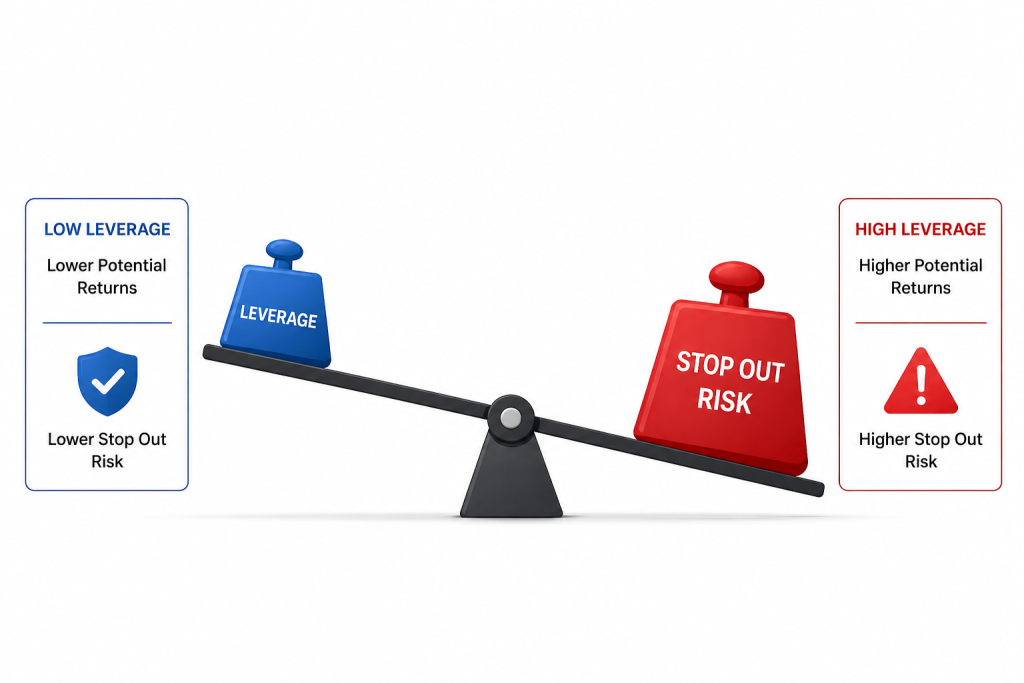
The Impact of Leverage on Stop Out Risk
Leverage is one of the most effective trading instruments. It enables traders to manage positions that are several times larger than their deposit. However, immense power carries significant risk.
Higher leverage reduces your margin need, allowing you to open larger trades, but even small price changes can have a significant impact on your equity.
For example:
With 1:30 leverage, a $1,000 account might control $30,000 worth of currency.
With a leverage of 1:500, the same account might control $500,000.
This difference significantly increases the likelihood of triggering a forex stop out if the market moves unexpectedly. Many beginner traders regard high leverage as a positive trait. Experienced traders see it as a tool that must be used with caution.
How Volatility and Whipsaws Trigger Stop Out
Markets very rarely move in straight lines. Instead, they move in waves. These waves can occasionally become violent. Economic news, geopolitical crises, and unexpected liquidity adjustments can all result in rapid price movements. These movements often create what traders call sudden swings.
A sudden swing happens when the price moves unpredictably in one direction and then immediately reverses. If a trader is excessively leveraged during these times, their account equity might fall dramatically.
This is one of the most typical situations in which traders are forced to liquidate. Understanding market structure fundamentals, like what is order block can assist traders in identifying zones where volatility may occur. Institutional order flow frequently concentrates around these zones.
Being aware of them enables traders to place their orders and manage their accounts more safely.
How to Avoid Getting Stopped Out
Most stop-out conditions are avoidable, and the good news is that traders who manage their risk appropriately and use discipline to trade have much better chances of reducing the possibility of their account reaching significant levels.
Below are some important strategies used by professional traders.
– Proper Position Sizing
One of the most common mistakes beginner traders make is placing orders that are too large for their account.
Even the best strategy cannot protect you from poor size selections.
Many experts stick to standard guidelines such as The 1% Rule in Forex Risk Management, which recommends risking no more than 1% of your account on any single trade.
This method enables traders to weather losing streaks without causing significant harm to their capital.
While this may seem to be a conservative method of trading, consistency tends to be on the side of risk management/disciplined traders.
– Lowering Leverage
High leverage may appear appealing at first, but decreasing it can significantly reduce account risk. Lower leverage equals higher margin requirements, which naturally restricts the size of positions you may open. This functions as a built-in safety system.
Many expert traders choose to minimize their leverage even when their broker provides larger ratios. It reduces profit potential marginally but prevents massive losses.
– Maintaining Healthy Free Margin
The free margin serves as a cushion to secure your account. It reflects your accessible funds to resist market movements. A good trading account often keeps a comfortable margin level far above the risky area.
This indicates that you should not open positions with the entire balance at once. Leaving breathing room permits your trades to proceed without driving the account into liquidation.
– Using Hedging Strategies
Some traders employ hedging strategies to limit exposure in unpredictable market situations. Hedging means opening positions that partially offset current positions. For example, if a trader has a large long position in a currency pair, they may open a small short position during significant news releases.
This strategy can help to stabilize account equity during times of extreme volatility. However, hedging should be applied with caution and a defined plan. When done appropriately, it may serve as an additional level of risk management.
Is a Higher Stop Out Level Safer?
The level at which brokers have their stop-out thresholds varies. The threshold level can vary from 20%-50% and can be lower than this as well. At first sight, a lower threshold may appear more appealing since it permits positions to remain open longer. It is not necessarily safer.
In fact, having a higher stop-out threshold can actually help to protect the trader by closing out a position earlier to prevent additional losses. It works as an early warning system. Traders should consider these factors when selecting a broker since they affect how the trading environment acts during volatile periods.
Ultimately, the safest strategy is to avoid using the stop-out mechanism at all. It should be seen as a last resort, not a typical trade conclusion.
Conclusion
Trading is frequently presented as an environment of opportunity, and in many respects it is. But, behind every winning strategy is something even more important: risk management. Understanding how account protection functions is an important step toward being a competent trader.
A stop-out event may seem scary, but it is there to ensure that both the trader and the broker remain financially stable. When combined with adequate position sizing, controlled leverage, and a focused approach, most traders barely face one.
The true goal is to manage risk in a way that permits you to remain in the game long enough to succeed. And in trading, survival always takes priority over profits.
FAQ
Can a broker reverse a stop out?
In most cases, no. The process is automated and executed by the trading platform once margin thresholds are reached.
Because it is a system-driven liquidation process, brokers typically cannot reverse the closed trades.
Only in rare cases involving technical errors might a broker review the situation.
What happens to my account after a stop out?
After positions are closed, the remaining equity stays in your account.
If the liquidation successfully prevents the balance from going negative, trading can continue once sufficient margin becomes available again.
However, many traders choose to pause and reassess their strategy before opening new positions.
What is a typical stop-out level?
Most forex brokers use stop-out levels between 20% and 50% of the margin level.
The exact threshold depends on the broker’s risk policies and the trading platform used.
Traders should always check these details in their account specifications.
How can I reduce stop-out risk?
The most effective way to reduce risk is through strong risk management practices.
This includes controlling leverage, limiting position size, maintaining healthy margin levels, and avoiding excessive exposure during volatile market events.
Consistent discipline is the best protection any trader can have.
Share
Hot topics

The Best Indicators for Trading in Forex
Introduction Every trader remembers the first time they used a trading platform chart. At first, it looks simple—a price simply moving up and down—but the more you watch, the more...
Read more



Submit comment
Your email address will not be published. Required fields are marked *