
What is a Floating Spread in Forex?
Introduction
If you’ve ever placed an order and noticed the price changes slightly as it’s executed, you’ve experienced spreads in forex trading. Many beginners find this confusing. They enter a trade that looks successful, only to see a small loss appear immediately on their platform.
The spread refers to the small difference between buying and selling prices. It is one of the primary ways brokers earn money by giving access to the financial markets.
While all brokers use spreads, each broker develops its business model differently. Some brokers have fixed spreads, which stay constant regardless of market movement or the trade’s price at entry. This is called a fixed spread.
Alternatively, some brokers use floating spreads that change every time the market moves based on supply and demand. These spreads can increase and decrease depending on how much demand/supply exists at the time of the trade.
For a new forex trader who is just starting to learn about the mechanics of the market, it’s important to understand the term spread. The cost of entering and exiting trades can influence profitability, the trading strategy selected, and risk management.
When you hear traders mention liquidity, volatility, and market sessions, you should understand that everything mentioned will affect spreads in real time. This means sometimes the spread will be extremely tight, while sometimes unexpectedly wide.
Within today’s modern trading environment and especially when using a metatrader5 account, spreads fluctuate based on changes in market activity; therefore, these dynamic spreads generally reflect how real liquidity flows through the global currency market.
Understanding the concept of What is floating spread and how it works will help you to avoid any surprises when making trading decisions. This will also help you to select the suitable broker based on your priorities and strategy, as well as the right time to trade.
Before we get into strategies and comparisons, let’s discuss the mechanics of spreads and why they exist in the first place.
How Floating Spreads Work
Prices in the forex market fluctuate regularly. Banks, hedge funds, institutional traders, and retail traders all place orders simultaneously. Because of the ongoing flow of orders, the spread between the buying price and the selling price is never fully steady.
This dynamic price differential is precisely what distinguishes floating spread forex situations.
High liquidity occurs when there is a high number of participants trading in one market (currency pair). As buyers and sellers compete to match orders at a fair price, the spread rate decreases.
When there are fewer participants involved in trading an individual currency pair in the forex market, the spread generally becomes wider due to the limited number of price points available to conduct business. Therefore, as fewer participants continue conducting business, the forex market would have to create a wider spread to identify the difference between buyer and seller.
Due to this volume of activity, prices fluctuate frequently, and spreads are different depending on the time of day. During the major trading sessions, such as the London-New York overlap, spreads are usually at their lowest.
On the contrary, during quieter times in the forex market, such as late Asian trading hours or on holidays, liquidity decreases, and spreads can widen significantly.
If you ever wondered what is floating spread, the answer is very simple: a floating spread is not fixed and constantly changes according to supply and demand, and overall market liquidity available to trade.
Floating spreads mirror the actual conditions of the interbank forex market, as currency prices are constantly changing as competing institutions provide liquidity.
Why Do Forex Brokers Use Floating Spreads?
Many current forex brokers prefer floating spreads because they more accurately reflect global market conditions. Rather than giving an artificial fixed price differential, floating spreads enable prices to move naturally.
- Access to Real Market Liquidity
Due to floating spreads, forex brokers are able to connect their customers directly with institutional liquidity providers like banks and other financial institutions. This means that prices are derived directly from the market rather than being manually adjusted by the broker.
- More Competitive Pricing
Traders can frequently benefit from lower spreads when there is a higher volume of trading activity since they will have the ability to compare prices across multiple liquidity providers and choose the provider with the lowest spread at any given time.
- Transparent Trading Conditions
Floating spreads better reflect the true supply/demand of the marketplace. As the volatility in markets increases, floating spreads will automatically widen. When there are more active traders in the market, spreads tighten.
This provides traders with a more accurate picture of market conditions.
Compatibility with Modern Platforms
Most forex brokers that utilize modern trading technology support floating spreads on their trading platforms. For example, a forex trader using a metatrader5 account would be able, at any time on their account, to view live changes in floating spreads on their trading charts.
Some brokers, such as otet broker, use floating spreads because they align closely with institutional trading conditions.
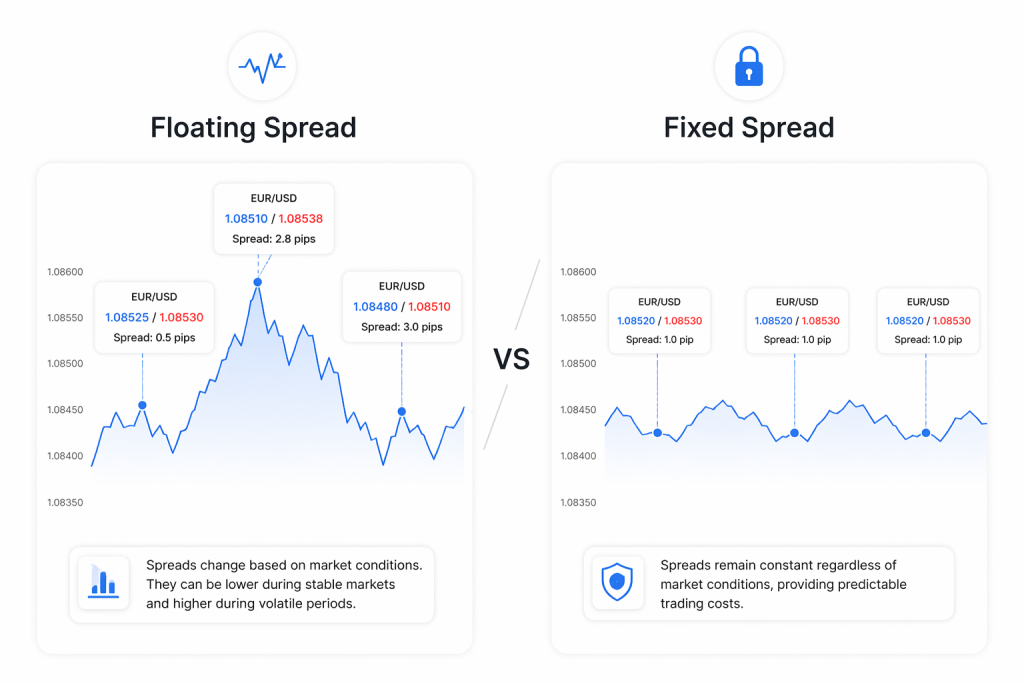
Floating Spread vs. Fixed Spread: Key Differences
One of the biggest questions beginner traders have is whether a floating spread is better than a fixed spread. Either model has some advantages; it all depends on the strategy a trader uses.
Below is a comparison that highlights the main differences between the two:
| Feature | Floating Spread | Fixed Spread |
| Price Behavior | Changes constantly with market liquidity | Remains constant under normal conditions |
| Typical Spread Size | Often tighter during active sessions | Usually wider but predictable |
| Reaction to News | Can widen significantly | Usually remains fixed |
| Market Transparency | Reflects real market conditions | Broker sets the spread |
| Suitable for | Experienced traders and scalpers | Beginners seeking predictability |
Floating spreads often attract traders who focus on what is spread trading, where very small price differences and execution costs are extremely important.
While spreads can also tighten significantly over a short period of time, this allows some strategies to operate with lower transaction costs than in fixed-spread environments.
Advantages and Disadvantages of Floating Spreads
Floating spreads have several benefits, but they may also bring up certain issues. Understanding both sides helps you determine whether this pricing model is appropriate for your trading style.
Advantages
- Lower Trading Costs During Active Markets
During high liquidity periods, spreads can become very tight. This is a benefit as it effectively reduces your cost of opening and closing trades.
- Real Market Pricing
Floating spreads represent the actual supply and demand conditions in the global market.
Being transparent might be valuable to traders seeking a precise market price.
- Better for High-Frequency Strategies
Scalpers and algorithmic traders tend to prefer floating spreads, where ultra-low spreads can be achieved at times during the peak trading hours.
Disadvantages
- Spread Widening During Volatility
One of the most significant disadvantages of floating spreads is that they might widen unexpectedly.
This commonly occurs due to significant economic announcements or unexpected geopolitical events.
- Less Predictability
Unlike fixed spreads, floating spreads cannot be predicted ahead of time. As a result, traders will need to observe the market closely and carefully to make trading decisions.
- Potential Slippage During Fast Markets
When markets move quickly, spreads can widen rapidly, affecting order execution.
This is particularly relevant to traders who are trading around major news announcements.
How Floating Spreads Affect Different Trading Strategies
Various trading styles will respond differently to floating spreads.
Longer-term traders will not experience significant impacts from spreads expanding or contracting since their trades last for hours, days, or even weeks. However, shorter-term traders like scalpers or day traders are much more impacted by changes in spreads.
Swing traders, for example, tend to focus on large price movements. A one or two pip variation in spread generally has little effect on their overall profitability. That’s why for short-term traders, even small spread changes might matter.
Challenges for Scalpers and Day Traders
Scalpers attempt to achieve small price movements with each trade; therefore, spreads are significant in considering whether the trade is profitable.
If spreads widen unexpectedly, scalpers will find it difficult to meet their trade profit targets.
Day traders similarly face challenges associated with spreads, particularly during a high-volatility market.
Therefore, experienced short-term traders carefully monitor market sessions and liquidity conditions prior to placing any order.
Effective Risk Management for Variable Spreads
Trading in a floating spread environment requires effective risk management. Spreads can change rapidly; traders must adjust their strategies accordingly.
Choosing the Right Trading Sessions (Market Overlaps)
The best time to trade would be during a time when one or more of the global sessions overlap. For example, the London-New York overlap provides high liquidity for the trader.
During this time, spreads are usually tighter, and price movements are more predictable.
Setting Logical Stop-Losses to Avoid Spikes
Traders should not place stop-loss orders too close to their entry price.
Sudden spread expansions could lead to stops even if the market has not moved against the trader.
Allowing a suitable margin helps to avoid unnecessary losses.
Position Sizing in Volatile Conditions
High volatility in the market typically means wider spreads. In a situation where large price movements occur, a trader may consider reducing their position size to minimize their overall risk. Making this small adjustment to their position size could help protect their capital during a period of large fluctuations.
When Do Spreads Widen Most?
spreads typically widen during times of low liquidity or increased volatility.
Major economic news events are a common cause. When important data such as interest rate decisions or employment reports are released, the market reacts immediately.
Liquidity providers may temporarily expand spreads to protect themselves from sharp price fluctuations.
Another common scenario takes place during calm market hours.
Late Asian sessions, weekend openings, and holiday times frequently attract fewer market participants. The spreads naturally widen as liquidity becomes more limited.
Understanding these timing trends allows traders to avoid placing orders when spreads tend to be unusually wide.
For this reason, professional traders frequently review the economic calendar before trading. Avoiding large news releases might limit your exposure to sudden spread increases.
In practice, most traders become comfortable with floating spreads once they observe how spreads behave during different market sessions. Watching the spread column on your trading platform for a few days can reveal useful patterns. Over time, this awareness helps traders choose better entry moments and avoid periods of unusually high trading costs.
Conclusion
Spreads are an important part of forex trading, yet many beginners ignore their significance.
Understanding floating spread conditions may help traders manage costs more effectively, develop better strategies, and prevent unnecessary surprises.
Floating spreads, unlike fixed spreads, are continually changing in response to liquidity and market activity.
This dynamic pricing model represents the actual dynamics of the global currency market, where prices are constantly adjusted based on supply and demand.
For many traders, floating spreads provide considerable benefits. They frequently provide lower costs during active market periods and more transparent pricing.
However, they also need a higher understanding of market timing and volatility.
Traders may make better trading decisions by understanding how spreads behave during trading sessions, news events, and liquidity cycles.
Finally, understanding spreads is more than just calculating trading costs. It’s about understanding how the market works.
Once traders are familiar with this notion, they’ve gained a better understanding of how forex pricing actually works.
FAQ
Which type of broker typically offers the lowest floating spreads?
ECN and STP brokers typically offer the lowest floating spreads because they connect traders directly to liquidity providers.
These brokers aggregate prices from multiple financial institutions, which creates a competitive pricing environment.
What are the best hours to trade to ensure the tightest floating spreads?
The tightest spreads usually occur during the London–New York session overlap.
This period has the highest trading volume in the global forex market, which increases liquidity and reduces spreads.
Why is there an immediate loss shown as soon as I open a trade with a floating spread?
The immediate loss occurs because trades open at the Ask price but can only close at the Bid price.
The difference between these two prices is the spread, which represents the transaction cost of entering the trade.
Share
Hot topics
RSI vs MACD: Key Differences, Strategies, and Which One Is Better?
Introduction In reviewing the charts used for trading, you likely see numerous indicators on the charts. Indicators include identifying the direction of the trend, monitoring momentum in prices, and identifying...
Read more




Submit comment
Your email address will not be published. Required fields are marked *