what is Pip in Forex?
When you look at currency prices fluctuating on a trading platform, you have likely noticed one interesting thing: while the amounts may change only by a small percentage, traders seem to react to these small changes as though they are significant.
These small changes are referred to as “pips,” and understanding them is one of the first steps in becoming a confident trader. If you cannot define what a pip is, it will be almost impossible for you to calculate profit, manage your risk, and evaluate your performance correctly.
Many traders initially focus on charts and strategies when seeking ways to achieve success. However, before you begin to learn about indicators or complicated systems, there is a very important question you must ask yourself: What is pip in forex?
Once you understand the concept of pip, everything else associated with trading becomes simpler. In this article, we will break down the concept of pip step-by-step so that you can understand what it is all about.
What Does Pip Stand For in Forex?
The term “pip” means “Percentage in Points” the standard measurement used for price movements in the forex market.
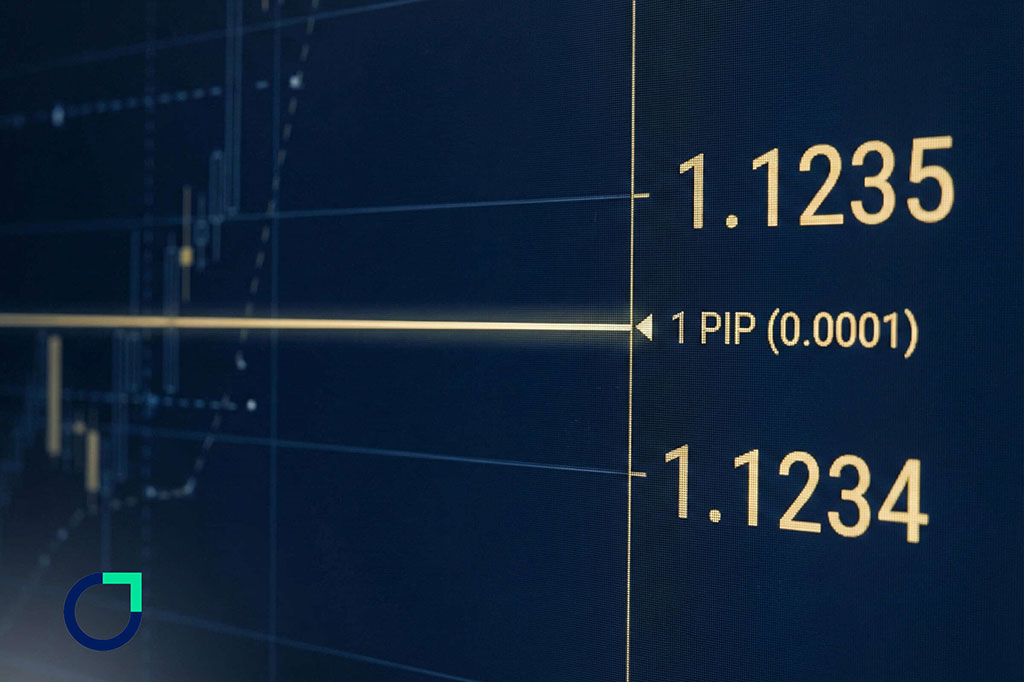
Typically, a pip is the 4th decimal place of currency pairs. For example, when EUR/USD rises from 1.1000 to 1.1001, there has been a price move of 1 pip.
Pips allow traders to track even the smallest price change in an accurate and consistent way. Rather than counting along a long stream of decimal numbers, traders can simply track pips, compare trades, and review performance this way.
Pips Meaning in Trading
Simply put, a pip is the smallest standardized price movement in a currency pair.
Pips are used by traders as a means of tracking their earnings, losses, spreads, and risk. Instead of saying “I gained 0.0020″, they will say “I gained 20 pips”. This is neater, clearer, and widely understood.
If someone tells you that they try to obtain 30 pips per trade, they are specifying their goal in an easily understandable unit of measure. This makes it easier to communicate and plan.
How Pips Work in Currency Pairs
The majority of currency pairs are quoted to four decimal digits.
For example: EUR/USD = 1.1050.
Here, if the EUR/USD price moves from 1.1050 to 1.1055, it indicates a move of 5 pips.
However, pairs involving the Japanese yen differ slightly. They are typically quoted to two decimal places.
For example: USD/JPY = 110.25
If it moves to 110.26, that’s one pip.
Once you understand how pip values differ between pairs, calculation mistakes become much less likely. Although the difference may seem small, calculation errors can become costly in real trading.
That’s why many traders eventually ask: What is a pip in a forex strategy? Because all trading strategies require a trader to measure pips, whether that strategy is a short-term scalping method or a long-term swing trading guide.
What Is a Pipette (Fractional Pip)?
Brokers’ advancements in trading technology began to lead to more accurate price quotations, which is what pipettes do.
A pipette is the tenth (1/10) of a pip. A pip is the fourth decimal place for an instrument, and a pipette is the fifth decimal place.
For instance:
EUR/USD = 1.10508
Here, the last number, which is 8, is a pipette.
The use of pipettes allows for more accurate pricing as well as tighter spreads between bid and ask prices.
Difference Between Pip and Pipette
A pip is the standard measurement. A pipette is a fractional version of it.
If EUR/USD moves from 1.10508 to 1.10518, that’s one pip (or ten pipettes).
Most brokers these days, including those platforms we use in a metatrader5 account, show pipettes automatically, so when you eyeball charts on metatrader5 platforms, you’re seeing very precise prices.
For starting out, it’s fine to focus mainly on pips. Pipettes are useful but basically just a subtle variation on pips.
How to Calculate Pip Value (Step-by-Step)
Knowing what a pip is isn’t enough. You also need to know how much it’s worth in money. The value of a pip depends on three things:
- The currency pair
- The lot size
- Your account currency
Let’s simplify it.
For most USD-based accounts trading EUR/USD:
- 1 standard lot (100,000 units) = $10 per pip
- 1 mini lot (10,000 units) = $1 per pip
- 1 micro lot (1,000 units) = $0.10 per pip
Factors Affecting Pip Value
Several factors affect pip value:
- Lot size
- The exchange rate
- The base and quote currency
- Your account currency
The currency in which your account is denominated
For example, trading USD/JPY will result in different pip values than trading EUR/USD. This is why professional traders always determine risk before they enter a trade.
Pip Value by Lot Size
Here’s a simple breakdown for EUR/USD:
- Standard lot = $10 per pip
- Mini lot = $1 per pip
- Micro lot = $0.10 per pip
If you earn 20 pips on a standard lot, you make $200.
If you lose 20 pips, you lose $200.
It’s straightforward once you understand the relationship.
Pip Value Formula
The general formula is:
Pip Value = (One Pip / Exchange Rate) × Lot Size
In most USD pairs, this will equal the fixed figures we’ve discussed, but it’s useful to know the formula when dealing with cross pairs, such as GBP/JPY.
Converting Pip Value to Account Currency
If your account isn’t in USD, conversion may be needed.
For example, if your account is in EUR but you trade USD/JPY, the final pip value must be converted into euros using the current exchange rate.
Most modern brokers do this automatically. Whether you are using Otet Markets or any other broker, the platform normally displays the current profit or loss for your trades as stated in your account currency.
Knowing how pip value works helps you position your trades more accurately.
Why Pips Are Important in Forex Trading
Pips are not just numbers. They are the foundation of trading decisions.
-
Measuring Spread
The spread is the difference between the bid and ask price.
If EUR/USD shows:
Bid: 1.1050
Ask: 1.1052
That’s a 2-pip spread.
This is the cost of entering the trade. Lower spreads generally mean lower trading costs.
-
Setting Stop-Loss and Take-Profit
Instead of saying “I’ll risk $100,” traders usually say, “I’ll risk 20 pips.”
This keeps the focus on market structure, rather than money alone.
For example, if your strategy has a target of 40 pips and a risk of 20, then your risk-to-reward is 1:2.
That’s far more meaningful than random dollar values assigned to a trade.
-
Risk Management Using Pips
When managing risk, professional traders think in both percentages and pips.
For example, if your stop-loss is 25 pips for a mini lot ($1/pip) trade, you will be at risk of $25.
However, if you trade a standard lot with a 25-pip stop, your risk increases to $250. This is an example of how the combination of lot size and pip distance will determine trading risk.
-
Measuring Trading Performance in Pips
Many professional traders track performance in pips rather than in money.
Why? Because money changes depending on your lot size.
If you made 300 pips in a month, that number remains constant regardless of position size. It tells you more about your skill than profit.
Real Examples of Pip Calculation
Here are some practical examples of applying some of what you’ve learned.
1- EUR/USD Trade
You buy EUR/USD at 1.1000.
You close at 1.1025.
That’s a 25-pip gain.
If you traded:
- Standard lot → $250 profit
- Mini lot → $25 profit
Now imagine your stop-loss was 20 pips. This is where understanding Pip in Forex can be applied to real-world trade, not just as a theoretical concept.
2- USD/JPY Trade
You buy USD/JPY at 110.20.
You sell at 110.50.
That’s a 30-pip move.
Keep in mind that when you are trading with yen pairs, the second decimal is considered a pip. Your profit will also depend on the lot size being traded, but you will still consider the movement from entry to exit as being 30 pips.
Can Pips Be Used in Gold, Crypto, and Indices?
Yes, but definitions can differ slightly.
Gold (XAU/USD) often uses a pip equal to 0.01 price movement. Many traders ask: How Much Is One Gold Pip Worth in USD?
The answer depends on the lot size. For many brokers:
1 lot of gold = $1 per 0.01 movement.
Cryptocurrency and indices also have pip-like measurements, although they could be referred to as “points”.
The same principle applies, a unit of measure that is standardised for determining price movements.
Even trading commodities or crypto with metatrader5 platforms, pip measurement is at the center of risk management.
Common Mistakes Beginners Make With Pips
Even though the concept of a pip is simple, many beginners misunderstand how it affects real trades. The most common mistake is confusing pips with money.
For example, two traders may both make 20 pips on a trade. One trader might earn $20, while another earns $200. The difference isn’t the pip movement — it’s the lot size. Without understanding that connection, new traders often overestimate or underestimate their actual risk.
Another common mistake is not allowing enough room in pips when placing stop-loss orders. Some traders focus only on the dollar amount they’re willing to risk instead of giving the trade enough room to breathe.
There is also confusion when switching between currency pairs. A 20-pip move on EUR/USD may feel very different from a 20-pip move on GBP/JPY due to volatility differences. The pip measurement remains the same, but the speed and behavior of the pair can change the experience.
Beginners also sometimes forget that spreads are measured in pips. If your target is 10 pips and the spread is 3 pips, you are effectively working with a smaller margin than you might think. That difference matters over time.
Managing pip distance properly is the foundation of position sizing and risk control. That’s what allows traders to place logical stop-loss levels and manage trades effectively.
When traders understand how pips relate to lot size, their decisions become more structured and consistent. Structured decisions lead to better trading results.
Over time, thinking in pips also helps you detach emotionally from money. Instead of reacting to dollar gains and losses, you begin evaluating trades based on structure and probability. This shift in mindset is subtle but powerful. It encourages discipline, reduces impulsive decisions, and helps you focus on long-term consistency rather than short-term outcomes.
Conclusion
Pips may seem like a small detail, but they form the foundation of trading.
Before using any indicator or trading strategy, you must know how to measure price movement.
When you truly understand pips, trading stops feeling random. You begin to see structure, measure risk properly, and make decisions based on numbers instead of emotions.
If you understand what a pip is in Forex, you gain clarity. Clarity leads to better planning, better risk management, and better overall results.
Trading won’t become easy overnight. But with a solid foundation in the basics, everything else becomes easier to learn and apply.
FAQ
A pip is the standard unit used to measure price movement in currency pairs. In most pairs, it represents the fourth decimal place.
Multiply the number of pips gained or lost by the pip value based on your lot size. For example, 20 pips on a standard lot of EUR/USD equals $200.
Yes. While the exact definition may differ slightly, gold, crypto, and indices use pip-like measurements (often called points) to track price movement.
Share
Hot topics
What is Balance in Forex? A Complete Guide for Traders
Introduction When you open a trading account for the first time, one of the first numbers you see on your screen is your balance. It looks simple. It looks clear....
Read more


Submit comment
Your email address will not be published. Required fields are marked *