What Is the Martingale Strategy in Forex?
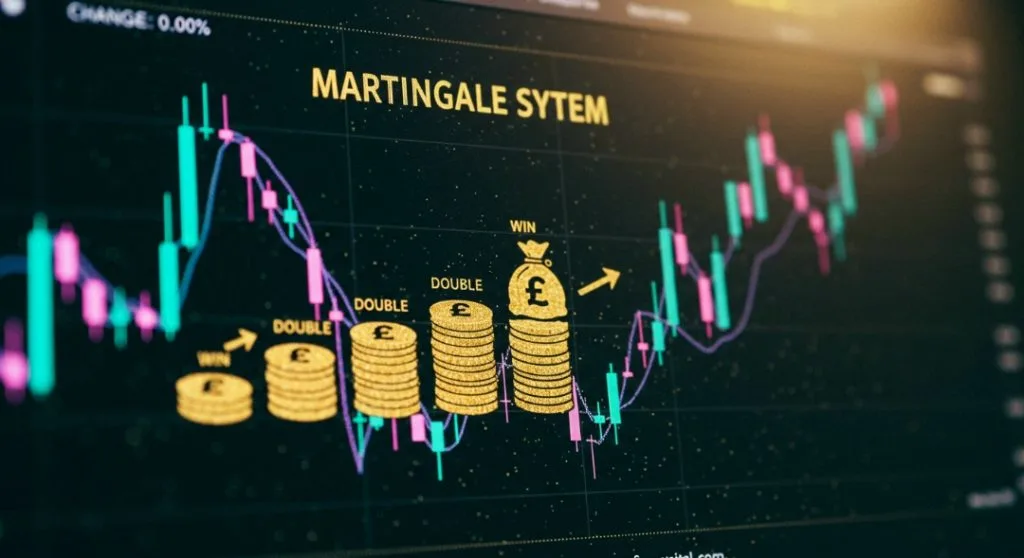
When traders first learn of the Martingale strategy, they often find it to be a magical idea. That is, if you lose, you double the amount of your next trade. A win will eventually let you recover all of your lost trades. On paper, it feels logical, but it is way more complicated in real trading conditions.
At OTET Markets, we believe education should be grounded in truth and accessible to all. In this article, we will attempt to help you understand what the Martingale Strategy is in Forex trading, why some traders prefer it, and what you can realistically expect if you choose to use it.
This article is written as a friendly discussion, not a technical manual, and aims to complement your learning as a fellow trader with experience on both sides of trading. Let’s explore the Martingale strategy in depth.
The Simple Idea Behind Martingale
The Martingale theory is not something that originated from the forex market; it originally came from the world of gambling. Players would double their bet after every loss, with the idea that if they continued doubling their bet, they would eventually win enough money to cover all the losses.
Once this idea was introduced into trading, it became known as martingale trading, with the concept of increasing your position size rather than doubling your casino bet after losing a trade.
This method of trading gives traders a structured, disciplined way to trade rather than guessing. When using this method of trading, you’re not making random guesses as to when to trade; you are using a predetermined set of rules, and this sense of control is one of the reasons traders are attracted to martingale trading.

How Martingale Looks in a Forex Trade
Imagine you open a EUR/USD position and the market has moved against you, hitting your stop loss. Based on the Martingale strategy, you now open another position to re-enter the market in the same direction, but at an increased lot size.
If that trade loses, you will further increase the lot size again. The concept is that when the market eventually turns in your favour, the larger lot size trade recovers your previous losses and makes some profit.
Many Forex traders who use the Martingale strategy have the expectation that the market will inevitably come back. However, this isn’t always the case; sometimes, the trend can continue for a much longer period than they expected.
Why Traders Are Attracted to Martingale
The Martingale strategy appears attractive to traders due to its emotional appeal. Losing trades can be hurtful, but the Martingale idea is to avoid accepting losses immediately. Another reason this strategy can also provide its users with small wins or profits; thus, a series of small recoveries can maintain the stability of an account (in many cases) over a period of several weeks or months.
For this reason, some market participants casually describe it as a forex betting system, even though real trading conditions are far more complex. While traders may experience some short-term profitability using the Martingale strategy, these small incremental profits may also hide long-term risk.
The Role of Probability in Martingale
Martingale strategies depend on the idea that losses and wins even out over time. In theory, if price movements are random, a reversal should eventually happen.
In reality, Forex prices are not purely random in the short term. Factors like interest rates, economic data, central bank decisions, and market sentiment influence them.
A strong trend can push prices in one direction much longer than a trader expects. When this occurs, Martingale exposure increases rapidly.
The Mathematics Traders Often Ignore
Doubling a position appears to be a manageable strategy on paper, but in practice, account size and margin requirements limit how long you can continue. For instance, with a small trade, you will probably feel safe. However, as you continue to experience losses, the size of your position will increase rapidly. The amount of margin you are using will increase, while your available free margin will decrease.
Once a trader has run out of margin, the broker does not consider their strategy and will close their positions automatically.
This highlights the risk in martingale when position sizes increase without strict limits.
Emotional Pressure and Decision Fatigue
Martingale is more than just a financial challenge. It’s also a psychological one. As traders increase their position sizes, they will begin to feel more pressure with each new trade. As a result, any small movement in the market can evoke a strong emotional response.
Many traders abandon their guidelines midway through a Martingale sequence. They close trades prematurely, modify lot sizes, or panic when experiencing drawdowns. At that time, the strategy shifts from systematic to emotional trading.
Why Small Accounts Are Especially Vulnerable
Traders with small accounts often fall for Martingale because the idea of quick recovery and consistent wins seems enticing.
However, small accounts have less margin flexibility for losses. A few losing trades could wipe out months of gains. Ironically, those who need the most protection are often taking the biggest risks.
Martingale vs Market Reality
Forex trading often experiences strong trends around key economic announcements like interest rate decisions or inflation data, and geopolitical news may lead to strong price movements for long periods.
In addition, a Martingale strategy can be at its highest risk during these times because if you increase your position size while trading against the overall trend, you may find yourself in a position that is similar to standing in front of an oncoming train. Even expert traders follow trends. Martingale, by design, frequently battles them.
Given these complications, can traders ever successfully use Martingale? Let’s consider when, if ever, this strategy might be effective. The Martingale method is effective during certain times for short durations. There is low volatility of currency, the market is in a sideways range, and the position size is disciplined.
Some traders have combined the Martingale method with strong technical analysis and allowed only a limited number of repeated actions in their strategy.
Nevertheless, even “modified” Martingale methods still contain significant structural risks. The market can make one large move against you for a long time and eliminate all of your previous steady wins.
The Hidden Cost of “High Win Rate”
Martingale traders may brag about their win percentage, but they close many trades profitably, usually 80% or 90% or higher.
What they fail to mention is the size of the losses. A single large loss can wipe out multiple small wins.
Do not evaluate a strategy by win percentage alone; instead, consider the risk-to-reward ratio and maximum drawdown.
Risk Management and Martingale
True risk management preserves capital first, while Martingale increases exposure as losses are incurred.
Some traders try to limit their exposure to danger by using a maximum number of Martingale steps, which does help; however, it guarantees a loss once the limit is reached. This means that a trader is going to have to take a large loss regardless.
Read More: How to Avoid Overtrading in Forex
Why Beginners Should Be Extra Cautious
New traders tend to underestimate how quickly their losses accumulate. They might test the Martingale strategy on a demo account and be happy with the results they see.
Read More: Best Brokers for Demo Accounts
But demo trading doesn’t account for the real-world emotions of trading. Live trading is very different from demo trading.
This difference becomes even more apparent when traders move from demo environments to real Trading Accounts, where capital is at risk and emotional pressure directly affects decision-making.
Without the experience of handling drawdown or controlling their emotions, new traders will find that the Martingale strategy can be very overwhelming.
The Broker’s Role and Trading Conditions
Execution speed, margin requirements, and leverage will all impact how Martingale works.
Even if all conditions are ideal, no broker can remove the structural risk associated with increasing exposure whilst losing.
This is why learning is more important than promises. To know how a strategy will perform in worst-case scenarios is crucial.
A More Sustainable Perspective on Trading
The consistent performance is what professional traders look for, not quick fixes for recovering from losing positions. Professionals also know that losing trades are part of the normal trading process, and they therefore size their trades accordingly. A single trade going wrong should never put your entire account at risk. The idea is completely contrary to the logic of Martingale.
Professional traders focus on controlling risk, staying patient, and maintaining realistic expectations. Their goal is long-term participation in the market, not short-term recovery from losses. This mindset encourages disciplined position sizing and acceptance of drawdowns as part of trading.
From an educational perspective, traders are encouraged to fully understand strategies before implementing them. Martingale is not always “bad,” although it is usually misunderstood. It is not an instant route to success. It is a high-risk approach that requires discipline, sufficient capital, and emotional resilience, which many traders underestimate. Understanding how markets behave is far more valuable than relying on recovery systems that assume price will eventually move in your favor.
Practical Advice for Curious Traders
If you want to learn about Martingale strategies, start by learning instead of just doing. Study drawdowns, how margin works, and how fast your exposure to risk increases; also, analyse worst cases or scenarios. Above all, ask yourself if you are ready to experience an extended period of losing trades.
A Human Reality Check
All traders want stability. They find reassurance in an always recovering loss.
But the market has no obligation to provide a reversal for anyone. Acknowledging this reality helps traders mature into professional traders.
A trader’s strategy should work because it properly manages risk, and not because they expect the market to eventually cooperate.
A Final Word on Responsibility and Expectations
Over the years, traders have learned that all strategies are associated with a certain amount of responsibility on the part of the traders themselves. The trader using the Martingale strategy, for example, will ultimately determine the outcome, regardless of the rules set forth to help guide their decisions. As such, the trader must have both discipline and good judgment, regardless of which strategy they use.
Most traders are first introduced to the Martingale strategy through a series of online resources, such as forums, automated trading systems, or shared strategies. Unfortunately, the context to fully understand the Martingale strategy is often absent from these discussions.
In order to understand how a strategy works, you must first understand how everything, account size, market condition, and emotional tolerance, affects the behaviour of that strategy.
In forex, success is not usually based on finding a perfect strategy; instead, it depends on the ability of a trader to manage risk, adapt to changing market conditions, and remain consistent with his/her trading approach. You can develop the skills of forex through education, patience, and self-awareness.
By maintaining realistic expectations of themselves and their trading strategies, traders will be able to find success in trading while avoiding systems that promise to offer them recovery through the absence of risk management. This mindset, more than any technique, is what supports long-term participation in the markets.
Final Thoughts
Martingale strategies might frequently appear calm at first glance, but can actually be dangerous. They may feel logical, disciplined, or even thoughtful. However, trading is not just about avoiding loss; it is also about limiting loss.
If you only remember one message from this article, let it be: sustainable trading is based upon your respect for risk. Not your anticipation of recovering losses. That approach will benefit you far more than any system that promises quick wins.
Share
Hot topics
What is Balance in Forex? A Complete Guide for Traders
Introduction When you open a trading account for the first time, one of the first numbers you see on your screen is your balance. It looks simple. It looks clear....
Read more



Submit comment
Your email address will not be published. Required fields are marked *