LIT style in forex
The LIT style in forex is a way of reading the market that focuses on why price moves, not just where it moves.
Rather than following indicators or reacting to candles, LIT evaluates liquidity, the actions of traders, and market traps. When price suddenly squeezes, hits a stop loss, and then moves how it is expected by many traders, there is often confusion for those traders from that sudden spike.
It was created from that frustration to provide clarity to how and why this happens instead of just having people ignore it.
At its core, LIT assumes the market is not random. Price often moves to trigger orders before the real move begins. Once you understand that idea, charts start to feel less chaotic and more intentional.
Read More: What Is Forex ?
What Does LIT Stand For
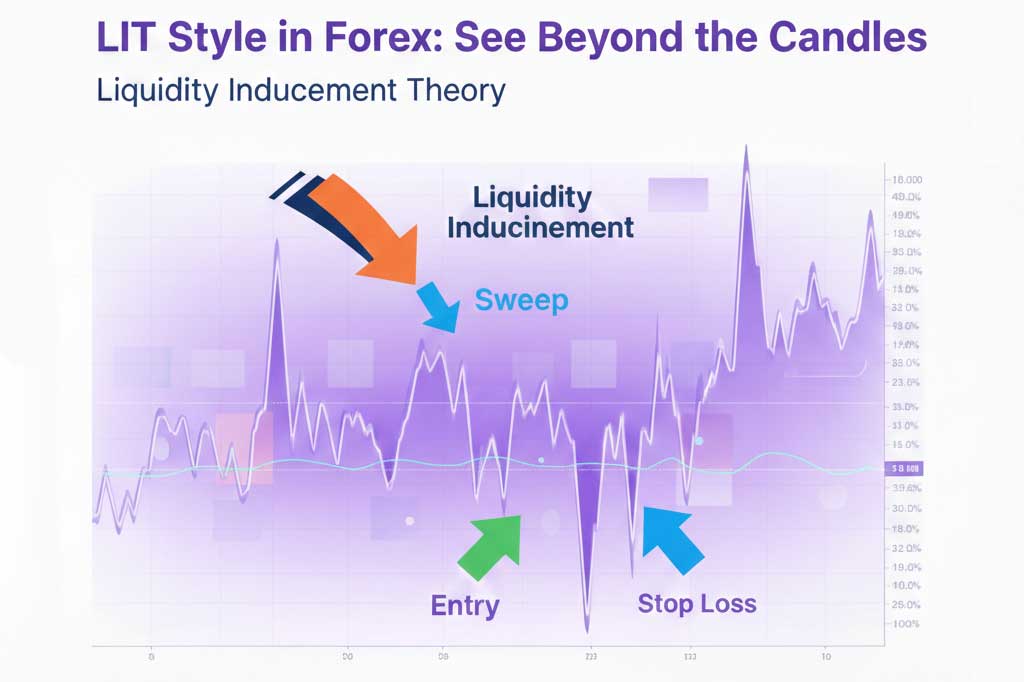
LIT stands for Liquidity Inducement Theory. In simple terms, it studies how price is pushed toward areas where many traders place orders.
These areas are usually obvious: equal highs, equal lows, trendline touches, or breakout levels. Retail traders gather there, and that’s exactly where liquidity builds up.
The market needs liquidity to move efficiently. So before a strong move, price often induces traders into bad positions. That inducement is what LIT traders look for. Instead of being trapped by it, they wait for it.
Core Principles of LIT Trading Strategy
The first principle is that liquidity comes before direction.
Price usually hunts stops and pending orders before committing to a trend.
The second principle is patience.
LIT traders wait for manipulation, not confirmation from lagging tools.
The third principle is context.
A setup only matters if it forms near key highs, lows, or structural levels.
This is why the LIT trading strategy feels calm compared to fast scalping systems. You are not reacting, you are observing and waiting.
How LIT Differs from Other Trading Styles
Many strategies focus on indicators like RSI, MACD, or moving average crosses. LIT focuses on behavior, not calculations. Breakout traders buy when price breaks resistance. LIT traders often wait for that breakout to fail first.
Smart money concepts talk about institutions in abstract terms. LIT keeps it practical: where are traders likely to place orders right now?
Instead of asking “Is this overbought?”, LIT asks, “Who is being trapped here?” That shift in thinking changes how you see every chart.
How LIT Identifies Market Moves and Deception
LIT identifies deception through false intent. Price shows strength in one direction, only to reverse sharply.
Common signs include equal highs or lows being taken quickly. Another sign is a strong candle into a key level, followed by hesitation. This is not randomness. It’s often a liquidity grab. Once liquidity is collected, price can move freely. LIT traders aim to enter after that moment, not before it.
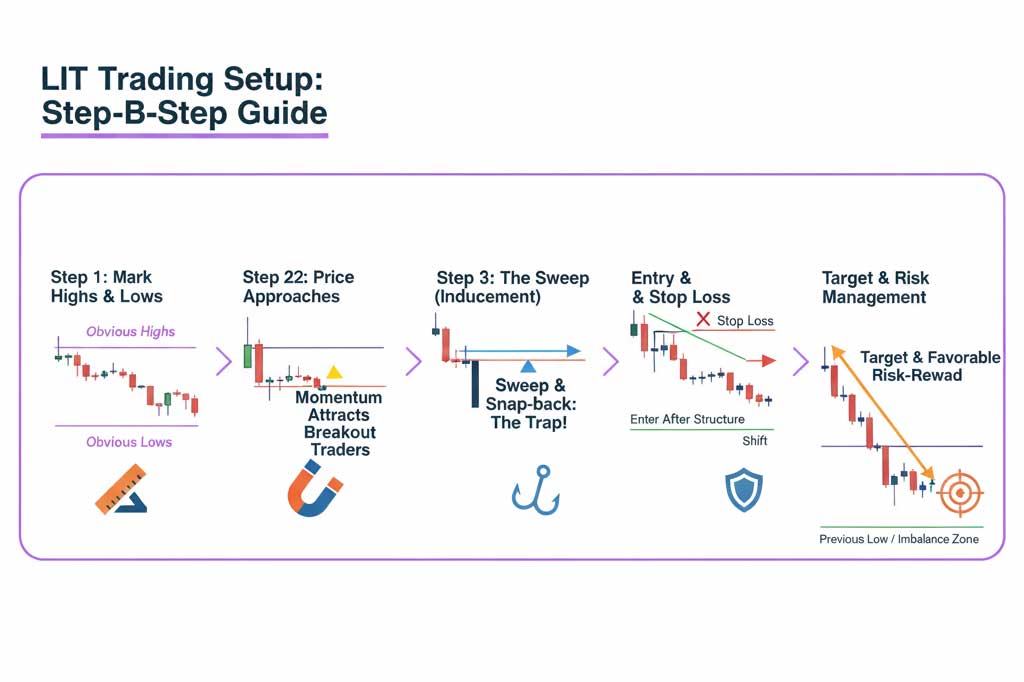
LIT Trading Setup: Step-by-Step Guide
Start by marking obvious highs and lows on higher timeframes. These are areas where stops usually sit.
Next, wait for price to approach those levels with momentum. This attracts breakout traders and early entries.
Watch for a sweep, price briefly moves beyond the level and snaps back. That sweep is the inducement.
Enter after structure shifts in the opposite direction. Stops usually go beyond the inducement high or low. Targets are often previous ranges or imbalance zones. Risk is defined, and emotions stay low.
Examples of LIT Trades
Imagine EUR/USD forming equal highs during London session. Retail traders see resistance and prepare for a breakout. Price spikes above the highs, triggering buy stops. Within minutes, it drops back below the level.
That drop signals the trap. A LIT trader waits for a lower high, then sells. Another example is during news events. Price often moves violently in one direction, then fully reverses. LIT traders don’t trade the news. They trade the liquidity reaction after it.
Tools and Indicators Used in LIT
LIT does not require many indicators. Clean charts work best. Market structure tools are useful: highs, lows, and breaks. Session highs and lows also matter.
Volume can help, but it’s optional. What matters more is where price reacts. Platforms like OTET Markets offer flexible charting and execution tools. Account types and execution speed matter more than fancy indicators. LIT depends on timing, not signal spam.
Benefits of LIT Trading Style
One major benefit is clarity. You stop guessing and start waiting for specific behavior.
Risk-to-reward is often favorable. Stops are tight because entries happen after manipulation.
It also reduces overtrading. You don’t trade all day—only when liquidity is obvious.
Psychologically, it feels empowering. You’re no longer the trader being hunted. For many, the LIT trading strategy brings structure without complexity. It’s simple, but not easy.
Limitations and Risks of LIT
LIT requires patience. If you need constant action, this style can feel slow. It also demands screen time. You must watch how price behaves near levels. Misreading inducement is a real risk. Not every spike is manipulation.
Beginners may overthink setups at first. Without practice, everything can look like a trap. Like any strategy, LIT fails without discipline. Risk management is still non-negotiable.
Conclusion
LIT style in forex is not about secret patterns or hidden indicators. It’s about understanding why the market moves the way it does. By focusing on liquidity, inducement, and behavior, traders gain context. That context turns chaos into something readable.
LIT won’t make trading effortless. But it can make it calmer, clearer, and more intentional. When paired with solid execution and the right trading accounts, it becomes a powerful framework. Not to predict the market—but to stop being surprised by it.
FAQ
In the FX market, LIT trading seeks to identify how prices are driven to become liquid so that traders can then make valid directional moves. Traders who adopt this trading philosophy are looking to identify traps and avoid false breakouts, as well to enter trades after they have been manipulated.
Liquidity Inducement Theory (LIT) explains how markets deliberately move price toward areas where many traders place stops or pending orders. Once that liquidity is collected, price is free to move in its intended direction.
LIT relies mainly on clean price charts, market structure, session highs and lows, and key liquidity zones. Indicators are minimal, as the focus is on behavior rather than calculations.
Beginner traders who are willing to be patient while learning how to analyze the market may find LIT to be a good fit for them, but they will need to practice self-discipline, as well as have the ability to wait for high probability trade setups before executing any trades, rather than just continually executing trades for quick profits.
Share
Hot topics

Gold symbol in forex
Introduction If you have ever opened a trading platform and searched for gold, you probably noticed a specific code instead of the word “gold.” In the forex world, assets are...
Read more




Submit comment
Your email address will not be published. Required fields are marked *