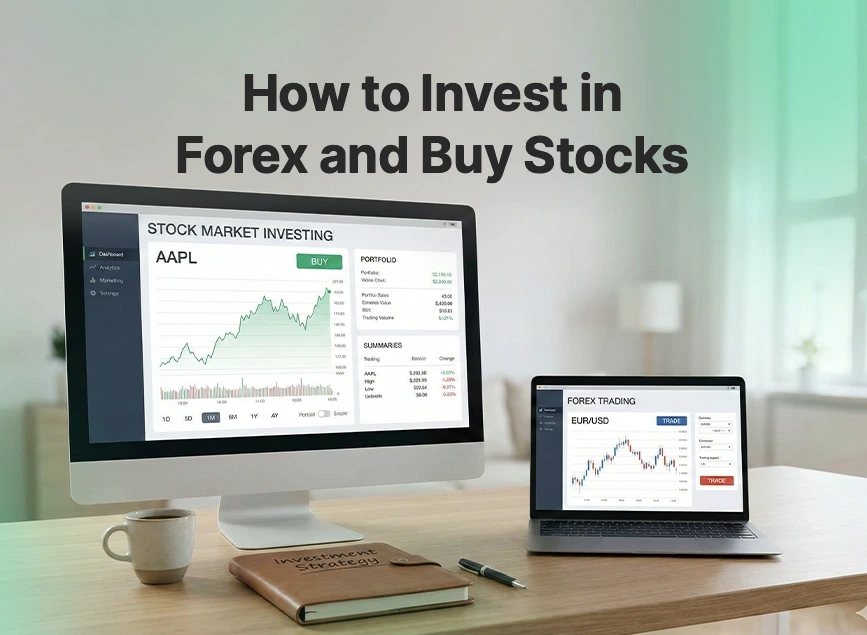
How to Invest in Forex and Buy Stocks?
Investing has become one of the most controversial topics.
Thanks to social media influencers promoting a particular trading platform or ordinary people trying to become financially independent.
It seems like everyone is looking for a way to make money. However, among the many ways to invest or earn money, Forex and stocks are two of the more popular options. Both Forex and stocks can help you build wealth, but they are two entirely different worlds.
If you’ve ever wondered how to invest in Forex or buy a stock (and most importantly, how to invest wisely), I will help guide you through what investing is as simply as possible.
The basics: What does it mean to invest in Forex or a stock?
First, before doing anything, it’s important for you to understand what Forex and stock investments are.
Foreign exchange (Forex) is the world’s marketplace to buy and sell currency. Think of Forex as a super-sized, truly international money exchange where people, businesses, and governments buy and sell currencies to profit from their fluctuating values.
For example: If you believe the euro will strengthen against the US dollar, you could buy euros at the current price now and sell them at the future price to make a profit. That’s Forex trading in a nutshell!
However, stocks represent ownership in a business. If I told you to buy a stock of a company, you are purchasing a small piece of ownership share of that company. Stocks are a “small piece” of that company’s future profits and growth.
While most people know that Forex consists of The concept may appear straightforward, but there are pros and cons for both markets and each have their own unique pacing.
Getting Started: Establishing your foundation.
If your aspirations include investing in Currency or Stocks, the foundation you’ll require is a functioning platform — a broker of some type, or company you are comfortable utilizing to access the market.
If you want to trade Currency, you’ll open an account with a regulated forex broker responsible for currency trading. Most brokers today have demo accounts too which are good for practicing until you feel comfortable using real money.
If you have everyone’s focus on stocks, your trading will most likely happen with an online brokerage account. Some common platforms allow your trading and management of your stocks to happen quickly and easily. The best part regarding the new platforms, they usually do not charge fees or commissions anymore.
Before hitting ‘buy’ just take some time to familiarize yourself with the platform. Familiarize yourself with where the charts are located, how to place trades, how to monitor performance on your trades.
The Mindset: Patience NOT Without Perfection.
An important pitfall most investors, especially newer investors struggle with is expecting immediate returns. Many traders come into the trading world with future dreams of doubling their money overnight and walk away upset from trading at all because the market doesn’t go their way.
Investing successfully has little to do with speed; more about consistency.
In Forex this means being able to learn how to understand how economic news, interest rates or types of global politics affect the use of their currency. In Stocks learning how a company’s performance or investor earnings reporting can affect the price of the stock based on overall market conditions as well.
This isn’t about guesswork; it is How to Make an Investment in Forex: Step-by-Step
If you’ve taken an interest in the currency market, here is a useful guide to follow.
Step 1: Learn the basics.
First of all, you can read a forex investment guide. It should help you get familiar with terms like pips, leverage and margin.
Step 2: Choose your broker.
You want to be sure the broker is a licensed company and regulated by an authority you recognize (for example, the FCA in the UK, or ASIC in Australia). A regulated broker will help you feel comfortable that your funds are protected and that the trading conditions are transparent.
Step 3: Practice first.
Open a demo account to practice before risking your money. This will give you the opportunity to trade, track your results, and accurately recognize what works and what does not work.
Step 4: Start with small amount.
When you move to a live account, then start trading a small amount. The goal of the beginning stage is not to make millions right away, it is to learn, keep your capital intact, and get live trading experience.
Step 5: Follow the news.
Global events impact currency value. You want to pay attention to interest rate decisions, inflation data, and general employment reports. Along the way, you will observe patterns and learn the impact these events will have, as well as understanding why currencies move.
Step 6: How to Buy Stocks: Step-by-Step.
In time, it’s a little more intuitive than Forex once you get through the steps.
Step 1: Choose your broker or app.
Most of the stock brokers today are online brokerages. You should sign up with your broker of choice, verify your identity, and fund your account.
Step 2: Look for companies.
You don’t want to buy a stock just because it is trending on social media. You want to look through the company to understand its history, leverage for profits, competitors and potential.
Step 3: Choose your strategy.
Are you an investor looking to hold your shares for the long term or a trader in search of short-term profit? Typically, a long-term investor is more concerned with growth and dividends presented by the company, whereas a short-term trader is concerned with the price or trend of the stock.
Step 4: Place your order.
Now that you have a company to buy, decide how many shares to purchase. Generally, there are two order types, you can use a “market order” (buy immediately at the current price) or a “limit order” (buy once the price hits a certain level).
Step 5: Track it, don’t overtrack it.
Be sure to check your portfolio regularly. There is no need to panic if the market moved a few percentage points on any particular day. Stocks and the stock market will go up and down within a day or week. Your goal is to stay focused ultimately on your long-term strategy.
Forex vs Stock trading: Which one is right for you?
There is no one answer to that question — it comes down to your personality and lifestyle.
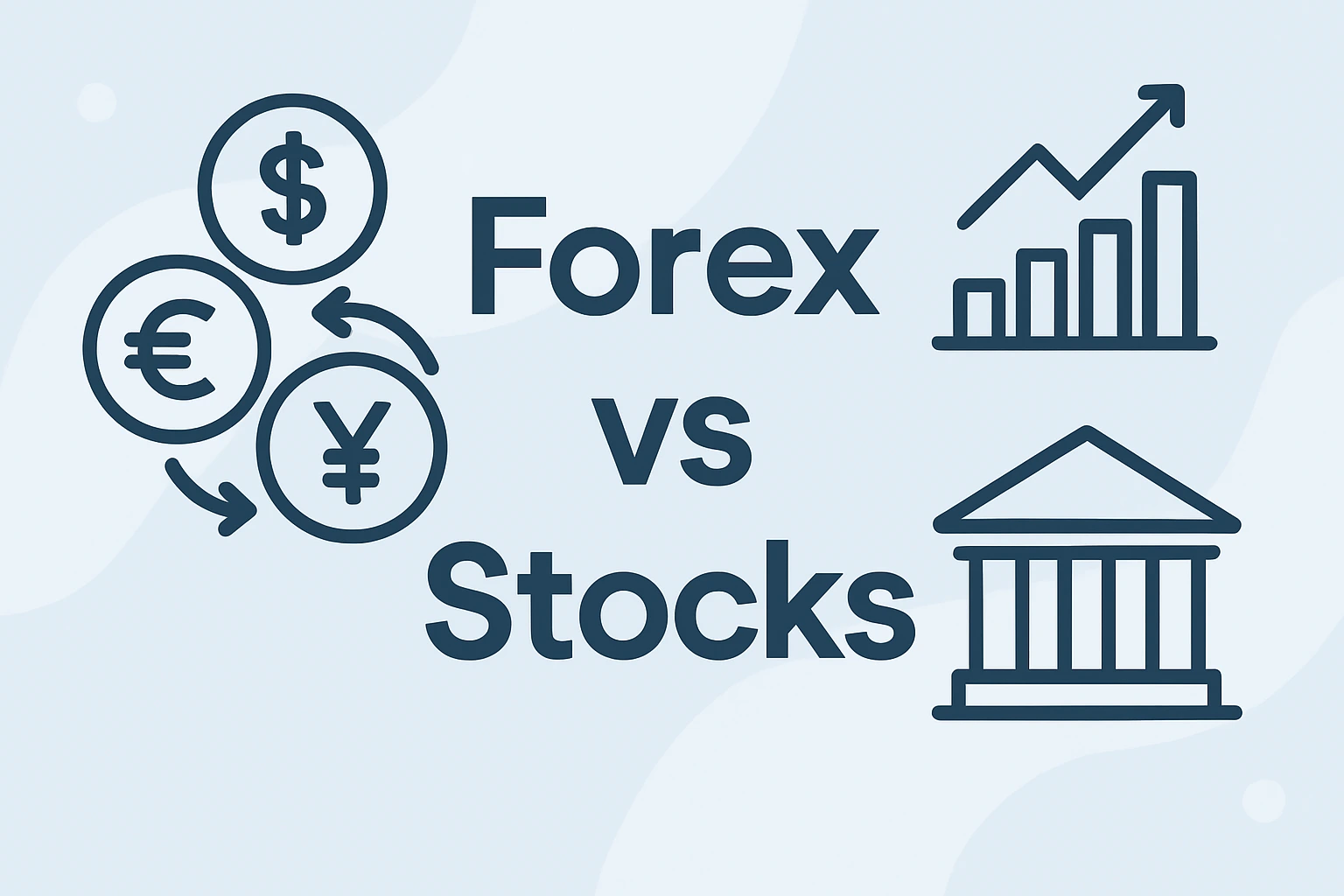
If you like action, you like following the news globally, and you feel comfortable watching the market, then Forex may work for you. Forex is open five days a week 24 hours a day, and currency prices are constantly changing.
If you prefer to invest in something you know, like stocks, rather than volatility, stocks may work better for you. The advantage with stock markets is that they have regular hours and price movement that is easier to manage for somebody with an active schedule.
Sometimes, a simple but effective decision-making tool is to ask yourself the extent to which you want to be involved. Forex vs stock trading is really contingent on your own comfort with volatility.
Some investors even choose both.They keep part of their cash reserves in long-term stocks as a hedge for stability and actively trade Forex in order to find short-term opportunities.
Risk Management: Protect Your Capital
Regardless of the market you engage with, the one principle I will tell you is simple: Do not risk anything you are not willing to lose.
All traders, new or advanced, will lose; the difference is what you do when you are losing a trade.
Use stop-loss orders to automatically close your trade when the market moves against you.
Don’t put all your capital into one position. Move it across multiple instruments.
Discipline is the key. You must avoid making emotional decisions. Markets are unpredictable and chasing losses often leads to bigger mistakes.
Even your simple forex investing guide will agree with those points—risk management is the cornerstone of sustainable success.
Timing and Psychology: The Underneath Complexity
“Buy low, sell high.”
Saying it is one thing, putting it into practice is another.
But realistically, timing the market perfectly is almost impossible. The better approach becomes creating good trading behaviors; for example, research before entering a trade, having a goal, and being patient when prices will move.
Psychological forces play a huge, important role in every financial market. Fear and greed drive behavior examples for everyone. If you learn to control your psychological reactions, you are already ahead of regular traders.
For example, while everyone is panicking and selling during a downturn, a calm investor may see a quality stock buy, at a discount.Online Trading: The Current Benefit
Technology has changed that. Investment is no longer confined to the world of professionals in suits all on Wall Street. Anyone with a smartphone and internet connection can now join in.
Online trading has made investment accessible to millions. You can look up current prices, complete your transaction and track your performance with the click of a button. Many trading platforms also offer educational materials, tutorials, and an online community for those new to investing.
However with the advantage can come disadvantage. The ease of online trading has opened the door to over-trading too. Successful investors treat their online trading platform as a tool, not a toy.
If you use online trading as a tool—have limitations on how much to trade, monitor your progress and continue to learn—you are one of the fortunate fortunate few who has leverage to enhance your financial future like never before.
Nesting the two worlds of investing:
Many smart investors take a hybrid approach and balance both Forex and stock investments.
Stocks are a great way to capture long-term growth and dividends and Forex can put short-term profits into your pocket. Combining both can help you balance your risk and reward.
As an example, you could invest in companies that have been around for a long time, like Apple or Nestlé, for long term value and use some of your money to trade a major currency pair like EUR/USD or USD/JPY with the intent of executing multiple trades for profit, quicker.
This may keep your overall investment experience simple and your portfolio growing. In case one market is at a lull, the other may be your opportunity.Continuous Learning Is Your Best Investment
Markets are always changing. What was right last year might not be right today. That is why continuous education is so valuable.
If you come across a news article, webinar or analyst that seems like a reputable source, make it a point to read or listen to it. The more information you take in, the better educated you will be in your decision making.
Even professionals continue to learn things about the markets every day for years. Treat education like a ongoing investment that builds, just like your portfolio does.
read more: What Is a Forex Broker and What Do They Do
Common Mistakes to Avoid.
Before we wrap up, let’s go over a few favorite traps that many new investors fall into:
Being too confident. If you think you can never lose, you are usually one trade away from making a really bad decision.
Not respecting fees. Commissions, or spreads might not seem like that big of a deal, however over time they always add up.
Following the crowd. Just because something is in the news does not mean it is the right one for you.
Investing without doing research. Never invest in anything when you do not understand it.
Risk management.you should Always use protective tools such as stop-losses, and position sizing.
and remember, investing is not just about predicting the future, it’s about preparing for it.
The Human Side of Investing.
Investing is not just about money however, it is about purpose. Take a moment to ask yourself the purpose of your investing. Are you solely investing for a rainy day? Buying a home? Or investing to build financial freedom?
Having this type of investing goal offers validity, and reasoning behind your decisions, while helping flush out the emotions contained within trading or investing.
Let’s say you begin by investing $100 a month. In the beginning, that investment might seem small. However, as time goes on, and by compounding your investment, it will eventually turn into something meaningful. The key is to start – even if it feels uncomfortable. Just start when you are ready and willing to commit to not selling months or years down the road.
Final Thoughts.
Learning how to invest in forex or stocks is not as complicated as it appears. It just takes time, money, and curiosity. To begin investing, Otet Markets recommend starting small, learning, and treating every decision, win or loss, an opportunity to learn. The financial markets can be unpredictable; however with proper thinking and strategic approach, they can be rewarding.
So, embrace whichever option resonates with you, forex or equity, and remember… The correct definition of success is not luck, it’s proper education, practice, and emotional control.
If you’re ready — take advantage of it! This moment in time will fluctuate, read that forex investment guide, learn and observe the differences along with the positives of trading versus investing, gather as much information as you can about online trading, and ultimately uncover sharing free and risk-free education approaches to build growth in learning, education, and investing to further your financial goals.
Finally! Don’t make the mistake that you can’t start investing without already being an experienced expert, all you need is the courage to jump into it after realizing you also could be like everyone else waiting. You can start investing whenever you have the courage to make the first commitment — and allow time to make that commitment into less in real-term chronological existence.
Share
Hot topics
What is Balance in Forex? A Complete Guide for Traders
Introduction When you open a trading account for the first time, one of the first numbers you see on your screen is your balance. It looks simple. It looks clear....
Read more



Submit comment
Your email address will not be published. Required fields are marked *