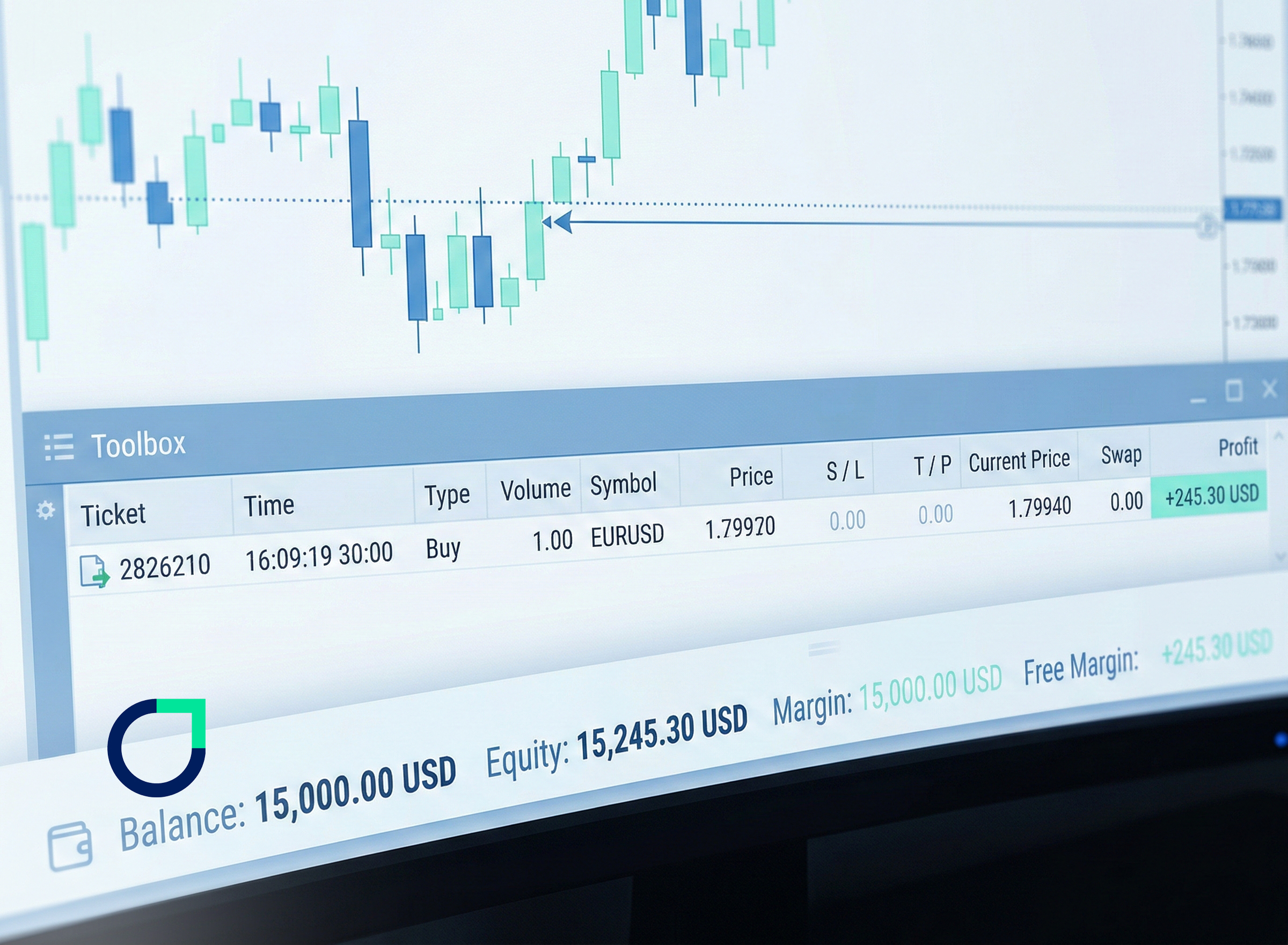
What is Balance in Forex? A Complete Guide for Traders
Introduction
When you open a trading account for the first time, one of the first numbers you see on your screen is your balance. It looks simple. It looks clear. But many beginners misunderstand what it really represents and how it behaves during trading.
If you have ever asked yourself What is Balance in Forex, you are not alone. It is one of the most fundamental yet misunderstood concepts in trading. Traders often confuse balance with equity, margin, or available funds. That confusion can lead to poor risk decisions.
Defining Account Balance
Your account balance in Forex is the total amount of money in your trading account excluding any open trade profits or losses. It reflects your deposited funds plus or minus any closed trade results.
If you deposit $1,000 and close a trade with a $200 profit, your balance becomes $1,200. If you later close a trade with a $100 loss, your balance becomes $1,100.
The key word here is closed. Balance only changes when a trade is finalized. As long as a trade is open, its floating profit or loss does not affect the balance directly.
How is Forex Balance Calculated?
Forex balance is calculated using a simple formula:
Initial Deposit
- Closed Profits
− Closed Losses
− Commissions or Fees
That’s it. There are no hidden components in the calculation itself. However, confusion usually happens because traders look at floating profits and assume their balance should increase immediately.
But floating profit belongs to equity, not balance. We will explain that shortly.
When Does Your Account Balance Actually Change?
Your account balance changes only in three main situations:
- When you deposit or withdraw funds.
- When you close a trade.
- When commissions, swaps, or fees are charged.
Let’s say you open a trade and it is currently showing +$300 floating profit. Your balance will not change until you close that trade. The moment you close it, that $300 becomes realized profit and is added to your balance.
This is why sometimes traders feel confused when they see a profitable trade but their balance remains the same.
What is equity in Forex
Equity is your real-time account value including open trades. It is calculated as:
Balance + Floating Profit − Floating Loss
If your balance is $1,000 and you have an open trade showing +$200, your equity becomes $1,200. If the trade shows −$150, your equity becomes $850.
Equity moves constantly while trades are open. Balance stays stable until trades close.

Difference between balance and equity in trading
Below is a simple comparison table to make it clearer:
Think of balance as your confirmed money. Think of equity as your live account value.
Understanding this difference is critical for risk management. Many margin calls happen because traders focus on balance instead of equity.
| Feature | Balance | Equity |
| Includes open trades? | No | Yes |
| Changes in real time? | No | Yes |
| Updates when trade closes? | Yes | Yes |
| Used for margin calculations? | No | Yes |
| Reflects floating profit/loss? | No | Yes |
Factors That Directly Affect Your Forex Balance
Several elements influence how your balance changes over time.
Closed Trades
Every trade you close either increases or decreases your balance. Consistent profit grows it. Repeated losses reduce it.
Commissions
Some brokers charge a fixed commission per trade. These charges reduce your balance immediately after closing the trade.
Swaps (Overnight Fees)
If you hold a trade overnight, swap fees may apply. These fees are deducted from your balance depending on the position and interest rate differential.
Withdrawals
Any withdrawal reduces your balance directly. Even if you have floating profit, withdrawing reduces confirmed funds.
Broker Conditions
Different brokers may have varying cost structures. For example, platforms like Otet Markets provide specific account conditions that influence how commissions and swaps are applied.
Why Balance is Essential for Effective Risk Management
Balance is the foundation of your trading decisions. It determines how much you can risk per trade and how much margin you can use.
Many professional traders calculate risk as a percentage of balance. For example, risking 1% of a $5,000 balance means risking $50 per trade.
If you ignore balance and focus only on potential profits, you expose yourself to unnecessary risk.
Using Balance for Position Sizing and Margin Calculations
Position sizing depends directly on your balance. If you have a $1,000 balance and you risk 2%, your maximum risk per trade is $20.
To calculate lot size accurately, traders often use tools like What Is a Forex Calculator and How to Use It. These tools help determine proper lot size based on balance, stop loss, and pip value.
For example, if you trade gold and want to know position exposure, you might also ask: How Much Is One Gold Pip Worth in USD? That calculation affects how quickly your balance can grow or shrink.
Platforms such as cTrader Accounts offer built-in margin calculators that help traders manage exposure responsibly.
What Happens to Your Balance During a Margin Call?
A margin call does not immediately reduce your balance. It affects your equity.
If your equity falls below required margin levels, the broker may automatically close your trades. Once trades are closed at a loss, that loss becomes realized and your balance decreases.
This is why margin calls are dangerous. The damage to balance happens after forced liquidation.
Practical Example: A Step-by-Step Scenario of Balance Changes
Let’s walk through a real scenario.
Step 1: Deposit
You deposit $2,000.
Balance = $2,000
Equity = $2,000
Step 2: Open Trade
You open a EUR/USD trade.
Floating profit = +$150
Balance = $2,000
Equity = $2,150
Step 3: Market Reverses
Floating loss = −$300
Balance = $2,000
Equity = $1,700
Step 4: Close Trade
You close at −$300.
Balance = $1,700
Equity = $1,700
Step 5: Open New Trade
Floating profit = +$400
Balance = $1,700
Equity = $2,100
Step 6: Close Trade
Balance becomes $2,100
Notice how balance changes only after closing trades. Equity fluctuates constantly.
Practical Tip:
Always monitor equity during active trades. Use balance for long-term risk planning.
The Psychological Side of Balance
Balance affects trader psychology more than many realize. Seeing balance drop after a loss feels heavier than watching floating loss.
Some traders close winning trades too early because they want to “secure” balance growth. Others refuse to close losing trades to avoid seeing balance shrink.
Understanding that balance is simply a reflection of confirmed outcomes helps reduce emotional decision-making.
Common Beginner Mistakes
Many beginners misunderstand balance in three main ways:
They assume floating profit increases balance immediately.
They ignore commission and swap costs.
They risk too much relative to balance size.
These mistakes often lead to faster account depletion.
Long-Term Growth and Compounding
Balance plays a key role in compounding.
If you grow a $1,000 account to $1,100, your next 5% gain is larger than before. As balance grows, position size increases proportionally if risk percentage remains consistent.
This is how disciplined traders build accounts steadily over time.
Conclusion
To understand what balance is in Forex trading, it’s important first of all to know that balance is the amount of money that you have verified as available to trade with at any given point in time. Your balance only changes when trades have been closed, when you deposit more money into your account and when your brokerage charges fees.
While equity changes in real time, balance reflects only realized results. By confusing both items, you can create confusion and poor risk management.
Professional trading is not only about entering into high-possible positions but also about protecting balances and managing risks; this enables you to develop and expand your trading over time. The better you understand how balances work, the greater control you will potentially have over your decision making, which will help to alleviate unnecessary emotional stress.
In Forex, balance is one of the main components to your success as a trader. The idea that balance is simply another number on your screen does not hold true; it is the very foundation upon which your entire trading journey begins.
FAQ
What is Balance in Forex?
Balance in Forex is the total amount of money in your trading account excluding floating profits or losses. It changes only when trades are closed, funds are deposited or withdrawn, or fees are applied.
Why is my balance not updating while I have an active profitable trade?
Because balance only reflects closed trades. Floating profit affects equity, not balance. Once you close the trade, the profit becomes realized and your balance updates.
Are unrealized profits included in the account balance?
No. Unrealized (floating) profits are included in equity, not in balance. Balance includes only confirmed results.
Share
Hot topics

How to mine Bitcoin with a miner
Introduction Bitcoin mining is often unclear to many. Many people picture conference rooms filled with noisy computers, or computer programs running on a monitor with complex code and processes that...
Read more




Submit comment
Your email address will not be published. Required fields are marked *