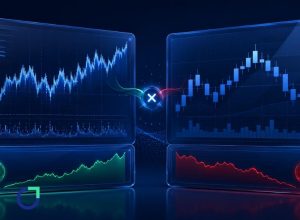
All traders have a starting point and for many, the starting point comes in the form of a demo account. A demo account offers a trader a safe environment to get to grips with the trading platform, test out trading strategies, and find out how the forex trading market works. While trading on a demo account may feel authentically realistic, is it the same as trading on a live account?
Yes and no. As demo accounts do often use the same live market data, the actual experience of trading can vary considerably. Knowing the differences between demo VS live trading account is an important part of preparing for the transition, as it allows traders to not have unrealistic expectations.
What a Demo Account Actually Simulates
A demo account is created to provide the same experience of trading without putting the trader into any kind of financial risk. The demo account allows you to make trades, test the different indicators, and get accustomed to the platform using virtual funds instead of real money.
Most brokers stream demo account real prices, meaning the charts and market quotes closely resemble those seen by live traders. This makes demo trading an excellent learning tool for understanding price action and platform features.
However, a demo account is still a form of simulated trading. Orders are processed in a virtual environment, so they may not interact with real market liquidity in the same way as live trades.
Many traders compare real versus demo forex accounts before funding their first live account. Although both environments may display nearly identical prices, the execution process behind the scenes is often different.
Another common term for demo trading is paper trading. It allows beginners to practice without financial pressure while giving experienced traders a safe place to test new strategies before risking capital.
Traders generally feel more confident in executing trades in a demo account than in a live account since they are not using real cash. This confidence may sometimes lead to good trading results, but it does not always give an accurate reflection of how the trader will do when dealing with real money later.
This is why one should view the demo account in terms of a training process rather than as a guarantee of future performance. Even though the demo account provides useful lessons in terms of technical skills, it is only through a live trading account that you get to learn about your performance and the reactions you will have when the money is involved.
Read More: What is a broker?
How a Live Account Connects to Real Liquidity
When using a live trading account, the process is much different from what happens with a demo account. With a live account, your trades are processed using the broker’s real execution system. Depending on the broker’s model, your orders might go to liquidity providers or get matched internally.
This connection to real market liquidity is one of the biggest difference demo live forex traders notice after funding their accounts. Prices may look almost identical, but execution depends on real market conditions rather than a simulation.
The trading experience may feel very much like trading on a demo account when the session is in full swing. But, once the market becomes unstable or liquidity goes down, this can change as live orders must compete against thousands of orders placed by other traders.
This creates an execution difference that simply cannot be fully replicated in a practice environment. A demo account can imitate market conditions, but it cannot perfectly reproduce how real orders interact with available liquidity.
When choosing best brokers for demo accounts, it’s worth checking whether the broker uses the same pricing feed and execution model for both demo and live accounts. The closer these environments are, the more useful your practice will be.
Even then, remember that no demo account can perfectly reproduce every aspect of live trading. Market depth, order flow, and liquidity constantly change throughout the trading day.
Why Demo Fills Feel Better Than Live Fills
One of the first things many traders notice after moving from demo to live is that trades no longer seem to execute as perfectly.
Filled orders in a demo environment are nearly instant because there is little to no competition for liquidity. The demo platform only simulates trades based on marketplace data.
Real markets are a different story. In live markets, there is always a need for buyers and sellers to fill orders while the prices can fluctuate in seconds.
This is one reason why demo results better than live is such a common question among new traders. It’s not always because the strategy stopped working it may simply be experiencing real market conditions for the first time.
During fast-moving markets, traders may also experience slippage demo differences. While demo accounts often execute exactly at the requested price, live accounts may fill slightly higher or lower depending on available liquidity.
Understanding slippage in trading helps explain why this happens. Slippage is a normal part of financial markets, especially during major news events or periods of low liquidity.
The goal is not to eliminate slippage completely but to choose a broker with reliable execution and realistic trading conditions.
Slippage, Spread and Requotes: Demo vs Live
When markets become volatile, further differences between demo and live trading reveal themselves.
In demo accounts, for example, spreads do not change that much and orders are executed almost instantly. However, live trading is rather dynamic, since the price is impacted by continuous changes in supply and demand.
This means traders may occasionally experience requotes live account or wider spreads during major market events. These situations are much more common in real trading than in a simulated environment.
The table below summarizes the most common differences.
| Feature | Demo Account | Live Account |
|---|---|---|
| Market Prices | Usually Live | Live |
| Order Execution | Simulated | Real Market |
| Slippage | Limited | Possible |
| Requotes | Rare | May Occur |
| Emotional Pressure | None | High |
Understanding these differences helps traders set realistic expectations before funding an account. A strategy that performs well on demo should still be tested under live conditions with small position sizes before increasing risk.
The Psychology Gap Between Demo and Real Money
The biggest difference between demo and live trading often has nothing to do with technology it has everything to do with trading psychology. When there is no financial risk, traders usually make calm, objective decisions. Once real money is involved, emotions such as fear, greed, and hesitation begin to influence every trade.
In the absence of any financial danger, decisions seem calm and unbiased. Traders tend to adhere to their strategies, wait patiently for the right opportunities, and even take losses with little stress. However, once money is in play, emotions get in the way of decisions. The fear of losing, the pleasure of winning, as well as the desire to recover losses influence on trading decisions. That is why the moment of open a live account is so important for long-term success. Even a profitable strategy can fail if emotions persuade a person to ignore his own rules. Many traders who are doing well on simulators find out that controlling emotions is far harder than learning technical analysis. The market remains unchanged, but emotions take their toll.
How to Use Demo Testing Without Fooling Yourself
One of the best ways to train for a forex trading experience is to use a demo account, but only when you have the right mentality about it. Treating a demo account like a game or attempting to make unrealistic trades may cause you to develop bad habits that can be very difficult to abandon once you start trading in real money.
The first thing to do is to use your demo account in a similar way to how you would be conducting trading in a live account. Make use of a realistic balance, use the same position sizing techniques, and avoid taking unnecessary risks by trading too much with the demo account simply because of the fact that it operates with virtual funds. This leads to a much more reasonable set of results.
Another important issue to resolve is writing a trading plan before you start trading. You need to write down the steps about your entry points, exit strategy, and the amount of risk involved. Once you have done that, stick to the rules consistently even if no real money is at stake.
Make sure you keep a trading journal during your testing process. Write down each of the trades and reasons for taking them. Lastly, make sure to check up on your trading journal regularly to find the repetitive mistakes.
announcements, and periods of high volatility. A strategy that performs well in different environments is usually more reliable than one tested under ideal conditions only.
Another common mistake is constantly changing strategies after a few losing trades. Every trading system experiences losing streaks, so switching methods too quickly makes it impossible to know whether a strategy actually works. Give your approach enough trades to produce meaningful results before making adjustments.
Finally, remember that the purpose of a demo account is not to prove how much virtual money you can make. Its real purpose is to develop good habits, improve decision-making, and prepare yourself for live trading. If you treat your demo account with the same discipline and respect that you would give a real account, the transition to live trading will be much smoother and far less stressful.
Bridging the Gap: Moving From Demo to Live Safely
Successful moving from demo to live should happen gradually rather than all at once.
A lot of professional traders advise starting with the smallest position size to get the real trading experience while the risk remains very low.
In the first weeks of trading, you should focus on becoming consistent rather than profitable.
It is essential to understand how your broker carries out the order execution process, the behavior of the spreads during extremely volatile times, and your response to gained and lost amounts.
If you experience different results in a live market when compared to a demo account, do not stop using your strategy straight away.
Position size transition is a gradual process that makes you get used to trading and to reduce the pressure and number of beginners’ mistakes.
What to Check Before You Fund a Live Account
Before you open a live account, take a few minutes to review the broker’s trading conditions carefully.
Compare spreads, commissions, leverage, execution methods, and available account types. If possible, verify that the broker’s demo environment closely reflects its live trading conditions.
You should also understand deposit and withdrawal procedures, customer support availability, and regulatory status before transferring funds.
Testing the platform with a small initial deposit is often a better approach than funding a large account immediately.
The objective is to confirm that the broker’s live environment matches your expectations before increasing your trading capital.
Conclusion
Using a demo account is one of the best things that new traders can do to prepare themselves for trading but it doesn’t provide the same experience like trading with real money.
Knowing the distinctions between demo accounts and live accounts enables traders to establish some reasonable expectations as regards trade execution, trading psychology, and the market.
Use your demo account to acquire the necessary skills and to test your strategies. When you feel sufficiently prepared, make the move to the live account while starting with small positions and keeping in mind sound risk management principles.
The more realistic your approach towards a demo account is, the easier it would be to make your first step towards trading.
Frequently asked questions
No. Demo accounts often use live market prices, but execution, liquidity, and emotional pressure are different because no real money is at risk.
The most common reasons are emotional decision-making, real market execution, slippage, and changing trading behavior once money is involved.
There is no fixed timeline. Most traders should remain on demo until they can follow a consistent trading plan and demonstrate stable results over a meaningful number of trades.
Most brokers provide demo account real prices, meaning the price feed closely matches live market data. However, order execution is still simulated, so the overall trading experience may differ from a live account.
Was this post useful? Send it to others.
Comments
No comments yet. Be the first.