
Weekly Economic Outlook amid Geopolitical tensions
Markets enter the week in a late-cycle balance: pockets of resilience, but rising sensitivity to inflation and geopolitics. U.S. data—CPI and follow-through demand indicators—will set the tone for real yields, the dollar, and global risk appetite. With equities elevated and positioning constructive, the reaction is asymmetric: hotter inflation can tighten financial conditions quickly, while benign prints support risk-on but with slower upside. Elsewhere, investors watch whether weakness broadens: Europe’s manufacturing remains soft, UK housing and construction stay pressured, and China’s recovery is uneven. Commodities diverge—gold bid on uncertainty, oil capped by 2026 surplus fears as periodic headlines jolt energy markets.
USA
The U.S. enters the week at a high-volatility intersection of macro and earnings. Markets will digest a key inflation print that should be less distorted by the prolonged government shutdown, while major-bank earnings begin to shape sentiment around risk appetite, credit conditions, and the consumer. With equities starting from a relatively firm footing and limited downside follow-through so far, the bar for negative surprises may be higher, but the CPI reaction function remains pivotal for rates, FX, and equity leadership.
US Economic Review
The first full trading week of 2026 reinforced a familiar U.S. macro mix: services remained firm, manufacturing stayed in contraction, and the labor market cooled on hiring but not on wages. The overarching message was “slowing, but still resilient.” Growth is moderating enough to keep recession fears contained, yet wage persistence and inflation expectations are sticky enough to keep the Federal Reserve cautious and highly data dependent.
On the growth pulse, the Atlanta Fed’s GDPNow model delivered the most optimistic headline, lifting its Q4 estimate to 5.4% before easing to 5.1%, still an exceptionally strong late-year signal. However, the composition of the upgrade matters. Incoming data suggest the improvement is driven in meaningful part by net exports and inventory arithmetic rather than a clean acceleration in domestic final demand. October trade data supported the headline tailwind, with the deficit narrowing sharply to -$29.4B as exports rose to $302.0B and imports fell to $331.4B. In GDP accounting, a narrower deficit boosts growth in the near term. Yet wholesale figures added nuance: inventories rose 0.2%/m while sales fell 0.4% m/m, implying an inventory build relative to demand. That can mechanically lift GDP, but it also raises the risk of an unfavorable stock-to-sales profile if demand does not re-accelerate. A further caveat is that the trade narrowing appears inflated by precious-metals flows, meaning the real-economy impulse may be smaller than the headline suggests.
Surveys continued to highlight a two-speed economy. ISM Manufacturing held below 50 at 47.9, with new orders at 47.7 and employment at 44.9, confirming ongoing factory-sector contraction. ISM Services, in contrast, printed 54.4 with solid business activity and new orders, showing the services engine remains in expansion. Inflation details remain relevant: manufacturing prices at 58.5 signals, input-cost pressure has not fully faded even as output and hiring remain weak.
The labor market was the week’s centerpiece and produced classic crosscurrents. Payroll gains disappointed (+50K vs +66K expected), private payrolls were soft, and manufacturing jobs declined. Yet the unemployment rate improved to 4.4% and broader underemployment fell, while claims stayed low evidence that layoffs remain contained. Continuing claims rose, suggesting re-employment is becoming incrementally harder. Wages stayed firm: average hourly earnings rose 0.3% m/m and 3.8% y/y, keeping the Fed focused on wage stickiness even as hiring cools.
Inflation signals were mixed. Consumer inflation expectations edged higher across measures, but Q3 productivity surged and unit labor costs fell, a disinflation-friendly combination that supports patience. Housing showed steady permits but softer starts, consistent with rate sensitivity. Meanwhile, QT continued, reserve balances improved, and front-end funding conditions remained calm.
US Economic Outlook, week ahead
The week ahead (Jan 12–18) is a key test for U.S. markets as investors look for a cleaner read on inflation and demand after shutdown-related data distortions. A major overlay is data integrity and base effects: recent inflation releases were affected by incomplete collection and statistical adjustments, and the BEA has signaled it may use CPI averaging to backfill missing PCE inputs. As a result, “measurement noise” remains elevated, and markets are likely to focus as much on the composition of releases as the headlines.
Three themes dominate. First, December CPI is the main risk event and will be treated as the first credible checkpoint for the disinflation story. Market pricing is likely to react asymmetrically: a hotter-than-expected print would lift real yields and pressure rate-sensitive equities, while a softer print would support risk assets and reinforce the “gradual disinflation/easing later” narrative—provided it does not come with a growth-scare tone. Second, Retail Sales and major-bank earnings provide two complementary reads on consumer health. As shutdown effects fade, bank commentary on card spending, delinquencies, and deposit trends will be closely watched for confirmation of the macro data. Third, the Dow Jones is particularly sensitive to this mix because its leadership tilt toward industrials, financials, and healthcare ties performance to rates/curve dynamics, industrial momentum, and market breadth.
For the core releases, the baseline expectation is a firmer CPI print that represents “payback” for the prior distortion without breaking the broader disinflation trend: headline CPI +0.35% m/m, core +0.36% m/m, with y/y around 2.7% headline and 2.8% core. Core goods may re-accelerate due to holiday pricing dynamics, while shelter is expected to revert toward its pre-shutdown trend. Markets will treat goods-driven payback differently from any renewed firmness in services inflation.
Housing also matters via new home sales (Sep/Oct). After August’s outsized jump, October is expected to normalize near 707K, with builders leaning on incentives. Retail sales are projected to rebound +0.5% m/m (+0.3% ex-autos). The most market-sensitive outcome is firm CPI plus strong retail, which could push yields higher and challenge equity multiples.
USD and Wall Street
This is a week where rates should lead. CPI is likely to set the initial direction for real yields and the dollar, retail sales will test whether the growth impulse is holding, and major-bank earnings should help markets decide whether the macro backdrop still fits a “soft landing” narrative or is drifting toward late-cycle risk. For the Dow Jones, the key is whether cyclical and financial leadership can persist without a destabilizing repricing higher in real yields. If inflation appears contained and the consumer remains steady, the setup supports rotation toward value/cyclicals and a constructive Dow tone. If CPI surprises to the upside—especially if stickiness shows up in services—front-end yields can reprice sharply, tightening financial conditions and quickly pressuring Dow breadth.
The USD is trading in a policy-sensitive regime. After last week’s mixed labor signals, the focus shifts decisively to inflation. Near-term USD direction will be driven by CPI surprises, front-end yield repricing, and risk sentiment. A “Goldilocks” mix—CPI broadly in line and retail sales steady but not hot—would likely keep the dollar range-bound, supported at the margin by U.S. relative resilience. By contrast, re-acceleration in CPI/core CPI, or sticky detail in shelter and services ex-housing, would lift front-end yields and strengthen USD demand, particularly versus low-yielders and more cyclical FX. If inflation cools while retail sales also soften, USD could drift lower, especially if equities remain buoyant and investors rotate into higher-beta risk exposure.
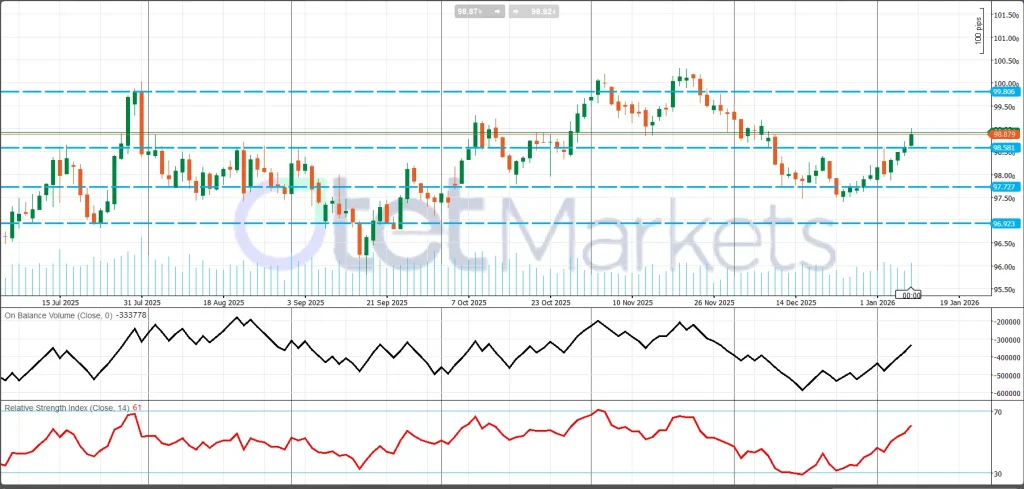
Technically, DXY remains in a broad range that has defined trading since mid-2025 (roughly 96.923–99.806). After peaking near/above 100 in November and basing around 97.727 in mid-December, the index has recovered to about 98.879 and reclaimed the 98.581 pivot. Momentum has improved: RSI is back near 61 and rising, and OBV is turning higher, suggesting better participation. Immediate resistance sits at 98.879, with 99.806 as the major “line in the sand” for a breakout; 100.00–100.50 becomes the upside magnet if that ceiling breaks. Support is 98.581, then 97.727.
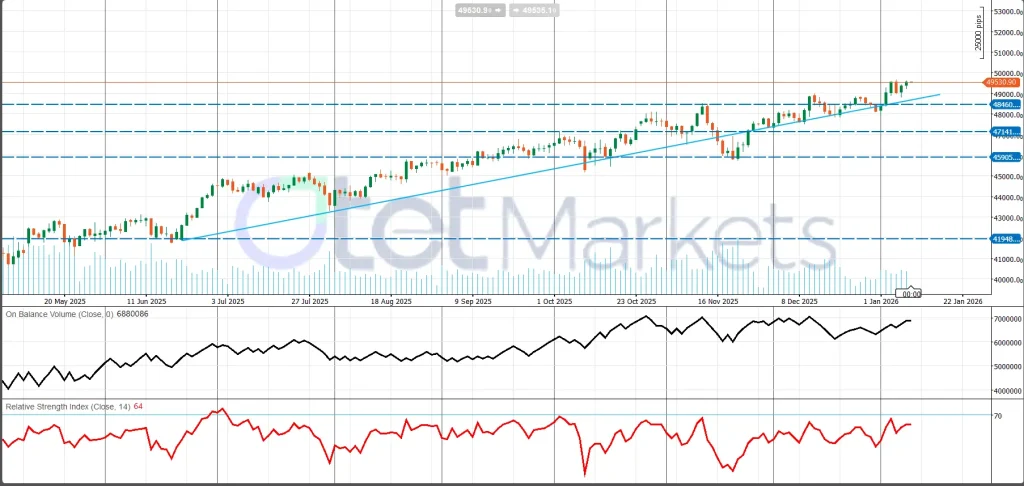
For the Dow, bank earnings matter directly (financial weight and consumer/credit read-through), and CPI remains the gating factor. The trend is technically bullish: the index reclaimed 48,460 and is consolidating under 49,530 in a post-breakout pause. A close above 49,530 opens the path toward 50,000, while a sustained move back below 48,460 shifts focus to 47,141 and 45,905 as downside supports.
UK Economic Outlook
The UK entered 2026 with slow growth but fragile macro balance, a theme that continues into the week ahead. The first full trading week of the year confirmed that activity remains positive in aggregate, but momentum is narrow and uneven, with services carrying growth while housing and construction remain clear drags. Financial conditions are no longer tightening at the margin—credit and money aggregates have improved—but policy remains restrictive in level terms, leaving the economy sensitive to rates and confidence shocks.
Business surveys underscored this imbalance. December PMIs pointed to modest expansion rather than acceleration: services stayed just above 51, manufacturing hovered marginally above the 50 thresholds, and construction remained deeply contractionary. The construction PMI near 40 is particularly important, as it feeds directly into housing activity, SME confidence, and employment across supply chains. This weakness continues to anchor downside risk to the broader outlook despite resilience elsewhere.
Housing data reinforced the message of rate sensitivity. Both Nationwide and Halifax house price indices rolled over again in December, with month-on-month declines and a clear cooling in year-on-year momentum. While mortgage approvals and net household lending held up better than prices alone would suggest, the underlying signal is caution rather than reflation. Borrowing remains positive, but negative housing equity withdrawal indicates households are not tapping housing wealth to support consumption, consistent with a more defensive consumer mindset.
Inflation signals at the retail level remain benign. The BRC shop price index showed only mild price pressure, supporting real incomes if sustained and reducing immediate inflation concerns. This backdrop gives the Bank of England more flexibility, but it does not remove the growth challenge created by weak housing and construction activity.
Monetary and financial conditions offered a slightly more supportive offset. Consumer credit growth picked up, broad money aggregates rebounded, and short-end gilt yields eased at auctions signs that liquidity is improving and that markets are not demanding materially higher compensation for near-term funding. This aligns with expectations that policy is no longer tightening, even if the BoE remains cautious about declaring victory on inflation.
Looking ahead to the week of January 12–18, November GDP is the central market catalyst. Consensus expects a modest 0.1% month-on-month expansion, reversing October’s contraction. Services are forecast to reach edge higher, while industrial output is expected to be flat. A confirmed uptick would help Q4 2025 end on a firmer footing, but PMI surveys through December suggest momentum remains mixed and fragile rather than strengthening.
For markets, the implications are clear. A firmer-than-expected GDP and services print would push back against the cooling narrative, potentially lifting front-end gilt yields and supporting GBP. Conversely, a soft GDP outcome, especially if services disappointment would reinforce the view that policy is restrictive enough to slow demand, supporting gilts and weighing on sterling.
Overall, the UK outlook remains one of low-speed expansion with structural weak spots. Services are keeping growth alive, inflation pressures are easing, and liquidity conditions are improving, but housing and construction remain significant constraints. For the BoE, this argues for cautious, gradual easing, with markets increasingly focused on whether modest growth can be sustained without further policy support.
GBP Weekly Outlook
GBP is likely to trade this week as a direct function of rates and growth expectations, with the highest beta catalyst being Thursday’s ONS GDP/output bundle and any reinforcing BoE messaging. An upside surprise in GDP and services would reduce near-term easing expectations, typically supporting sterling. A downside miss—especially if weakness is concentrated in services and/or construction—would strengthen the “slow-growth” narrative and leave GBP vulnerable.
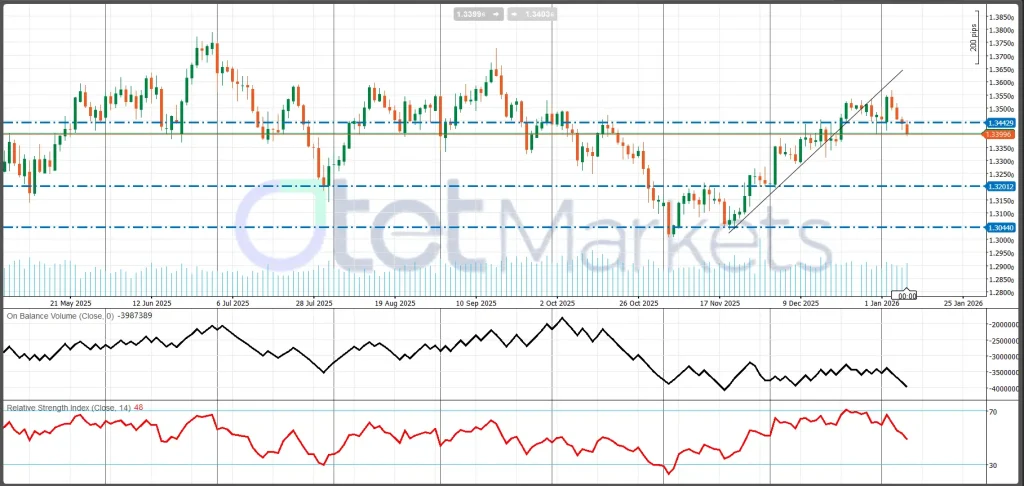
Technically, GBPUSD remains range-to-choppy and is now at an inflection point after its late-2025 rally lost momentum. Price has rolled back toward 1.33996, sitting around/below a broken rising trendline—consistent with consolidation or a corrective pullback rather than immediate trend continuation. Momentum has softened (RSI ~48) and participation is weakening (OBV rolling over), which reduces the probability of an immediate rebound without rebuilding demand.
Key levels: 1.33996 is the near-term support and decision point; a sustained break increases downside risk toward 1.32012 (with 1.30440 as deeper support). Resistance starts at 1.34429; a reclaim improves structure and reopens 1.3550–1.3600.
Gold Market and Weekly Outlook
Gold starts the week firm and close to cycle highs, supported by a combination of elevated geopolitical demand and a rates backdrop that still leaves room for Fed easing later in 2026. The key question for the next leg is whether U.S. CPI validates a path toward lower real yields—which would support continuation higher—or forces a repricing toward higher yields, increasing the risk of a corrective pullback. Even if gold retraces tactically, the broader setup remains constructive: policy uncertainty and escalation risk keep dips attractive, and gold is still biased to outperform whenever markets face rising uncertainty around trade policy, alliances, or institutional constraints.
The macro backdrop explains why gold is supported, but still volatile. Markets continue to price a geopolitical risk premium, yet short-term trading has turned choppy. The move toward $4,500 and subsequent retracement looks consistent with a market that is still “bid” on uncertainty but vulnerable to cross-metal volatility and profit-taking, particularly when silver swings spill over into broader precious-metals sentiment. Ahead of the U.S. Supreme Court decision being discussed around tariffs, gold is positioned to benefit under either outcome. A ruling that constrains or invalidates the legal basis for current tariffs could trigger a sharp repricing in risk and an increase in policy uncertainty—typically supportive for gold. Even a “tariff-positive” ruling that expands executive latitude could reignite trade confrontation with Europe and China, keeping tail-risk hedging demand active. The Greenland angle adds another layer: deterioration in EU–U.S. relations or sustained escalation in rhetoric around sovereignty and military posture tends to strengthen gold’s role as a geopolitical hedge. Ongoing unrest in Iran further adds tail risk; any regional spillover or rising probability of direct U.S. action could lift risk premia and support safe-haven flows.
Beyond geopolitics, the week is fundamentally about data. December CPI is the core macro catalyst, and with recent shutdown-related collection issues still in the background, markets are likely to focus on “signal versus noise.” A hot CPI typically lifts real yields and the USD, pressuring gold initially—though equity stress can later redirect flows into hedges. A benign CPI supports lower real yields and a softer USD, helping gold retest highs. Retail Sales and PPI provide follow-through to confirm whether inflation impulses are broadening or fading.
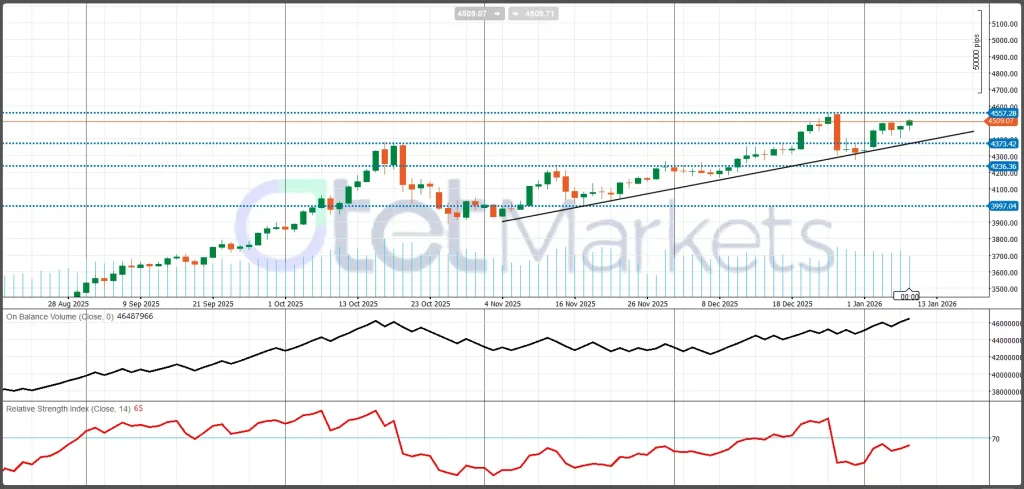
Technically, gold remains strong near record territory, trading around $4,524/oz, within reach of $4,550 resistance. Above that, $4,600–$4,700 are the next psychological extension levels. On the downside, $4,450–$4,430 is the first key demand zone, with ~$4,400 as deeper support. As long as gold holds above the mid-$4,4xx area, the structure remains trend-supported and consistent with “buy-the-dip”; sustained acceptance below it would signal a deeper correction.
Oil current market condition and weekly Outlook
Oil enters the week with a bearish baseline as expectations for a 2026 supply surplus continue to strengthen. Without a clear and sustained supply shock, the market is likely to treat rallies as opportunities to sell, leaving crude vulnerable to a gradual grind toward multi-year support.
Current market condition
Crude is trading in a low-price, supply-heavy regime, with Brent around $63/bbl and WTI around $59/bbl. The latest rebound appears more like headline-driven mean reversion than a decisive trend reversal. The dominant narrative remains that the market is focused on next year’s balance—specifically the risk that 2026 looks comfortably supplied—rather than near-term scarcity. That framing is reinforced by analyst expectations: a Reuters poll points to average prices easing in 2026 (roughly Brent ~$61.27 and WTI ~$58.15) and outlines a potential surplus in a wide range of ~0.5 to 3.5 mb/d, with some projections allowing for downside into the mid-$50s.
Geopolitical developments are still relevant, but currently they do not provide a consistent bullish impulse. The market remains sensitive to incremental supply headlines—especially around the possibility that Venezuelan flows could gradually return if rehabilitation efforts progress. At the same time, rising odds of a Russia–Ukraine ceasefire would likely compress the geopolitical premium embedded in crude by reducing perceived disruption risk. These factors tilt the risk balance lower unless they are offset by material tightening in physical fundamentals.
Near-term fundamentals snapshot
Recent inventory data highlighted mixed signals: crude stocks drew down meaningfully, but refined products built sharply. A large gasoline build and higher distillate stocks suggest that product balances and demand dynamics—potentially seasonal, consumption-related, or refinery-run driven—are doing much of the near-term pricing work. On the supply side, the Baker Hughes oil rig count edged lower, hinting at slightly softer drilling momentum, though not enough on its own to change the broader surplus narrative.
Policy and geopolitics
OPEC+ remains positioned as a floor defender rather than a catalyst for higher prices, reaffirming its commitment to market stability while keeping voluntary adjustments in place. Reuters also reported December OPEC output falling, largely linked to Iran and Venezuela, which can tighten prompt conditions. However, markets appear to treat this as a partial offset within the wider oversupply framework, rather than the start of a new bull cycle.
Key drivers this week
- EIA Weekly Petroleum Status Report (Wed, Jan 14): the most consistent weekly catalyst. In a surplus narrative, crude reacts most when crude and products move together—builds typically reinforce bearishness, while simultaneous tightening can support a tactical bounce.
- EIA STEO (Tue, Jan 13): a key input shaping how investors frame 2026 supply-demand expectations.
- Supply expectations: OPEC+ guidance and the market’s evolving assumptions around “return barrels” (including Venezuela, plus steady U.S./Brazil flows).
Technical outlook (WTI)
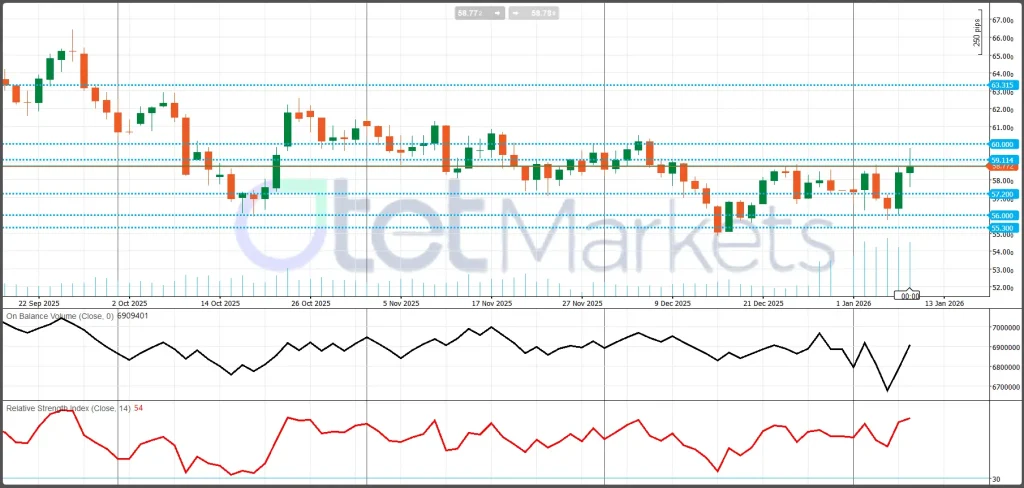
WTI remains below $60, keeping the structure heavy. Key support is $55–$56; a clean break increases the probability of fresh multi-year lows, with $55 viewed as the key inflection. Resistance is $60, the first “line in the sand,” with $62–$63 as the next ceiling. While below $60, rallies remain vulnerable unless inventories tighten or the 2026 surplus narrative meaningfully improves.
Cryptocurrencies and BTC weekly Outlook
Bitcoin has slipped back into the low-$90,000s (around $90.9k), and the near-term tone has turned more defensive as market flows shifted from supportive to risk-off. The most important development is the reversal in U.S.-listed spot Bitcoin ETF demand: reports cite roughly $681 million of net outflows in the first full week of 2026 and a multi-day redemption streak totaling $1.1 billion+. That flow regime matters because it directly impacts liquidity and short-term price resilience, particularly during macro-event weeks.
Volatility is clearly being priced for movement, but conviction in spot is mixed. Implied volatility in BTC options (Jan 2026 contract) is running in the high-30% range, consistent with a market expecting event risk around macro releases and policy headlines rather than a clean, fundamentals-driven trend. At the same time, policy and institutionalization narratives—especially around stablecoins and charter discussions—remain active. This is supportive for the longer-term “institutional plumbing” thesis, but it also raises the probability of short-term, headline-driven swings.
For the week ahead, macro is the primary catalyst. BTC continues to behave like a high-beta expression of the real-yield and USD impulse, making U.S. CPI (Dec 2025) the key event risk, followed by U.S. Retail Sales (Nov 2025) for confirmation on demand. The reaction function is straightforward: a hot CPI that pushes real yields higher and strengthens the USD typically pressures BTC—especially with ETF flows already negative. A benign CPI that allows yields to ease can stabilize risk appetite and support a sharp rebound, particularly if positioning is cautious and flows begin to stabilize.
The second key driver is whether the ETF flow regime improves. CPI week will be interpreted through the lens of whether outflows reverse into inflows (risk-on confirmation) or persist (risk-off reinforcement that caps rallies). The policy/regulatory backdrop remains a tailwind over time, but it is headline-sensitive and unlikely to be the sole driver of week-to-week spot direction.
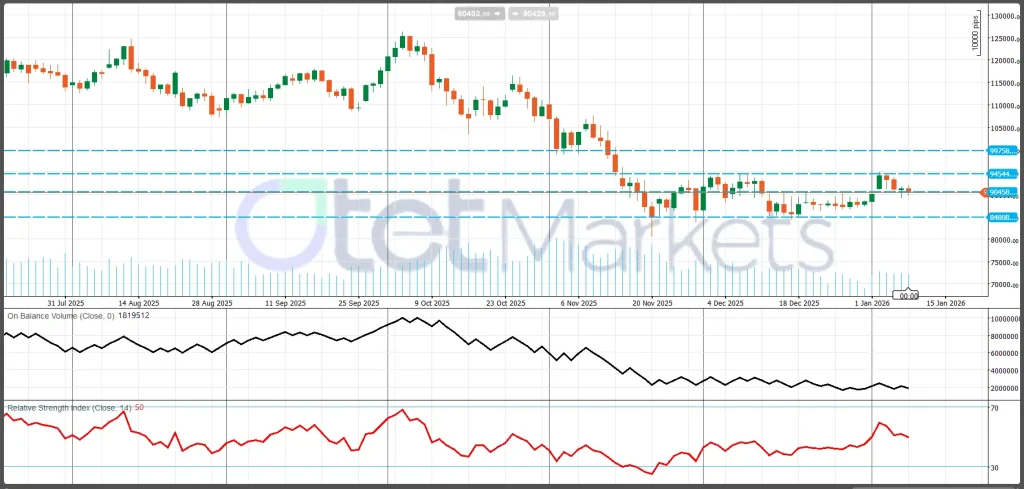
Technically, BTC is trading near a critical pivot zone. Resistance sits at $95,000, the most immediate rejection area, with $100,000 as the major psychological level that likely requires softer yields and improving flows. Support is $90,000, the key pivot, with ~$89,300 next if $90k breaks. Holding above $90k with improving macro/flows favors a recovery attempt toward $95k; sustained acceptance below $90k increases the probability of a move into the high-$89k area and keeps rallies sold until flows stabilize.
Share
Hot topics

What is News Trading in Forex? A Complete Guide to Event-Driven Strategy
Introduction If you have ever watched the forex market during a major economic announcement, you know how dramatic it can be. Prices jump within seconds. Spreads widen. Volatility explodes. For...
Read more




Submit comment
Your email address will not be published. Required fields are marked *