
US Economy, USD, and Wall Street
Weekly Review – Week ending Friday, Jan. 23, 2026
The week ending Friday, Jan. 23, 2026, reinforced a “moderate expansion with late-cycle normalization” baseline rather than a clean re-acceleration narrative. Markets were driven early by headline volatility around trade policy, but a subsequent walk-back of tariff threats helped stabilize risk sentiment into the weekend. Beneath the headlines, activity remained expansionary, consumer tone improved, and labor conditions stayed firm, while forward-looking indicators and policy-driven inflation risks kept the debate focused on how long the Fed can maintain restrictive settings without compressing growth.
On the growth pulse, January S&P Global PMIs remained steady and consistent with continued expansion. Composite PMI held at 52.8 (vs. 52.7 prior), with Manufacturing at 51.9 and Services at 52.5—solidly in growth territory but not signaling a breakout. Consumer sentiment improved meaningfully: the University of Michigan final January reading rose to 56.4 from 52.9, with expectations and current conditions also moving higher. Still, forward signals remained mixed. The Leading Index stayed negative at -0.3% m/m (November), keeping the late-cycle/slowdown-risk narrative alive if financial conditions tighten again.
Inflation and rates were characterized by modest easing in expectations but a persistent policy-risk floor. Michigan’s 1-year inflation expectation eased to 4.0% while the 5-year held at 3.3%—not accelerating but still elevated enough to matter for the Fed’s “anchoring” lens. PMI commentary continued to flag sticky price pressures, with tariff-linked import costs and elevated prices-paid/charged measures highlighting an inflation risk that is partly policy-driven. Treasury yields traded more on headlines than data, moving with risk appetite: a mild flight-to-safety tone early, then partial retracement as trade tensions cooled.
Labor remained the backbone of the soft-landing story. Initial claims at 200k and continuing claims at 1.849 million points to a market that is normalizing but not cracking. Household demand stayed resilient—real consumer spending rose 0.3% m/m in both October and November, keeping Q4 consumption constructive—yet income growth lagged spending, pushing the saving rate down to 3.5%, increasing sensitivity to shocks. Disinflation progress continued (core PCE +0.2% m/m in Oct–Nov), but a potential “tariff bump” risk remains, keeping the USD supported on a rates-floor narrative while Wall Street remains highly sensitive to policy headlines.
U.S. Outlook (Week Ahead): Jan 26–31, 2026 — USA, USD, Wall Street
Markets in the week ahead will be driven primarily by Fed communication risk, mega-cap earnings guidance, and headline sensitivity around Washington policy. The FOMC meeting (Jan 27–28) is the central macro catalyst, with the rate decision and Chair Powell’s press conference on Wednesday, Jan 28. The base case is no policy change, but markets will trade the nuance: how firmly the Fed signals “higher for longer,” how it frames progress on inflation, and whether it addresses (directly or indirectly) the increasingly market-relevant Fed-independence narrative and broader policy uncertainty.
At the same time, earnings matter as much as macro this week. Roughly one-fifth of the S&P 500 reports, including multiple mega-cap names, and the market’s focus will be on guidance quality, especially whether AI capex is translating into visible productivity or revenue payoff. With equity multiples still sensitive to rates and duration, any guidance that implies heavier spending with slower payback can pressure high-duration leaders even if headline results beat.
The data calendar is “lighter than it looks” because the BEA delayed two major releases—Q4 2025 advance GDP and December Personal Income & Outlays (including PCE inflation)—to Feb 20 (from the typical late-January window). That shifts the week’s macro battleground away from “hard growth + PCE inflation” and toward Fed messaging, labor proxies, and inflation pipeline signals (notably PPI). Treasury supply is also meaningful early in the week (bills plus 2Y/5Y/FRN and 7Y), which can influence front-end pricing into the Fed and, by extension, USD tone and equity duration.
Macro conditions entering the week still point to modest expansion, but with a familiar late-cycle mix: sticky price pressures in surveys (often tied to tariff-related costs), softer labor signals in the same datasets, and consumers feeling somewhat better. Housing remains constrained by rates and affordability, with policy uncertainty also weighing on turnover and demand.
Day-by-day, Monday brings Durable Goods (Nov) and Treasury auctions (13W/26W bills, 2Y). Tuesday features Consumer Confidence, Case-Shiller, and the 5Y auction. Wednesday is FOMC plus the EIA weekly petroleum report and a 2Y FRN auction. Thursday delivers jobless claims, productivity & costs (rev.), and the 7Y auction. Friday closes with PPI (Dec) and Chicago PMI (Jan). Durable goods are expected to show a headline jump led by aircraft, with signs capex is broadening beyond high-tech. Trade visibility remains impaired post-shutdown, but the market will watch how tariffs and supply-chain reconfiguration shape the outlook.
USD: headline barometer with a rate “floor”
The USD’s weekly story was driven less by rate differentials and more by confidence, geopolitics, and policy credibility. Early in the week, President Trump’s Greenland-linked tariff threats were treated as a potential renewed transatlantic trade shock, weighing on broad U.S. risk sentiment and pushing the dollar lower alongside equities and bonds. As the administration later walked back the tariff threats, emphasized it would not use force, and framed a NATO-related “framework,” risk appetite stabilized and the dollar’s downside pressure eased.
A key undercurrent was a visible shift in international allocation psychology. Reuters reporting on a Danish pension fund moving to divest U.S. Treasuries highlighted how geopolitical risk and fiscal optics can influence marginal flows—an additional channel that can pressure the USD during periods of policy uncertainty, even when traditional macro drivers are not decisively bearish.
Looking ahead, USD direction remains closely linked to rates and equity-duration sensitivity. A Fed message that reinforces a “higher-for-longer” floor would likely support the dollar while pressuring duration-heavy equities; a more comfortable disinflation tone could weaken the dollar and lift risk—unless tariff headlines reintroduce a risk premium.
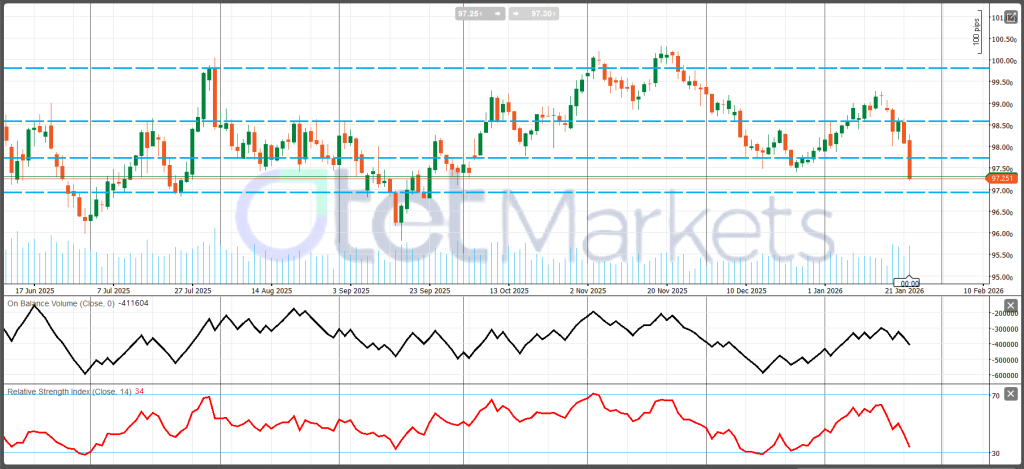
Technically, DXY has been in a downward rotation since its November peak near 100.0–100.5, failing repeatedly at the 98.6–99.2 supply zone. The latest move is a sharp bearish impulse that has broken down from the January upswing and pushed price back into (and slightly below) the 97.5 pivot, keeping the near-term bias bearish. RSI is around 34—bearish and nearing oversold, which can allow for tactical bounces, though not yet extreme. OBV has rolled over again, reinforcing the downside break. Key support sits at 97.0–97.2 (a close below confirms), then 96.4–96.6 and 96.0–96.2. Resistance is 97.5–97.8, then 98.0–98.2, 98.6, and 99.2–100.5 overhead.
Wall Street
Wall Street’s week was defined by a classic “policy shock drawdown, de-escalation rebound” pattern—leaving the net picture headline-driven rather than macro-led. The underlying macro backdrop still looked consistent with a soft-landing/steady-growth regime, but policy risk repeatedly hit confidence, risk premia, and cross-border flow expectations. In other words, equities did not trade like a fundamentally weak market; they traded like a market with elevated sensitivity to political and geopolitical catalysts.
The sharpest risk-off move came when the Greenland-linked tariff threat hit. Bloomberg described a broad liquidation across stocks, bonds, and the dollar, alongside a jump in safe-haven demand. Major U.S. equity benchmarks sold off aggressively—S&P 500 fell 2.1%, the Dow dropped 1.8%, and the Nasdaq slid 2.4%—with volatility repricing higher and crypto underperforming. The tone then improved materially as the administration walked back tariff threats. On Thursday, Jan. 22, U.S. equities rebounded as risk appetite returned: AP reported the S&P 500 up 0.5%, Dow +0.6%, and Nasdaq +0.9%. Despite the whipsaw, weekly performance finished only modestly changed overall (S&P 500 and Nasdaq slightly down, Dow roughly flat), underscoring that the week’s volatility was more “event shock” than “trend break.”
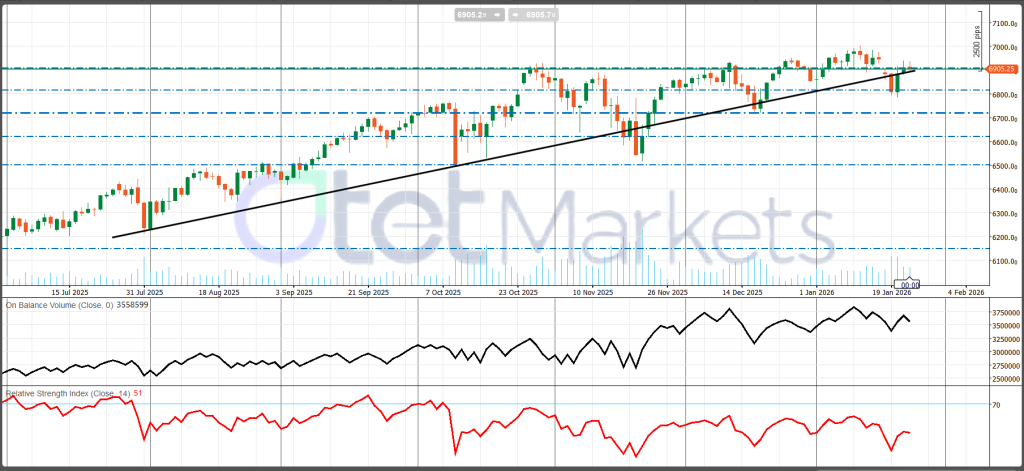
Technically, the S&P 500 remains in a primary uptrend dating back to mid-2025, but it is now compressing into a high-importance decision zone where rising trend support converges with horizontal resistance near 6,900. RSI around 51 is neutral, implying room for expansion once the compression resolves. OBV remains constructive over the broader trend but has flattened recently, suggesting buyers are present but need fresh participation to clear resistance decisively. Key levels: resistance at ~6,900–6,930, then 7,000–7,050; support at trendline (~6,850–6,900), then 6,800, followed by 6,700/6,600/6,500 if downside accelerates.
Fed: “No change” expected, but the path is the story
The January FOMC meeting (Jan. 27–28) is widely expected to deliver a hold, consistent with consensus. The Fed currently maintains the federal funds target range at 3.50–3.75%, following a 25-basis-point cut in December. The policy statement will be released on Wednesday, Jan. 28, followed by Chair Powell’s press conference. With the policy decision largely priced, the market focus shifts to forward guidance and the Fed’s reaction function—what the Committee signals about the conditions required to resume easing and how it frames the balance of risks.
The macro backdrop entering 2026 remains supportive of a pause. Growth momentum has been solid—real GDP expanded 4.3% in Q3 2025, and economists surveyed by Reuters look for growth around 2.3% in 2026. At the same time, inflation remains above the Fed’s 2% target, while unemployment sits near 4.5%, leaving the policy trade-off contested: inflation progress argues for patience, while late-cycle labor normalization keeps cuts on the table if conditions soften. Rate-sensitive sectors such as residential and nonresidential construction continue to face constraints from elevated financing costs, reinforcing the case that policy remains meaningfully restrictive even after the December cut. Debate over the neutral rate—and how restrictive policy truly is—remains active.
Politics adds another layer of uncertainty. Public criticism from President Trump and the pending selection process for the next Fed chair (Powell’s term ends in May) have elevated investor attention on Fed independence; Reuters has highlighted concerns that perceived political interference could undermine the institution’s credibility and complicate the rates outlook.
Consensus expectations are firm. A Reuters poll found all 100 economists expect no change at this meeting, and a majority anticipate no move for the entire quarter. Market pricing similarly assigns only a minimal probability to another near-term cut, with expectations skewing toward easing later in 2026. Internally, the Committee appears split into three camps: a dovish wing focused on labor-market softening, a hawkish wing emphasizing inflation risks (and not ruling out hikes), and a centrist group favoring cautious, data-dependent calibration. With no new Summary of Economic Projections, the statement will likely reiterate data dependence and “balance of risks” language.
Baseline expectations may still include two 25-bp cuts in 2026, but the bar for easing has risen; the dominant uncertainty is now timing and cadence, with risks skewed toward later and potentially less easing.
Bank of Canada (BoC) — January 28 Policy Preview
Canada enters the late-January Bank of Canada (BoC) meeting still absorbing the economic fallout from tariffs and a more strained relationship with the United States. Domestic demand indicators remain soft: retail sales have slipped into negative territory, and the labour market continues to show pockets of weakness. With consumer activity subdued—reflecting slower job momentum and persistent uncertainty around U.S. relations—the growth outlook for the year appears restrained. That backdrop keeps the question of renewed BoC easing on the table, even if it is not imminent.
A January rate cut remains unlikely. Governor Tiff Macklem is expected to communicate comfort that current policy settings are appropriately restrictive, but the tone could become more receptive to the possibility of restarting cuts if downside growth risks intensify. Importantly, markets are not priced for substantial easing this year, which means even small changes in language—any hint of “cut optionality”—could reprice front-end rates quickly and keep the Canadian dollar capped. The base case remains a hold, but the risk balance is becoming more two-sided than earlier in the cycle.
Policy conditions going into the meeting support patience. The BoC ended 2025 holding the overnight rate at 2.25%, citing easing inflation and the need to assess the lagged effects of prior tightening. Inflation progress has been real but uneven: headline CPI slowed to 2.2% in October before edging up to 2.4% ahead of the January decision window, while core inflation continued to moderate—supporting a wait-and-see stance rather than urgency to adjust policy. Growth signals are mixed: the labour market is cooling, suggesting slower momentum, but upside-supermarkets in output remain possible. Housing is still rate-sensitive, though pressure from variable-rate mortgages has eased from prior peaks.
Consensus expectations are clear: a hold at 2.25% on January 28. The BoC is expected to emphasize data dependence and the balance of risks, avoiding confusing signals while inflation is near target but still vulnerable to short-term volatility.
For markets, the decision itself matters less than tone. A hold should keep variable-rate mortgage pricing broadly steady near term, but any hint that easing could resume sooner would likely push short-end yields lower and weigh on CAD. Key watch items are the quarterly Monetary Policy Report, especially updated growth and inflation projections, and the USMCA renegotiation backdrop, which could materially shift the BoC’s risk assessment and policy bias.
Gold (XAU/USD) Current market conditions and Weekly Outlook
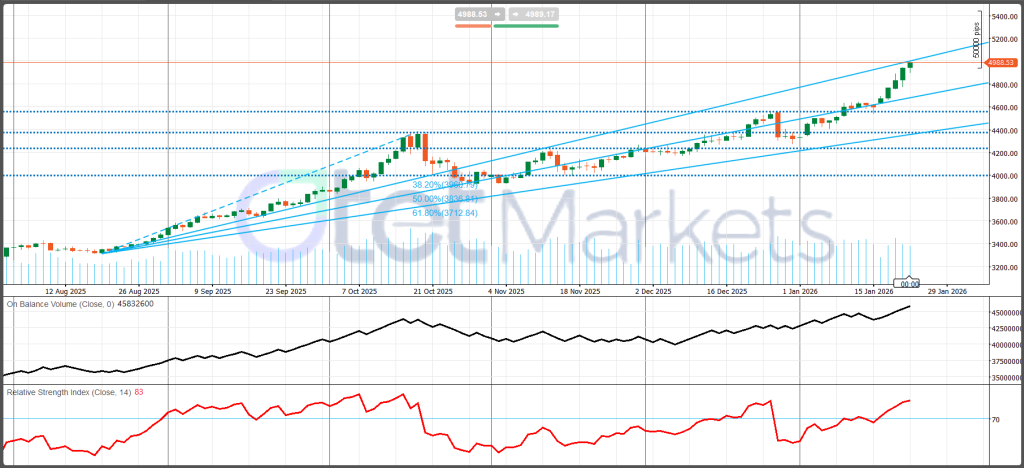
Spot gold traded near $4,987/oz on 24 Jan 2026, extending a powerful uptrend that has delivered +11% year-to-date after a +64% gain in 2025. The rally continues to be underpinned by a combination of safe-haven demand and structural central-bank buying, with analysts estimating national-bank purchases in 2026 could average roughly 70 tonnes per month, providing a persistent demand floor. Geopolitics has been the dominant catalyst—U.S.–Greenland friction, Iran-related tensions, and the Russia–Ukraine war have repeatedly lifted risk premia—while expectations for easier monetary policy have reinforced the bid. Surveys indicate that around 95% of participants expect the Fed to hold rates at the Jan 28 meeting, and recent PMIs point to moderate U.S. expansion, helping keep inflation expectations from re-accelerating sharply.
For the week ahead, gold’s near-term direction hinges on Fed messaging and headline risk. The market will focus on the FOMC decision and Chair Powell’s press conference: a hawkish tone (emphasizing sticky inflation and keeping a higher-for-longer bias) would likely support the USD and yields, cooling bullion’s momentum; a dovish tilt (acknowledging softer growth or hinting at eventual cuts) would extend the rally. Inflation signals, particularly PCE, will matter to reprise the expected policy path. Meanwhile, geopolitics remains an active volatility engine: further escalation—especially any material widening of Middle East tensions—could keep safe-haven flows dominant. Central-bank diversification remains a key structural tailwind, with some strategists (e.g., Goldman Sachs) citing private-sector and reserve diversification as supportive of higher 2026 price targets.
Scenario-wise, a hawkish Fed outcome could trigger a corrective pullback toward roughly $4,760, while a dovish outcome or cut-hint could lift odds of a break above $5,100, with potential follow-through toward $5,300. If risk appetite improves meaningfully (de-escalation or stronger data), gold could retrace toward $4,880 support.
Technically, the trend remains bullish inside a rising channel, but RSI ~83 signals an overbought, stretched condition that often precedes consolidation or pullbacks. OBV rising supports the uptrend. Key resistance is $5,000, then $5,150–$5,250; key supports are $4,900–$4,850, then $4,600, with deeper supports at $4,400–$4,200 and $4,000.
Crude Oil (WTI/Brent) – Current Market Conditions and Outlook
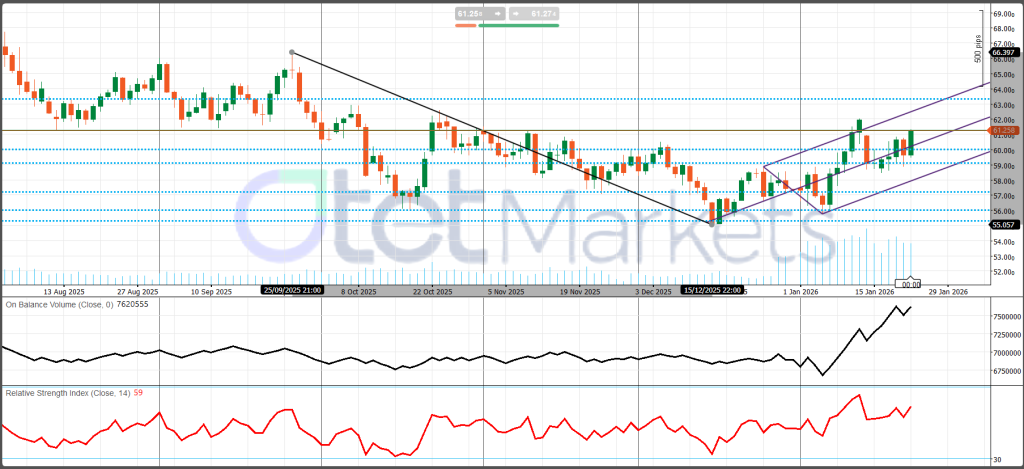
WTI crude futures climbed to $61.28/bbl. on 23 Jan 2026, up 3.23% on the day. Over the past month, WTI is higher by about 5%, though it remains roughly 18% below year-ago levels. Brent finished the week near $65.89/bbl., maintaining a modest premium but reflecting a similar push-up between geopolitics and oversupply concerns.
The near-term tape has been dominated by shifting geopolitical risk premium. Oil rallied earlier in the month after President Trump signaled an “armada” heading toward Iran, reviving fears of supply disruption. That move was amplified by temporary outages at Kazakhstan’s Tengiz field and a weaker dollar. But the premium proved fragile: by 22 Jan, crude fell around 2% as Trump softened rhetoric toward Greenland and Iran and headlines suggested incremental progress toward peace in Ukraine, prompting analysts to describe a partial deflation of the geopolitical risk premium.
Fundamentals have been less supportive. U.S. inventory data added pressure as the EIA reported a 3.6-million-barrel crude stock build for the week ending 16 Jan, more than triple expectations. Longer-term, oversupply risk is a persistent cap: the IEA projects global oil stocks could rise by 3.7 million bpd in 2026, implying supply growth may outpace demand unless OPEC+ materially offsets.
Looking into the week ahead, crude will remain sensitive to macro policy signals and headline geopolitics. The FOMC is important via the USD and demand expectations: a stronger dollar and tighter financial conditions typically weigh on commodities and global growth sentiment. Davos can add headline risk. On geopolitics, oil has been whipsawed by Iran and Ukraine narratives; further escalation—especially any material Middle East supply risk—could quickly reprice crude higher. Supply monitoring remains essential: updates on Tengiz restart timing, Iran output under sanctions, and Venezuelan exports (with limited U.S.-allowed purchases) are key swing factors. A credible Ukraine peace path could reduce prices by lowering the risk premium and potentially easing constraints on Russian flows.
Scenario-wise, a return of geopolitical stress or meaningful outages could push WTI back toward $68–$72 (Brent toward ~$75). Conversely, de-escalation across Ukraine/Iran and reduced tariff threat would likely deflate premia and pull WTI toward the mid-$50s, with $58 as a key support test. A demand slowdown signal (weaker data + stronger USD post-Fed) would deepen oversupply fears. OPEC+ headlines later in the week are a two-way catalyst.
Technically, WTI has shifted to a more constructive posture after breaking a medium-term downtrend in mid-December and building a rising channel. RSI near 59 supports continuation if support holds, while rising OBV confirms improving participation. Resistance sits at $61.8–$62.5, then $63.8–$64.2, with $65–$66 as a channel target. Support is $60.0–$59.5, then $58–$57, with $56–$55 as the major base/invalidation zone.
Bitcoin (BTC), Current Market Conditions, and Weekly Outlook
Bitcoin finished the week near $89,500, experiencing a decline that marked five consecutive daily losses. Earlier in January, BTC had tested the $98,000 area but reversed lower as U.S. political risk intensified and broader risk appetite deteriorated. The dominant driver was not crypto-specific fundamentals, but a sharp repricing of policy credibility and institutional risk in the United States.
The drawdown was fueled by rising uncertainty around Federal Reserve independence. Reports that the Department of Justice served subpoenas to Fed Chair Jerome Powell—alongside renewed pressure from President Trump for aggressive rate cuts—added a destabilizing “governance shock” dimension to macro markets. When combined with tariff threats toward Europe linked to Greenland and persistent geopolitical tensions, the result was a broad risk-off tone that hit digital assets hard. In this environment, Bitcoin traded more like a high-beta macro asset sensitive to confidence, yields, and liquidity conditions than a clean defensive hedge.
Despite that volatility, institutional demand signals remain constructive. U.S. spot Bitcoin ETFs reportedly recorded their strongest week of net inflows since October, including a large one-day inflow into Fidelity’s FBTC ($351 million). On-chain positioning also hinted at accumulation: addresses holding 1,000–10,000 BTC increased by 28 over the past week. Together, these indicators suggest that larger investors are treating weakness as an opportunity to add exposure, even as shorter-term trader’s de-risk.
For the week ahead, the key macro catalyst is the FOMC decision and Chair Powell’s press conference on Jan. 28. Bitcoin tends to respond to shifts in rate expectations and real-yield dynamics. A hawkish hold—especially messaging that pushes back on March easing—could keep BTC under pressure as yields and the dollar firm. A dovish tilt that acknowledges slowing growth or keeps the door open to earlier cuts would likely ease financial-conditioning stress and support a rebound. Beyond the Fed, the market will watch whether ETF inflows persist, as institutional flow remains one of the most important near-term “tells” for dip-buying conviction.
Structurally, the Fed-independence controversy and geopolitical noise have also revived the longer-horizon narrative debate: a more politicized policy regime may strengthen the ideological case for decentralized assets as a hedge against institutional decay, even if the immediate impact is higher volatility.
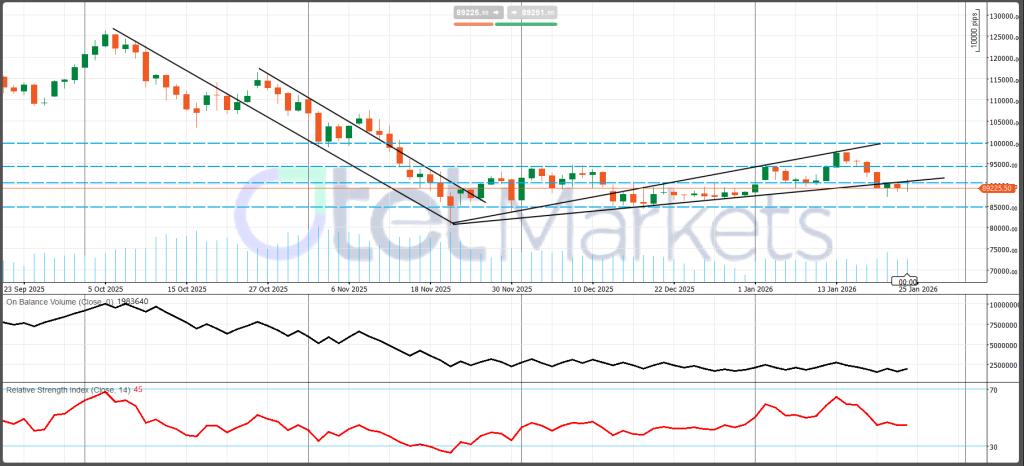
Technically, BTC remains in a post-selloff consolidation: a sharp October–November decline (roughly 125–130k down to ~82k) transitioned into a tightening structure with higher lows, resembling a rising wedge/ascending compression. Momentum is still soft (RSI ~45) and OBV does not yet confirm a strong uptrend, implying rallies may be sold until key levels break. Resistance is 92–93k, then 95k, with 100k as the major cap; support is 89–88k, then 85k, with 82k the critical downside magnet if 85k fails.
Share
Hot topics

What is Balance in Forex? A Complete Guide for Traders
Introduction When you open a trading account for the first time, one of the first numbers you see on your screen is your balance. It looks simple. It looks clear....
Read more




Submit comment
Your email address will not be published. Required fields are marked *