
Policy Week, Crosscurrents Everywhere: Global Economic Outlook – Week 50, 2025
Week 50, 2025 brings a highly policy-driven trading environment, with markets expected to react more to central bank communication than to the rate decisions themselves. As inflation cools and demand remains uneven, policymakers face the challenge of protecting growth while maintaining inflation control. Most advanced economies are expected to hold rates, while selective easing appears likely in some emerging markets. With several key decisions scheduled, global sentiment remains sensitive, and any shift in forward guidance or the expected 2026 policy path could elevate volatility across currencies, bonds, stocks, and commodities.
USA
The U.S. economy continues to move toward a moderated pace of growth, with inflation easing and the labor market softening without breaking. The key unknown for Week 50 is whether the Federal Reserve aligns with the market’s dovish expectations—or reins them in with cautious guidance. For now, the baseline outlook remains a soft-landing trajectory with manageable friction—not recession.
Week 50 is about interpretation—not noise. The Fed’s message and labor-market data will guide expectations for whether this week’s expected cut marks the beginning of a smoother easing cycle into 2026 or a tactical adjustment requiring more evidence before continuing.
U.S. Weekly Macro Summary Ahead of the December FOMC
Recent U.S. data reinforces the idea of a soft landing rather than a recession threat. Growth is cooling gradually, inflation continues to ease, and the overall economic tone feels orderly rather than disruptive. With the December FOMC meeting approaching, markets are now focused less on whether the Fed will cut rates and more on how quickly policymakers will validate dovish rate expectations. Forward guidance may influence markets as much as the decision itself.
Consumers Still Supporting Growth—But Losing Momentum
Consumer spending remains the foundation of U.S. growth, especially in services. However, cracks are starting to appear. The long-delayed September Personal Income and Spending report showed flat real consumption, signaling a softer start to Q4. Goods spending slowed, while services remained resilient. Consumer credit growth also slowed, suggesting tighter borrowing conditions are finally impacting household behavior.
Despite this cooling trend, holiday spending appears healthy, with private-sector tracking pointing to solid Black Friday demand and an estimated 3.5–4.0% growth in holiday retail sales. This supports the idea of a gentle slowdown rather than a collapse.
A Split Economy: Strength in Services, Weakness in Manufacturing
Recent ISM surveys show a widening divide: services activity continues to expand, while manufacturing remains in contraction. Manufacturing weakness—including declines in new orders and employment—signals that the industrial sector is not leading this cycle. Meanwhile, services-driven inflation remains sticky, even as cost pressures ease slowly.
Industrial production data also reflects the same pattern: modest headline gains and stalled manufacturing output, partly due to auto-sector pullbacks. Technology-related production remains a bright spot.
Growth, Inflation, and Labor Remain Stable
The Atlanta Fed GDPNow estimates slipped slightly to 3.5%, consistent with slowing but still solid growth. Disinflation remains intact: September Core PCE eased to 2.8%, and real spending flattened evidence that softer demand is helping inflation drift lower.
Labor data continues to show resilience rather than stress. Jobless claims remain low, and layoffs have not accelerated, suggesting the labor market is cooling via reduced hiring rather than widespread job cuts.
Sentiment and Market Positioning Ahead of the Fed
Consumer sentiment improved slightly as inflation expectations eased. Financial conditions loosened as short-term yields fell, though quantitative tightening continues quietly. Futures pricing now heavily favors a December cut, which may be running ahead of Fed caution.
U.S. Weekly Economic Outlook
Week 50 is shaping up as a pivotal period for U.S. markets, driven primarily by the December FOMC meeting. With the economy still recovering from post-shutdown data delays, traders and policymakers are likely to respond more to the tone and guidance from the Federal Reserve than to isolated data releases. The macro backdrop remains characterized by a soft-landing narrative: inflation is easing gradually, growth is slowing but not collapsing, and labor conditions are loosening without signaling panic.
Data Uncertainty Still Matters
With the Bureau of Labor Statistics revising its release calendar, economic data continues to arrive irregularly. This means every scheduled dataset this week plays a dual role—not only offering fresh insight but also helping restore confidence in trend visibility.
Tuesday’s JOLTS: Key Labor Market Signal
The release of the JOLTS report for October stands out as an essential check on the labor market. Two indicators will be of particular importance:
- Job openings-to-unemployed ratio, which recently dropped below 1. If it continues declining, it will confirm weakening labor demand.
- Quit rate, holding near 1.9%, acts as a proxy for worker confidence. A decline would signal heightened caution, and fewer voluntary job moves.
The JOLTS results will help validate whether cooling labor trends seen in private-sector trackers are becoming more widespread.
The Main Event: FOMC Meeting (Dec 9–10)
The Fed’s two-day meeting remains the center of attention. Markets currently expect a 25-basis-point rate cut, driven by softer labor momentum and elevated—but moderate inflation. However, internal Fed consensus appears less unified than earlier in the year, meaning dissents and Powell’s language may drive market reaction as much as the policy move itself.
The likely outcome is a measured cut, paired with conditional guidance that signals patience rather than commitment to a fast-paced easing cycle.
Midweek Data: Employment Cost Index (ECI)
Wednesday’s ECI release is another important labor cost indicator. Forecasts point to 0.9% quarterly growth and a 3.6% annual pace. If data meets expectations, it will reinforce the view that wage pressures remain elevated but are not accelerating, supporting a cautious easing stance.
Remaining Week: Claims, State Data, and Market Repricing
Thursday’s jobless claims and state-level employment numbers will help test whether labor cooling is broadening geographically. Friday offers no major data, suggesting markets will enter a post-Fed adjustment phase.
Wall Street & U.S. Dollar Weekly Outlook – Week 50, 2025
This week is shaping up to be classic Fed-driven market territory, with both the U.S. dollar and major equity indices — particularly the Nasdaq 100 — poised to react sharply to policy signals and tone rather than just the rate outcome itself. The December FOMC meeting on Dec 9–10 is the clear anchor event. Markets are firmly pricing in a 25 bps rate cut, supported by softer recent data and increasingly dovish interpretations of prior Fed messaging.
However, the lingering distortions in economic reporting following the federal shutdown mean that the guidance from Chair Powell—especially around inflation, labor cooling, and the pace of future easing—may drive markets more than the decision itself. Investors will be focused on whether the Fed validates expectations for additional cuts into 2026 or signals caution.
U.S. Dollar: Soft Bias, But Not One-Way
The dollar is expected to soften modestly if the Fed cuts and frames it as precautionary rather than the start of an aggressive easing cycle. Importantly, sentiment around the dollar is no longer one-directional: recent strategist surveys show a growing minority expecting USD resilience rather than weakness.
A more hawkish-than-expected outcome — such as a rate hold or a conditional cut with firm inflation messaging — could trigger renewed dollar strength via short-covering.
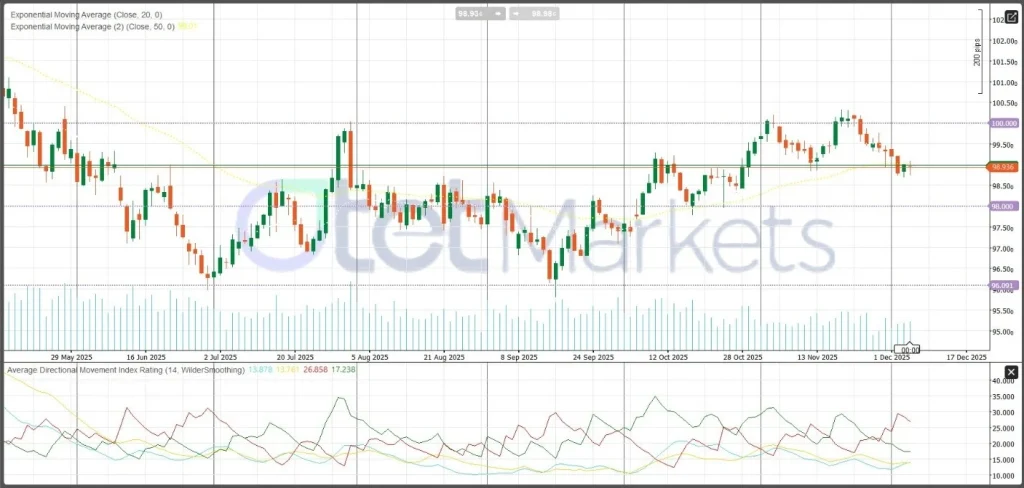
Technically, the USD is consolidating after a recent pullback. The 99.0–99.1 zone near the 50-day EMA is the key pivot:
- Break above: opens upside toward 99.5 and potentially 100.0
- Failure: keeps pressure intact, with support at 98.0, then 97.5 and 96.09
The weak trend readings suggest markets may experience volatile, choppy price action until a clearer directional catalyst arrives.
Wall Street: Nasdaq 100 in Focus
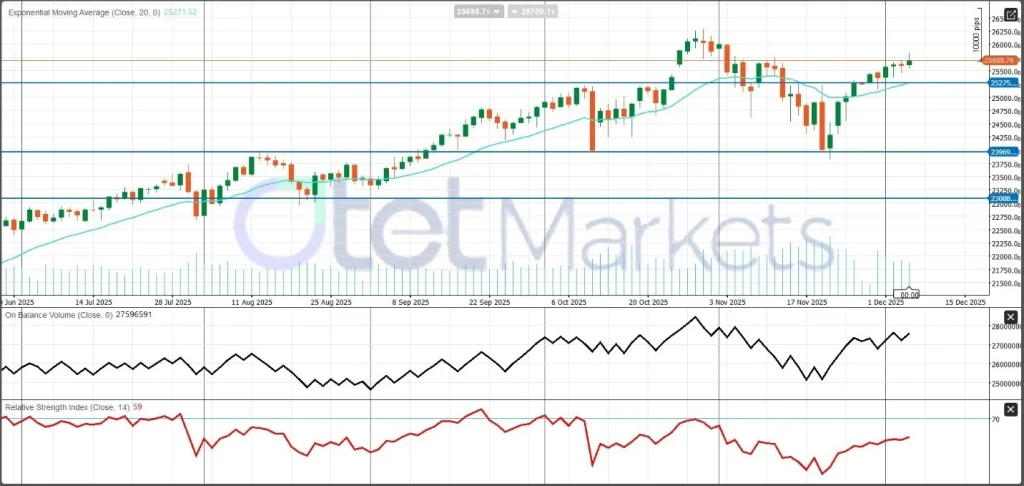
The Nasdaq 100 remains the market’s key sensitivity point due to its long-duration growth profile and reliance on discount-rate expectations. If the Fed confirms a soft-landing narrative with a measured cut, the Nasdaq could extend recent strength — supported further by ongoing optimism around artificial intelligence and long-term earnings growth.
However, if Powell signals that future cuts require stronger justification, upside momentum may slow.
Technically, the Nasdaq maintains a supportive structure above the EMA 20 (~25,271). Immediate resistance sits around 25,700 and then 26,000–26,250, while key supports stand at 25,275, and deeper levels at 23,969 and 23,088 if volatility spikes.
Week Ahead, and Central Banks in Focus
The coming week is set to be unusually active for global monetary policy, and a clear theme is emerging across major central banks: cautious neutrality with selective easing. Most policymakers remain in assessment mode rather than entering a decisive new phase of tightening or easing. The RBA, BoC, and SNB are widely expected to hold rates, reflecting a desire to monitor slowing inflation and uneven demand before committing to further policy moves. Meanwhile, the CBRT and Brazil’s BCB appear positioned for additional small cuts, signaling a controlled easing path where domestic conditions allow more flexibility.
Overall, markets may respond less to the headline rate decisions and more to the tone, forward guidance, and policy language—especially as investors look for clarity on inflation expectations, currency stability, and the possible trajectory for 2026.
RBA — Tuesday, December 9
Expected: 3.6% | Previous: 3.6%
The Reserve Bank of Australia is widely expected to leave rates unchanged, as policymakers attempt to balance sticky service inflation with signs of cooling household spending and slowing economic momentum. While no rate move is anticipated, the wording of the statement will be key, especially on wage dynamics, inflation persistence, and how restrictive current policy settings are considered.
Focus point:
✔ The tone around inflation and labor tightness will signal whether the RBA is leaning toward patience—or preparing for future adjustments.
BoC — Wednesday, December 10
Expected: 2.25% | Previous: 2.25%
The Bank of Canada is likely to hold rates, marking what appears to be the end of its easing phase after October’s final 25 bps cut. Canada’s latest data is sending mixed but generally resilient signals: Q3 GDP growth improved sharply, unemployment fell to its lowest level since mid-2024, and inflation—though moderating—remains above target.
With growth stabilizing and price pressures still elevated, the BoC is expected to keep rates unchanged not only this week—but potentially well into 2026.
Focus point:
✔ Whether the statement confirms the end of the cutting cycle or leaves room for adjustments if inflation cools faster than expected.
BCB (Copom) — December 9–10
Expected: 14.75% | Previous: 15.00%
Brazil’s central bank is expected to deliver a small 25 bp cut, consistent with its gradual and cautious easing approach. While the reduction is modest, the messaging may carry more weight than the move itself. Policymakers will likely reiterate that future cuts depend on inflation expectations, fiscal credibility, and financial stability.
Focus point:
✔ Whether policymakers hint at a slower pace of cuts—or more persistent easing if inflation trends behave.
SNB — Thursday, December 11
Expected: 0.00% | Previous: 0.00%
The Swiss National Bank is expected to maintain its policy rate at zero, continuing a careful stance amid subdued inflation pressures. Given Switzerland’s currency-sensitive economic framework, the SNB’s comments on the Swiss franc and inflation projections will guide market reaction more than the unchanged rate itself.
Focus point:
✔ Any shift in tone regarding tolerance for a stronger franc or deflation concerns.
CBRT — Thursday, December 11
Expected: 38.5% | Previous: 39.5%
Türkiye’s central bank is expected to cut rates by 100 bps, signaling the continuation of its cautious easing trend as inflation gradually eases and credit conditions evolve. However, the communication strategy will be critical to understand whether this move is a one-off adjustment or the beginning of a longer policy cycle.
Focus point:
✔ Forward guidance on inflation, the lira, and whether policymakers will continue easing or pause after this cut.
Energy Market Review & WTI Outlook – Week 50, 2025
The energy market begins Week 50 in a balanced but uncertain state, shaped by competing forces: geopolitical tensions, rising inventories, and shifting expectations around demand and policy. Crude oil remains range-bound, while natural gas prices stay contained by comfortable storage levels.
Crude Oil: Stuck Between Supply Pressure and Geopolitical Risk
Oil prices spent last week fluctuating within a tight band as conflicting drivers held the market in equilibrium. Early weakness came from expectations of a supply surplus and cautious optimism surrounding renewed Russia-Ukraine peace discussions.
- WTI fell toward ~$58.75
- Brent slipped to ~$62.54
The narrative reversed midweek when pipeline strike headlines resurfaced and peace talks stalled, restoring some geopolitical premium. Prices recovered modestly:
- WTI rebounded near ~$59.23
- Brent moved back toward ~$62.89
By week’s end, the picture was mixed but stable: WTI closed near $59.46 (up ~1.5%), while Brent held around $63.12. This reflects a market where neither fundamental surplus signals nor geopolitical risks are dominant enough to drive a breakout.
Supply Fundamentals: Inventories Rising, U.S. Rigs Increasing
Inventory reports leaned bearish. The latest EIA update showed builds across crude and refined products, including:
- Crude: +0.574M barrels
- Gasoline: +4.518M barrels
- Distillates: +2.059M barrels
At the same time, U.S. production signals continued drifting upward, with the oil rig count rising to 413 and total rigs climbing to 549. Together, rising supply and stocked inventories restrain bullish upside and reinforce the current consolidation trend.
WTI Weekly Outlook: Policy and Reports Drive Momentum
WTI enters the week around $60 per barrel, supported by expectations of a Fed rate cut during the Dec 9–10 FOMC meeting, which could improve demand sentiment. OPEC+ maintaining steady output guidance and ongoing sanctions dynamics add uncertainty.
Key scheduled releases — including the EIA Weekly Petroleum Report, the EIA STEO, IEA OMR, and OPEC MOMR — may reset forward supply-demand expectations.
Technical Picture: Stabilizing but Not Yet Bullish
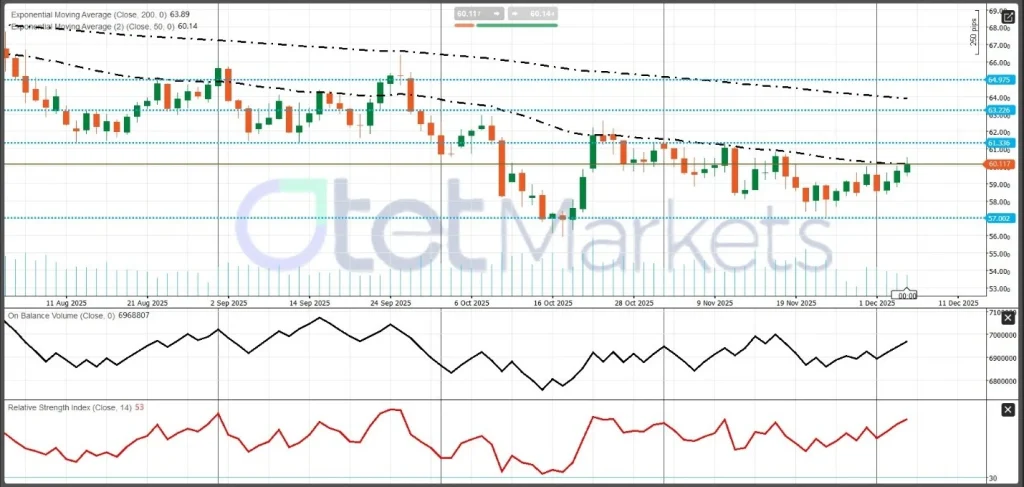
WTI is attempting to build a base near the 50-day EMA, while the 200-day EMA at ~$63.9 remains the key reversal threshold. RSI near 53 signals neutral-bullish potential, and improved OBV hints at early accumulation.
- Resistance: $61.33 → $63.23 → $63.9–$65.00
- Support: $60.00 → $57.00 (major floor)
Gold Market Update & Weekly Outlook – Week 50, 2025
Gold enters Week 50 trading with a steady tone, holding near the $4,220–$4,230/oz level as the market prepares for the upcoming December 9–10 FOMC meeting. Although prices dipped slightly over the past week, the broader macro picture remains supportive. Expectations of a 25-bps rate cut, easing U.S. real yields, and a softer U.S. dollar continue to reinforce a constructive environment for gold.
Current Market Drivers: Data, Dollar, and Policy
Market pricing now assigns roughly a 90% probability of a rate cut, and falling short-term yields reflect growing confidence that monetary policy is shifting toward accommodation. Recent U.S. data supports the soft-landing narrative: Core PCE slowed to 0.2% m/m and 2.8% y/y, real consumption flattened, and consumer credit growth softened. These signals show cooling demand without recessionary stress — a macro mix that benefits gold.
Inflation expectations are also edging lower. The latest University of Michigan survey showed declines in both one-year and five-year inflation forecasts, reinforcing expectations of lower real rates ahead — another supportive factor for gold.
The U.S. dollar pulled back last week while EUR, GBP, and JPY showed moderate recovery. Several strategists now expect further dollar weakness into year-end and early 2026 as rate differentials narrow. Meanwhile, risk assets rallied — including equities and Bitcoin — prompting some mild profit-taking in gold but not enough to disrupt the broader bullish structure.
Key bullish drivers remain intact:
- Lower real yields
- Weaker dollar environment
- Higher probability of Fed easing
- Cooling inflation and steady demand
These dynamics continue to support ongoing institutional and central-bank demand.
FOMC Decision: Main Catalyst for Price Direction
The Federal Reserve meeting is the most influential event for gold this week. The cut itself is widely expected — meaning tone and forward guidance will likely move markets the most.
- Base case: A data-dependent, balanced cut keeps gold stable.
- Bullish outcome: A cut with openness to further easing in 2026 could trigger a breakout.
- Risk scenario: A hawkish tone or no cut could spark a short pullback.
Technical Outlook: Bullish Bias Still Intact
Gold remains in a bullish consolidation phase, holding above both the 20-day and 50-day EMAs. RSI near 60 suggests mild upside room, while OBV remains steady — signaling digestion rather than distribution.
Key levels:
- Resistance: $4,198–$4,200 and $4,380
- Support: $4,141, then $4,031, with deeper support at $3,877 if volatility rises

Crypto Market Update & Bitcoin Weekly Outlook – Week 50, 2025
The crypto market starts in Week 50 in a recovery and stabilization phase after a sharp correction earlier in December. Bitcoin’s sell-off — followed by a fast rebound back above $90,000 — appears to have been driven more by leveraged unwinding than weakening fundamentals. Research from BCA suggests the recent volatility stemmed from forced liquidations and speculative repositioning rather than a shift in long-term sentiment or macro conditions.
Sentiment Reset, Long-Term Thesis Unchanged
Several short-term triggers contributed to the pullback: Tether’s rating downgrade, algorithmic trading rebalancing, renewed regulatory pressure from China, and speculation that MicroStrategy may sell a portion of its holdings. Positioning metrics confirm that the flush-out was extreme — with over $19B in liquidations during October and key valuation metrics slipping below fair value. Fear gauges also reset, with the Crypto Fear and Greed Index falling to lows last seen during the 2022 bear market.
Despite this sentiment shock, institutional adoption continues to grow. Vanguard now permits crypto allocations, Bank of America recommends a 1–4% allocation, and ETF flows have turned positive again. BCA reiterates its view of Bitcoin as a global wealth hedge, similar to gold, benefiting from limited supply and growing long-term adoption. The firm upgraded BTC to overweight, viewing dips below $90K as attractive for long-term buyers.
Market Conditions: Stabilizing, but Not Fully Risk-On
Bitcoin is currently consolidating in the high $80K–low $90K zone, while altcoins lag — a sign the market is still cautious and not yet rotating into high-risk speculative assets. BTC continues to behave like a macro-sensitive liquidity asset, responding closely to interest-rate expectations and central-bank tone.
Fed Meeting: The Main Catalyst
The December 9–10 FOMC meeting is the dominant event this week. A 25-bps rate cut is widely expected, but Powell’s communication will likely determine whether BTC stays range-bound or attempts a breakout.
- Base case: Supportive cut → stability in current range
- Bullish case: Cut + dovish guidance → potential upside breakout
- Bearish case: Hold or hawkish tone → renewed downside pressure
Technical Outlook: Stabilizing, Not Reversed
Bitcoin remains in a base-building phase rather than a confirmed uptrend:
- Resistance zones: $90K–$90.7K → $92K → $94K → $97.5K
- Support zones: $89K–$88K → $85K if selling resumes
- RSI near 41 and declining OBV signal cautious momentum
A confirmed break above $97.5K would signal a trend reversal.

Share
Hot topics

What Is a Forex PAMM Account? Complete Guide
Introduction If you’ve ever wanted to invest in Forex but had reservations about doing it alone, you’re not by yourself! Many people are interested in investing in the Forex market...
Read more




Submit comment
Your email address will not be published. Required fields are marked *