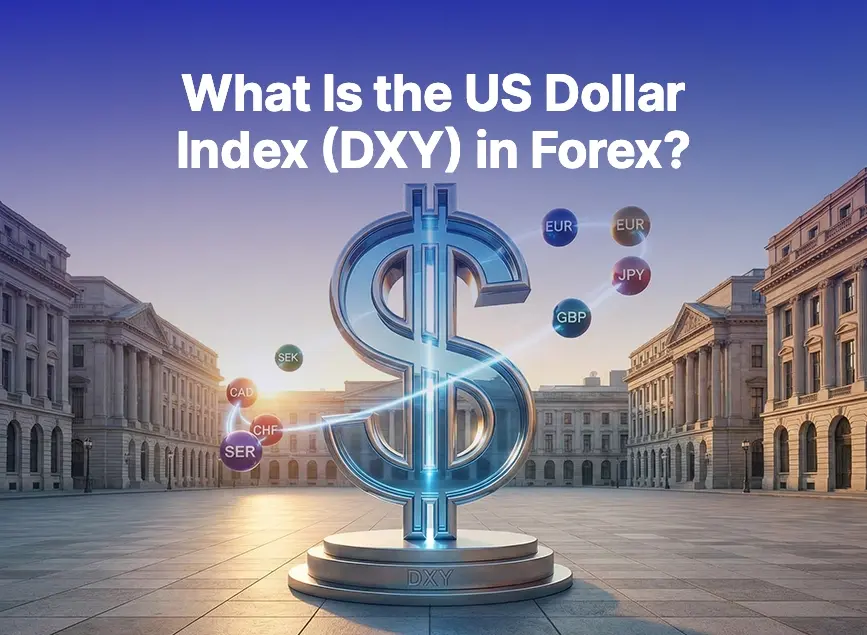
What Is the US Dollar Index (DXY) in Forex?
If you’ve spent any time exploring global markets, you’ve certainly heard about the US Dollar Index, known as DXY. For many beginner traders, it appears to be one of those complex financial techniques that analysts discuss on television but never completely explain. However, the DXY is more practical than it seems, and if you figure out how it works, it may become one of the most valuable indicators in your daily trading decisions.
Whether you trade major currency pairs, commodities, or cryptocurrencies, understanding how the DXY operates can help you recognize market momentum, identify early trend shifts, and make better decisions. Consider it like learning to read the weather: you can’t control what will occur, but you can plan for it. In this article from otetmarkets, we’ll talk about what the DXY is, why traders examine it so closely, how it’s calculated, and how you can use it in your own trading strategy. The idea is simple: to explain everything in a natural way without bombarding you with academic verbiage.
To keep things simple, the dollar index meaning refers to how the market measures the overall value of the USD compared to other major currencies.
A Simple Explanation: What Exactly Is the DXY?
The US Dollar index is an indicator that measures how well the dollar has performed when compared to other currencies. The dollar index is the best way to represent how the dollar’s performance can be evaluated as a whole.
An increasing dollar index indicates that the dollar is becoming stronger, whereas a decreasing dollar index indicates that the dollar is becoming weaker. Because of the major role that the dollar plays within the current financial system, it is a simple matter to calculate the dollar index.
With about 80% of all currency transactions occurring with US dollars, it is no surprise that investors look to the dollar during times of uncertainty. With so many consequences, it seems natural that traders seek a single indicator to understand what the dollar is doing — and the DXY is exactly that indicator.
Where the DXY Comes From
The US Dollar Index (DXY), first introduced via the Intercontinental Exchange (ICE) in 1973, was created during the early years of substantial change in Exchanges and Trading, as well as global financial markets. Before that year, many currencies were directly tied to the value of the US dollar, which was itself tied to Gold.
Once the United States eliminated the “gold standard” from currency usage, currencies became “free float”. This meant that the value of each individual currency could fluctuate based on supply/demand.
The introduction of the DXY led to extreme fluctuation. It provides an easy method for measuring how the US dollar performed overall and throughout all the different International Currency Exchanges. From that point forward, traders have a dependable standard to compare currency movements.
Even now, fifty years later, the DXY remains one of the most widely followed indicators in global financial markets.
After understanding where the DXY comes from, let’s see which currencies make up the index and why they’re included.
The index does not include all currencies in the world. Instead, it is determined using a specified basket of six main currencies:
- Euro (EUR) – ~57.6% weight
- Japanese Yen (JPY) – ~13.6%
- British Pound (GBP) – ~11.9%
- Canadian Dollar (CAD) – ~9.1%
- Swedish Krona (SEK) – ~4.2%
- Swiss Franc (CHF) – ~3.6%
The euro represents more than half of the index, hence EUR/USD often has a strong inverse relationship with DXY. If the DXY rises rapidly upward, the EUR/USD tends to fall. If the DXY drops, the EUR/USD often goes upward.
You do not need to remember the precise numbers, but understanding the relationship explains why the DXY is so important when examining key currency pairs.
Why does the DXY matter so much to traders?
For someone new to forex, the DXY might seem like just another chart, but it serves a function that individual currency pairs do not. It provides a comprehensive, balanced assessment of the dollar’s strength in numerous global markets.
Read More: U.S. Dollar Index Rises Amid Improved Consumer Confidence
This takes us to a different term, the dollar strength index. Some traders refer to the DXY as the dollar strength index because it reflects the US dollar’s relative strength or weakness against other major global currencies. This is important for multiple reasons:
-
It Helps Predict Market Movements
When the DXY rises, it typically indicates risk aversion. Investors pump money into the dollar because they are concerned about the future. As a result:
- Gold prices tend to decrease.
- EUR/USD and GBP/USD regularly fall.
- Emerging-market currencies weakened.
When the DXY falls, the opposite usually occurs. Money moves into higher-risk assets, pumping up stocks, commodities, and cryptocurrencies.
-
It Creates a Clearer Trading Context
Assume you notice the EUR/USD falling significantly. Before you jump in, you look up the DXY. If the DXY rises, your analysis makes sense: the US dollar is strengthening overall. However, if the DXY is flat or decreasing, something else is driving EUR/USD, probably a euro-related event.
-
It Helps You Avoid False Signals
Indicators for a single currency pair might sometimes be misleading. However, looking at a wider DXY picture might assist in determining if a trend is real or short-term.
For instance, if your EUR/USD chart indicates a bullish pattern but the DXY is reaching new highs, you might prefer to be cautious. Simply defined, the DXY allows you to understand why a currency pair behaves as it does.
Breaking Down the Calculation (In a Simple Way)
You may see extensive formulas online that demonstrate how the DXY is calculated, but traders generally do not need to memorize them.
The index calculates the value of each currency in the basket by comparing its exchange rate to the USD, adjusting for weight, and combining the results.
The starting value was set at 100 in 1973. So, if the DXY is 105 today, it signifies the dollar has strengthened by 5% since 1973.
If it is 95, the dollar has fallen by 5%. The calculation itself is more complex, but understanding how it works is considerably more important than knowing the exact math.
How Traders Use the DXY in Real Life
Here is a typical example of what you would find in an EUR/USD trading function: You see the EUR/USD is trending downwards, and you want to determine if it is a temporary move or the start of a more significant trend. To confirm your current analysis of the EUR/USD pair, you encounter a DXY Chart.
When the DXY price has broken through a significant resistance level, it is an indication of increasing US dollar strength against all currencies. This gives further indicators to confirm that EUR/USD is indeed going down. The practice of looking for confirmation through cross-analysis occurs frequently with all types of professional traders.
Another Scenario: Gold Traders Rely on It Too
Gold (XAU/USD) has frequently shown an inverse relationship with the DXY. When the dollar strengthens, gold becomes more expensive for international buyers, and the demand reduces, This drives gold prices downward.
When the US dollar weakens, gold prices often rise. So, even if you never trade euro pairs, the DXY can help guide your decisions.
DXY and Market Sentiment: A Practical Interpretation
DXY and Market Sentiment: A Practical Interpretation.
One of the most useful features of tracking the DXY is determining how it reflects global sentiments.
When DXY rises, it frequently indicates:
- Investors are seeking protection.
- Stock markets might be under pressure.
- USD assets become more desirable.
- Riskier currencies weakened.
A rising DXY can be interpreted as indicating that the world is in “defensive mode.”
When DXY falls, this usually indicates:
- increased trust in global markets.
- Investors shift funds to stocks and risky currencies.
- Commodity prices are rising,
- USD pairings are experiencing fluctuation.
A dropping DXY often indicates a more bullish economic scenario. Over time, you will discover trends in DXY fluctuations and currency pair behavior. This instinct is one of the aspects that distinguishes skilled traders from beginners.
The Connection Between DXY and Forex Trading Strategies
Traders apply the DXY in many ways, but here are three of the most common ones.
-
Trend confirmation.
Before entering a USD order, many traders check the DXY to confirm the dollar’s overall direction. This allows them to avoid trading against the bigger trend.
-
Reversal Detection
When market sentiment moves, the DXY frequently reacts quickly. A quick break through support or resistance level can indicate an upcoming reversal in major pairs.
-
Correlation Trading.
Pairs such as EUR/USD, GBP/USD, USD/JPY, and gold have well-known connections with the DXY. Understanding these connections might help you construct better trading strategies.
How to Read DXY Forex Charts Like a Professional (Without Overcomplicating Things)
In this section, we will also discuss another term that you have requested to include, which is referred to as DXY Forex. The term is very simply defined by Forex traders as the DXY Forex analysis of the USD Index as part of their currency trading process.
Here are some basic tips for reading DXY Forex charts:
- Strong breakout events will usually indicate that a Major USD trend is developing.
- Divergence seen on DXY and USD Pairs
- Economic conditions such as inflation, interest rates, unemployment numbers, etc.
- Simple Tools such as trend lines, Moving Averages, and Support/Resistance levels
- Avoid over-analysis; simplicity is effective with the DXY.
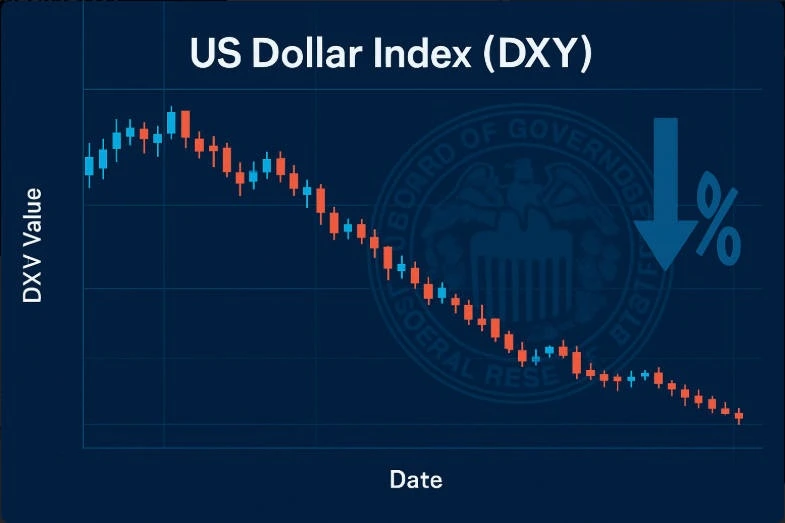
The DXY is highly responsive to U.S. economic data, as these events directly impact the value of the dollar (USD). For example, the DXY will typically increase when the Federal Reserve raises interest rates, so you can see this reflected in the price chart of the DXY.
Why the DXY Matters Beyond Forex
The DXY is intended to be used by traders as a benchmark for determining interest rates; however, it has a wider impact beyond just Currency trading. Its movements also affect the following global markets:
- Commodity prices
- Stock markets
- Global trade
- Investment flows
- Corporate earnings
For instance, if the DXY is high, the price of US goods sold in foreign markets will be higher, making it harder for US exporters to sell their products overseas. Conversely, for US travelers, their purchasing power abroad increases when the USD is strong. That is why economists, investors, and central banks all pay close attention to these movements.
Limitations of the DXY (Yes, It’s Powerful — But Not Perfect)
While the DXY is extremely useful for traders, it is also important to understand the limitations of this indicator.
-
The Basket Is Outdated
The DXY was created in the 1970s, and over then, the global economy has changed dramatically. Major modern trading partners, such as China, Mexico, and South Korea, are not included in the basket of currencies used to create the DXY.
-
Heavy Euro Weight
The DXY tends to move in the opposite direction to the Euro/U.S exchange rate because the Euro comprises over half of the DXY. Because of this, the DXY can often be expected to move in the opposite direction of the Euro/U.S exchange rate, which some traders believe limits the DXY’s reliability as a market indicator.
-
Not a Perfect Reflection of Global USD Strength
The DXY is a helpful market indicator, but it does not necessarily reflect how the U.S. dollar performs against every major economy.
However, despite these limitations, the DXY remains a key indicator of USD trends on a global level.
How the DXY Helps Everyday Traders
Assume you’re new to trading and open your chart to see EUR/USD falling rapidly. You can be unsure if you should sell, wait, or ignore the move. However, when you look at the DXY, you will find that it is slowly rising.
Suddenly, the scenario becomes apparent. You now realize that the downward movement is not random; it is part of a bigger USD-strength trend.
This simple awareness can prevent you from making emotional decisions. That’s the true value of understanding the DXY: not just learning what it is, but also learning how to “read” the market with greater context.
Final Thoughts: Why Learning the DXY Makes You a Better Trader
Understanding the US Dollar Index is one of the smartest investments you can make in your trading education. To get started, you do not need to have a deep understanding of complex financial concepts or formulas. Rather, your key to success in relation to the US Dollar Index is simply to create the habit of checking the Index frequently and understanding its price movements.
Having the ability to identify how the US Dollar Index behaves will give you better insight into the entire Forex market. As you continue to learn and practice this skill set, you will develop an increased level of comfort and familiarity with it.
Whether you trade major currency pairs, commodities, equity indices, or cryptocurrencies, you will always use the DXY (US Dollar Index) as an extremely valuable resource. Think of it as the heartbeat of the global currency market — steady, revealing, and always worth listening to.
Share
Hot topics

Gold symbol in forex
Introduction If you have ever opened a trading platform and searched for gold, you probably noticed a specific code instead of the word “gold.” In the forex world, assets are...
Read more



Submit comment
Your email address will not be published. Required fields are marked *