Understanding Exchange Rates in the Forex Market
Every time you have traveled to another country, transferred money overseas, or checked online before the holidays, you have had an interaction with currency or exchange rates; even if you did not call it that, they were there quietly changing what you bought or used. In the forex market, exchange rates play an even more pivotal role than they do in everyday global economic activity.
Understanding currency exchange rates is essential because they quietly influence how much value we receive when converting money between different economies.
At OTET Markets we often speak with traders who feel curious but somewhat confused about how exchange rates work. This article is devoted to helping you with that by explaining the entire process with step-by-step examples, making it as clear and relatable to you as possible.
What an exchange rate really represents
An exchange rate compares the value of one currency to another. It is a way to determine how much money you need to spend to receive a certain amount of foreign currency. For example, if you see that the value of one euro today has increased compared to one month ago against the US dollar then some changes have occurred in the market.
The exchange rate is not fixed and changes often based on news releases regarding economic data, political events, and the overall feelings that the market has toward the respective economies. An exchange rate is a representation of how the economy of each country is performing and how the economies of each country are linked together.
Exchange rates act as a bridge between national economies, reflecting differences in growth, stability, and investor confidence. As these factors shift, exchange rates respond almost instantly, offering traders insight into how markets react to economic change in real time. When people reference an exchange rate for currency, they refer to the fact that these values are constantly changing.
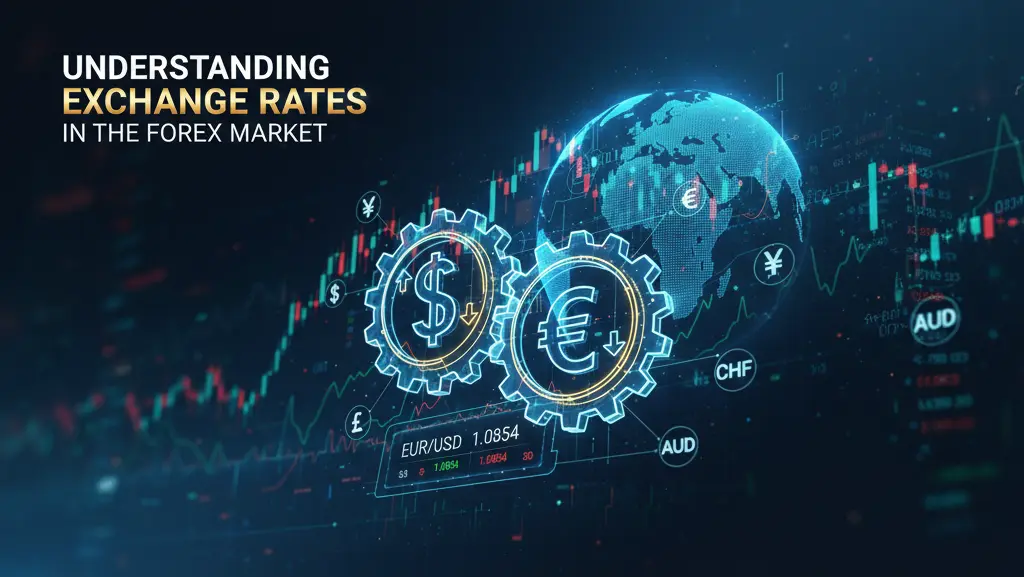
The forex market in simple terms
The forex market is where dealers can buy and sell different types of currency. Unlike a stock exchange, which has a specific central place where all trades occur, the forex market is conducted entirely electronically across numerous global financial markets. The forex market operates 24 hours a day on weekdays.
In the forex market, there are banks, financial institutions, corporations, governments, and retail traders all participating. Some participants exchange currencies for business needs, while others engage in speculative trading or hedging activities. It is this diversity of market participants that provides liquidity and flow to the forex market.
In order to understand why exchange rates are always in flux, you must first understand how the forex market operates.
Currencies are always traded in pairs
This section focuses on forex pairs explained in a simple and practical way for new traders. In forex, no currency is traded alone. Instead, all currency is traded against another. It does not only look at the actual value of a currency, it also shows the relationships between two economies.
When EUR/USD rises, it means that the euro has increased in value against the dollar; a falling EUR/USD shows that the dollar has gained strength over the euro. The relative value comparison of two currencies is what makes forex trading different and interesting.
Base currency and quote currency
Every currency pair consists of two Parts; The base currency and the quote currency. The exchange rate tells you how much of the quote currency you need to buy one unit of base currency.
For instance, if EUR/USD trades for 1.10, it means one euro costs $1.10. Once you understand this simple structure, it will help you understand price movement.
This example helps clarify the forex rate meaning by showing how one currency is valued against another in real market conditions.
To successfully read charts and confidently place trades, you need to understand this relationship.
Major, minor, and exotic pairs
Not all currency pairs will necessarily behave the same way, there are often currency pairs which can be traded with much higher frequency than other pairs. The major currency pairs include: the US dollar (USD), the euro (EUR), Japanese yen (JPY), and British pound (GBP), and those pairs generally exhibit high liquidity and tighter spreads.
The minor pairs are simply the currency pairs that consist of some major currencies, but not including the US dollar, for example, (EUR/GBP). On the other hand, exotic pairs contain one major currency and some currency from a developing economy, and those pairs tend to move more sharply and have the highest volatility.
Understanding the type of currency pair you are trading provides you with a better understanding of the potential risk factors and opportunity associated with that pair.
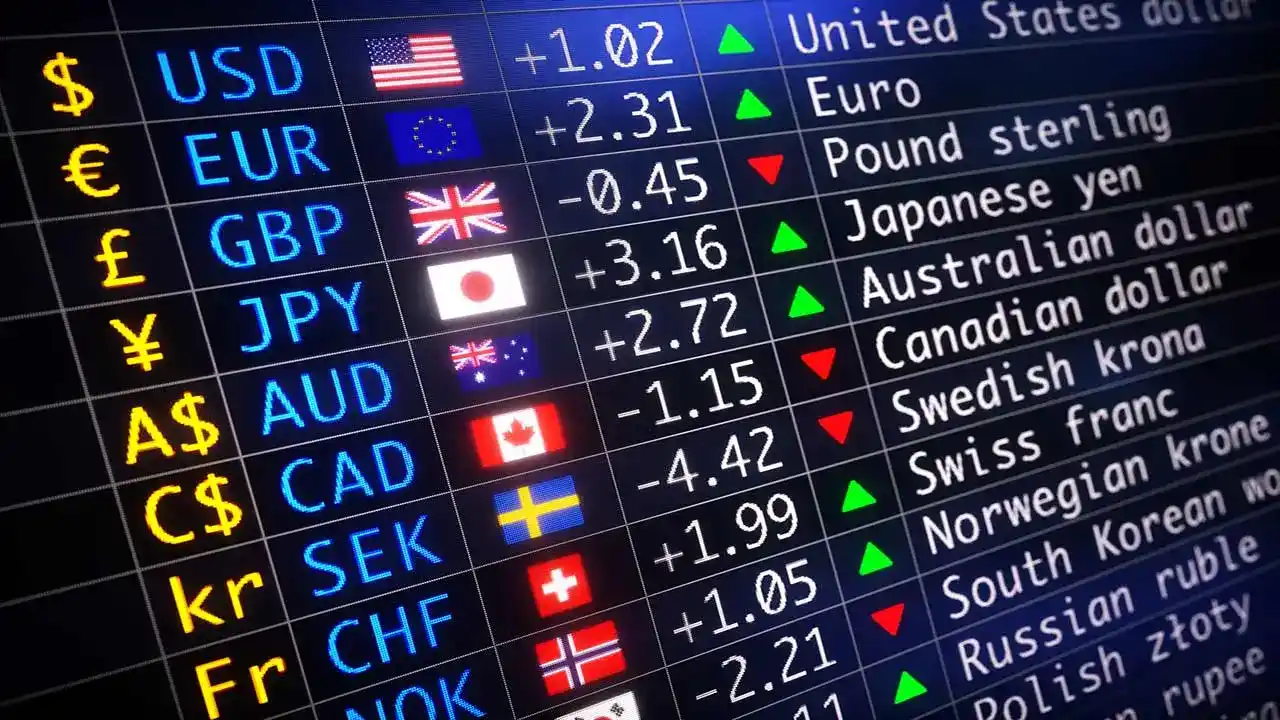
What drives exchange rate movements
Currency supplies and demand determine the exchange rates. When demand for a currency increases, it means the value will increase, but when demand falls for a currency, it means the value will decrease. There are many forces behind this simple idea.
Interest rates are one of the important factors for a currency’s value. Typically, higher interest rates will attract foreign investment, and increase demand for a currency, but in lower interest rates the opposite will occur. Therefore, forex traders closely follow the central bank decisions regarding changes in interest rate policy.
Economic indicators including inflation, GDP and employment are just a few factors that can impact market expectations and price movement for currencies.
The role of central banks
Central banks play an important role among the most dominant factors in the forex market. They directly influence interest rates and the money supply with their policies; therefore, even slight changes in the wording of central bank speeches can create substantial volatility in the market.
Traders often review central banks’ press conferences, statements and meeting minutes to understand future policy expectations and direction. Traders do not speculate; rather, they evaluate signals to help manage their future monetary policy expectations.
Central banks may also intervene directly in the market to stabilize their currency, although this practice is less common today than in the past.
Political and global events
Global events and politics also have a significant impact on exchange rates. These can be things such as elections, trade negotiations, conflicts or geopolitical tensions and they all influence the confidence of the investors and traders. When uncertainty increases for any reason the traders will usually switch to what they perceive as safer currencies.
For instance, unanticipated political news can cause sudden price swings, often within minutes. These experiences remind forex traders that the forex market is not just an aggregation of charts or numbers, but also a reflection of real world events.
By understanding this correlation, forex traders are better prepared.
Market sentiment and psychology
Price movements are not always determined only by economic fundamentals. The traders’ collective view on risk (emotions), and market sentiment also plays a significant role in driving price action. Sometimes prices move because traders expect others to act in a certain way. Understanding the mental element of trading is essential when trying to interpret the price action. As a result of this influence, the trend may take longer to develop or may turn on a dime when traders collectively shift their opinion of the risk.
At OTET Markets, we encourage traders to utilize both technical analysis and to develop an understanding of current trader sentiment in the markets.
Read More: Investment Psychology: How to Make Rational Decisions
How traders analyze exchange rates
The methods that forex traders use to analyze exchange rates are many. Some traders utilize technical analysis based on charts and indicators to identify trends and patterns. Others prefer to use fundamental analysis based on economic data and news events.
Most forex traders will utilize both methods. In addition, the traders might often take advantage of fundamentals to determine the overall trend, while at the same time, using technical analysis to identify when to enter or exit trades.
Ultimately, there is no single “best” way to analyze forex market movements. Success comes from consistency, discipline and a commitment to learn.
Risk and reward in forex trading
Trading exchange rates comes with risk. Prices fluctuate quickly, and leverage may cause both gains and losses. This is why risk management is required.
Successful traders usually focus on risk management over maximizing their profit. They set clear limits, place stop-loss orders, and only risk what they can afford to lose.
Education and preparation can help transform forex trading from a guessing game to an organized activity.
Read More: How to Manage the Risks of International Stock Trading
Learning forex step by step
Understanding forex does not occur instantly. It builds gradually, through reading, observing, and practicing. The majority of traders choose one or two currency pairs to follow closely and observe how they respond to news.
Keeping a simple journal can also help. Writing down why a currency moved or how a trade played out reinforces learning over time.
At OTET Markets, we believe education should feel supportive, not overwhelming.
Common misconceptions about exchange rates
People often believe that exchange rates are manipulated or controlled by hidden rules. While the actions of larger players influence the market, exchange rate determination arises from the collective actions and expectations.
Another misconception is that understanding forex requires complex mathematical models or formulas. In reality, the core concepts become intuitive when explained clearly. By focusing on fundamentals and staying curious, traders will be able to cut the confusion and uncertainty of forex.
Exchange rates and long-term trends
Exchange rates can form long-term trends influenced by economic cycles. Therefore, traders will be able to use knowledge of the historical trends of the foreign exchange market to determine how to take advantage of these trends.
Understanding how to identify these historical trends allows traders to develop their trading strategies to align with the market, rather than to go against the market. In addition, having patience and perspective is critical for success in this process.
Putting knowledge into practice
Learning about exchange rates is only the first step. Applying that knowledge thoughtfully is where real progress happens. Demo accounts and educational tools allow traders to practice without pressure.
Over time, patterns become clearer, and confidence grows. The goal is not perfection, but steady improvement.
Forex trading is a journey, and understanding exchange rates is a strong foundation for that journey.
Final thoughts from OTET Markets
Exchange rates are the foundation of the forex market, connecting economies and shaping daily trading decisions. By understanding how they work and what drives their movement, traders can approach the market with greater clarity and confidence. At OTET Markets, we believe clear education is the first step toward informed and responsible trading.
A clear understanding of exchange rates helps traders make informed decisions, manage risk more effectively, and better interpret market movements. With the right knowledge, forex becomes less intimidating and more structured, even for those at an early stage of their trading journey.
Over time, this understanding supports long-term development, allowing traders to refine decision-making skills and remain adaptable as market conditions evolve. A strong foundation in exchange rates encourages patience, discipline, and a more structured approach to navigating the forex market confidently.
Share
Hot topics
What is Balance in Forex? A Complete Guide for Traders
Introduction When you open a trading account for the first time, one of the first numbers you see on your screen is your balance. It looks simple. It looks clear....
Read more


Submit comment
Your email address will not be published. Required fields are marked *