
ECN vs Standard Account: Which Is Better
If you have put in any time learning to trade Forex, you will find yourself faced with some kind of decision on what account type to pick. Although this may not seem like an important decision, the account you pick will change almost every aspect of your trade – your cost, how fast your orders will fill and what strategies you will ultimately utilize. When it comes to different types of accounts, the two most often seen are ECN and Standard. Because brokers typically market their special accounts as the “best”, it can be a bit confusing at first to discern the difference between them. But once you strip away all the components of the different accounts and put them in plain, simple, language, knowing which one to pick can be simplified.
In this Outet Markets post we are going to discuss ECN vs Standard trading and then discuss what the different forex account types mean and then we will discuss what the spreads are like. At the end you will be better prepared to understand what account is really (for you & not just what looks best on the brokers website) Let’s get started.
First What do ECN and Standard Accounts Mean?
Before we can even consider a decision you need to know what these terms actually are. A Standard account is defined as the most standard type of Forex account. When you execute a trade it is routed through the broker’s in-house system. You can think of it as executing your trades “with” the broker. The prices come from liquidity providers, but the broker is issued in the quoting price and often getting paid for the execution.An ECN account (Electronic Communication Network) is a type of account that allows you to interact directly with the market and trade the raw prices derived from various banks, institutions, and liquidity providers, as if you were a player in a global market. All of them have their own advantages, disadvantages, and purposes.
The Forex Account Types
There are many types of accounts in Forex; however, retail traders would consider ECN and Standard accounts to be the most two common ones. Brokers may also have accounts named micro accounts, zero spread accounts, or just copy-trading accounts; however, in general, they function under one of the two accounts that you may choose.
Ultimately, when choosing between the two accounts, you are choosing between:
- How orders are executed
- How much you will pay in spreads (or commissions).
- How fast you get into a position
- How close your experience is to the “real market. “
So lets look closer.
What is a Standard Account?
Standard accounts are generally where beginner traders will start. You trade using fixed or variable Market Spread and the brokers fee is generally encompassed in the spreads shown. I like an account that includes all of the trader fees within the transaction spread so that I don’t have a distinct charge apart from the spread.
So let’s say the EUR/USD has a price difference of 1.2 pips in a standard account, that price difference is already priced with the brokers markup.
Standard accounts are popular because:
- Straightforward
- No commission,
- Leverage options are flexible
- Require not a lot of experience and etc.
Standard accounts may not be the best choice for someone who is looking for the tightest spreads and fastest execution.
What is an ECN Account?
An ECN account will do something differently.Rather than taking a mark-up on the spread, brokers will directly give you the raw price from their liquidity provider. In fact, this spread can be incredibly low, even as low as 0.0 pips.
However, nothing is free. Typically, ECN accounts charge a commission on each trade. So even if you are getting a tighter spread, you are paying for each position when you open and close them.
ECN accounts are known for:
- Very tight forex spreads
- Fast execution
- Transparent pricing
- Better for trading strategies like scalping.
When you trade with ECN accounts, your orders are directly sent to the market which means that your execution will be cleaner, faster and less likely to be manipulated.
Read More: What is an ECN Account?
ECN vs Standard Trading: What They Each Represent.
Now that we have defined ECN vs Standard trading, let’s take a look at them in practical terms.
-
Execution Model
ECN: Direct access to liquidity pool.
Standard: Execution through the broker.
-
Cost Structure
ECN: Low spreads + commission per trade
Standard: Higher spreads + no commission
-
Suitability
ECN: Best for experienced traders
Standard: Best for beginners, or traders who rarely trade.
-
Transparency
ECN: More transparent pricing
Standard: Heavily dependent on the brokers model.
All of this is important considerations when you are determining your trading costs, your profits, and your overall experience.
Understanding forex spreads
At the foundation of ECN vs Standard accounts is the concept of forex spreads, which is the hidden cost of trading.
Although spreads for ECN accounts are very low because they come straight from the market, they can range even between 0.0 to 1 pip on major pairs when active on the market.In Standard Accounts, spreads are generally higher, usually between 1 to 2.5 pips, as the broker adds their markup. For scalper and day trader, spreads are a large component of your profitability. A difference of even one pip on every trade can have a large impact on your results over time.
Example in Reality: Cost Comparison
Let’s say for the sake of example, you make 10 trades a day on EUR/USD trading 0.10 lots.
Standard Account:
Average Spread: 1.5 pips
Cost per trade: approximately $1.50
Total daily cost of trading: $15
ECN Account:
Spread: 0.2 pips
Cost: $1 commission per round turn
Total cost of trading: $1.20
Total daily cost of trading: $12
Now, imagine this over 20 trading days. Small differences start to add up. However, if you make only 1 or 2 trades per week, the difference may not mean much – which is why your account choice would need to reflect your trading style.
ECN Accounts Pros and Cons
Let’s distill it simply:
ECN Account Pros:
- Tight spreads
- Faster execution
- Best for scalping and more active traders
- Pricing is clearer and more transparent
- Lower slippage during busy trading hours
Read More: Benefits of ECN Accounts in cTrader
Cons of ECN Accounts:
- Commissions
- Higher minimum deposits
- More complicated for beginner traders
- You will need to manage risk exactly
Many traders prefer ECN when they seek precision and want to enter the market at the real price based on supply and demand.
Standard Accounts Pros and Cons
Pros of Standard accounts:
- No commission
- Simpler pricing
- Good for new traders
- Often lower minimum deposits
- Easier for swing and long-term traders
Cons of Standard accounts:
- Higher spreads
- Not ideal for scalping
- Higher slippage during any volatility
- You are dependent upon the brokers model for execution
Standard accounts simplify the overall effort and therefore less accuracy.
Which Type of Account Is Preferable for Beginner Traders?
Standard accounts are often easier for beginners to use because:
- They are more straightforward
- They do not require calculating commissions
- They are more forgiving
- They often have a lower deposit requirement
While you are learning, Standard accounts will allow you concern yourself with the basics of trading, strategy, discipline, and psychology, without worrying too much about variations in technical execution.
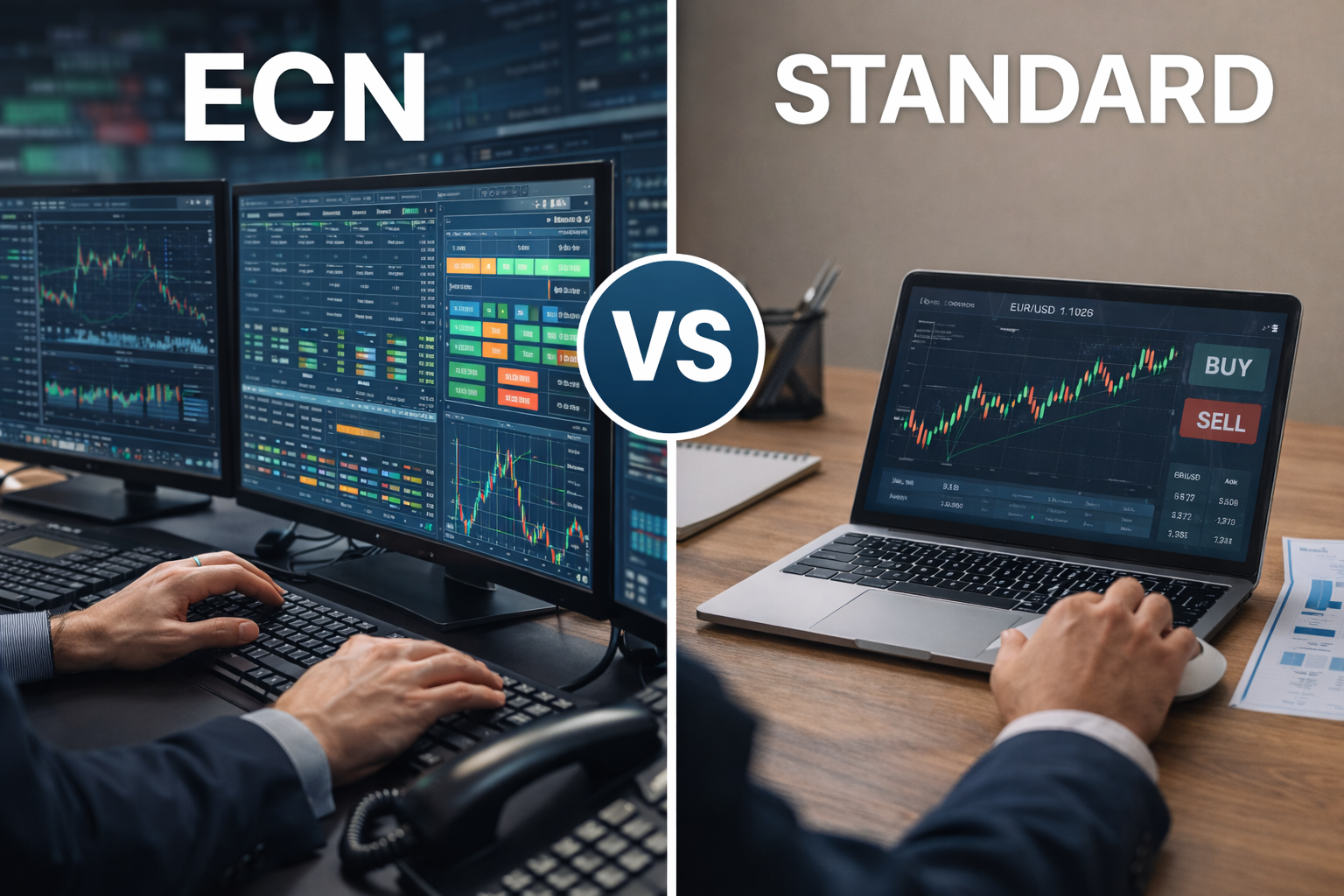
Which Account Is Preferable for Intermediate or Advanced Traders?
If you have started to become more active or have a strategy that relies on fast entry, small stops, or precise executions then ECN is usually the better option.
ECN traders are usually:
- Trading sometimes multiple times per day
- Conducting intraday strategies or scalping in other words trading daily or even hourly
- Trading during volatile times when there are “high-volume” sessions
- Valuing agreed spreads
- Valuing transparency in the spread offered by broker
If you have been taking trading seriously up until now, ECN will feel more professional.
Think of It Like Two Different Driving Experiences
When you choose an account, it is somewhat comparable to choosing a manual or automatic car.
A standard account is like an automatic — easier, smoother, all together a more beginner-like experience.
While an ECN account is a manual- – more control through precision, but requires more skill.
Neither is “better” in a universal sense as it depends on the trader.
What about stop losses, slippage, and higher execution quality?
ECN generally has a higher or “cleaner” execution because excess volume throughout orders across multiple liquidity providers and during times of high activity, this may result in lower slippage.If you are trading with a Standard account, your order is typically routed through a broker, which may lead to:
– Minor delays
– Requotes
– Wider spreads in times of volatility
However, all of this depends on the quality of the broker. If you are with a regulated and trustworthy broker, a Standard account may not feel that much different from an ECN account.
A Scenario You Might Appreciate
Imagine you are a new trader. Let’s call her Sara. She trades on average 1–2 times a week. She typically trades “swings” and is relatively simple. A Standard account is a good fit for Sara.
Now, let’s consider her friend Armando. Armando is a new trader like Sara, but he trades 10 times a day, scalping during the London and New York sessions. Armando prefers quick executions and low spreads. He will find an ECN account much more beneficial than a Standard Account.
Both have the same hobby.
Both have different styles.
Both have different needs for the account type.
Remember: Your trading style will drive your choice of account type.
You will want to ask yourself these questions:
– Do I trade often or do I place trades sparingly?
– Do I scalp or hold trades?
– Do I care more about speed or simplicity?
– Do I mind paying a commission?
– Do I want raw market prices?
These will guide you to choose the right account.
Can you switch to another account type later?
Yes, many traders trade using a Standard account to build the basic level of understanding of risk, spreads, and execution before making the switch to an ECN account.
Your trading will change.
Your profile will change.
Your experience will also change so account types can change.
There is no rule that you have to have a written a letter to the broker determining the “perfect” account on day one.
Final Thoughts: ECN vs Standard is Not Better — Better For You
So, which is better — is it an ECN account or is it a Standard account?
The correct answer is based on your trading style, frequency, experience, and goals. If the goal is to have low forex spreads, greater transparency, and immediacy, then ECN is better.
If the goal is simplicity, stability, and ease of entry, then Standard is better.
ECN vs Standard accounts is not about choosing the way that is “better; it is about selecting the account that best fits your journey as a trader.
The more experience you have and the more you learn about different types of forex accounts, the more naturally you will demonstrate a preference. Choosing the right account is simply indicative of being competent, confident, and becoming a consistently successful trader in your account. The more aligned an account is with your trading style, the easier and more enjoyable the trading experience will be.
Share
Hot topics

What is News Trading in Forex? A Complete Guide to Event-Driven Strategy
Introduction If you have ever watched the forex market during a major economic announcement, you know how dramatic it can be. Prices jump within seconds. Spreads widen. Volatility explodes. For...
Read more




Submit comment
Your email address will not be published. Required fields are marked *