cTrader vs MetaTrader 5
Choosing your trading platform is one of the first steps in online trading. This decision shapes your entire trading experience, influencing your charts, order execution, trading tools, and how you interact with the markets.
At OTET Markets, traders benefit from one of the most powerful trading environments on the market — complete with full access to MetaTrader 5 (MT5) and advanced ECN/STP execution.
But as the world of trading continues to evolve, many traders are starting to ask themselves if MT5 is really the best game in town? Or whether cTrader – MT5’s long-time rival – offers something better?
Perhaps you’ve seen discussions comparing cTrader to MT5, or read a random trading platform comparison article somewhere. It’s a fair debate. And if you’re deciding on a platform for the long-term, you deserve to know “who’s got the edge,” especially if you’re trading under the OTET Markets structure and liquidity.
We’ve stripped everything down for you and broken matters down in simple terms. No confusing jargon, no complex tech speak, just plain old-fashioned human talk on what each platform does great, and where they stand apart – especially at OTET Markets!
Why Your Platform Choice Matters More Than You Think
A platform is not just “software.” It becomes your trading environment — almost like your workstation. Imagine trying to work with slow, unresponsive tools in a stressful environment. That can easily affect your decision-making.
On the other hand, trading on a smooth, intuitive, fast platform gives you a sense of control. You’re able to spot opportunities faster, react more decisively, and manage your risk more clearly.
Choosing a platform isn’t just about features—it’s about finding the environment that helps you think clearly and stay confident while navigating changing market conditions.
This is why OTET Markets pays attention to platform technology. Their infrastructure routes your orders directly to external liquidity providers under an ECN/STP model, meaning you’re not dealing with artificial interference from a market-maker. The platform you choose influences how efficiently you connect to that liquidity.
You’d be amazed at how many traders improve performance after committing to a trading platform that aligns with their thought processing style. Some traders use platforms that provide a structured way to view the market, allowing them to remain disciplined. Others are motivated by dynamic, interactive visual representations of data, which help them stay engaged and focused on market activity.
Using two different platforms may affect the interpretation of the same chart by two different traders. It is possible for traders using two completely different platforms, MT5 and cTrader, to arrive at significantly different outcomes when selecting trades, solely because their respective platforms emphasize and de-emphasize different aspects of the trading process.
Consequently, selecting a trading platform is more than a preference; it becomes integrated into an individual trader’s trading persona. MT5 and cTrader are both powerful, but they feel different, and they serve traders differently.
read more: What Is MetaTrader and How Does It Work
A Quick Background: MT5’s Reputation vs cTrader’s Rise
MetaTrader 5 has been around for over a decade and is one of the world’s most widely used trading platforms. Many traders grew up using MT4 and later transitioned to MT5, so when traders talk about the best forex platforms, MT5 is almost always in the conversation.
Although cTrader and MT5 were released within a year of each other, cTrader is widely viewed as the more modern platform due to its interface and design approach. It has a modern, user-friendly interface which is attractive and clean, has great transparency features, and has a reputation for precision and ‘depth’ which many ECN traders love.
OTET supports MT5 because, combined with our liquidity, it provides you with the best platform to trade on. With just a little understanding of cTrader, you have some perspective on what else is out there and what it is that MT5 has to compete against.
User Experience: Clean and Modern vs Familiar and Flexible
If you think about how using the platforms feels, there is a noticeable difference.
MetaTrader 5 feels like a tool you grow with.
Its interface is traditional, structured, and familiar to anyone who has ever used MT4. If you like organization and simplicity, MT5 gives you that comfort. Everything is where you expect it to be, nothing feels too shiny or distracting, and you can switch between multiple charts and indicators effortlessly.
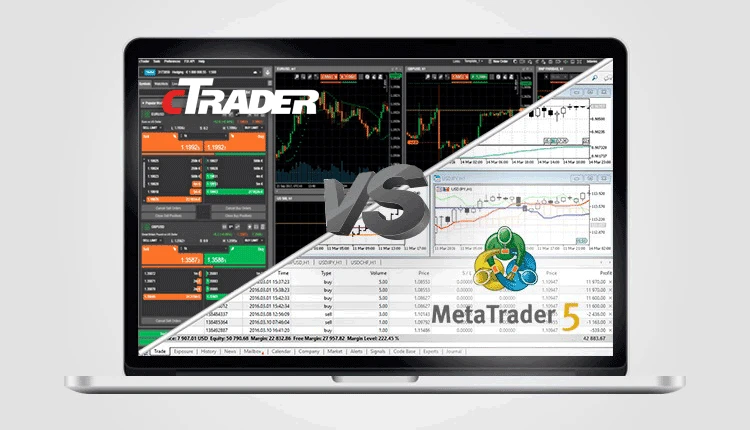
cTrader feels modern and minimalistic.
Its design resembles a sleek digital dashboard. The charts are visually polished, and the navigation feels intuitive — like the way modern apps are built. If you enjoy visually clean interfaces and quick accessibility of tools, cTrader has that fresh “tech-era” feeling.
Traders at OTET Markets often describe MetaTrader 5 as the platform they rely on for full functionality, custom indicators, and long-term workflow. cTrader, on the other hand, appeals not only because of its clean UI, but also because it offers native FIX API access, advanced depth-of-market tools, smoother tick-data charting, and more precise execution reporting.
In short, while traders appreciate cTrader’s design, its real strength is the level of transparency it provides in execution.
Execution Speed and Transparency: Where cTrader Shines but MT5 Keeps Up
Execution matters greatly with OTET, especially as an ECN broker. Both platforms are fast, but they handle information differently.
cTrader is known for transparent order-book depth.
It shows Level II pricing in a way many traders find clearer. You see more detail about liquidity, which can help you understand market depth before placing a trade.
MetaTrader 5 focuses on efficient routing and smooth execution.
OTET’s MT5 setup is optimized for low-latency execution through external liquidity providers. While MT5’s depth-of-market display isn’t as visually advanced as cTrader’s, its execution quality in a strong ECN environment can be just as fast.
So in reality, your execution at OTET Markets depends more on our infrastructure than the platform itself—and ours is made for the fluid, stable routing of MT5 traders.
Charting Tools: Different Strengths for Different Styles
Charting is the backbone of any trader’s workflow; every trader wants something to help them with analyzing the market, without any hesitation or slowing down.
So MT5 offers robust charting with extensive customization.
You get:
- Dozens of built-in indicators
- Flexible timeframes
- The ability to add unlimited charts
- Smooth optimization for expert advisors
Its charting feels practical and adaptable. You can tailor it exactly the way you want.
cTrader offers beautiful charts with advanced depth features.
Its charts are visually sharper, and drawing tools feel slightly more refined. Its charts are visually sharper, and drawing tools feel slightly more refined. Some traders prefer cTrader’s charting for scalping because of the smoothness and clarity.
When trading with OTET Markets, MT5’s charting often wins for long-term use simply because of its deeper customization and integration with automated systems.
Algo Trading and Scripts: MT5 Dominates Here
If you plan to trade algorithmically — even if you’re not doing it today but might in the future — MT5 has a clear advantage.
MetaTrader 5 uses MQL5, one of the most powerful scripting languages in forex trading.
It allows:
- Custom indicators
- Automated strategies
- Copy-trading scripts
- Trading robots
- Backtesting with historical data
OTET Markets traders who use EAs (Expert Advisors) rely heavily on MT5 because the ecosystem is so large. You can find thousands of free and paid tools built by the global community.
cTrader uses cAlgo, built on C#.
It is powerful, but with a smaller community, of course. If programming is your thing, you’re likely loving C#. For most traders, the environment favoured is one of MQL5, which feels easier and much more resource-rich.
Order Types and Flexibility
You get all the standard order types on both platforms; however, they differ in the way in which they display your orders.
- MT5 organizes everything in a simple dropdown style.
- cTrader uses a more modern pop-up format with sliders and interactive controls.
In terms of actual functionality, both cover:
- Market orders
- Limit and stop orders.
- Stop-loss and take-profit
- Trailing stops
- Partial closing of orders
At OTET, the execution model is the same regardless of platform. So the main difference is feel, not function.
Copy Trading and Social Trading
This is where MT5 has a wider ecosystem, OTET Markets’ MT5 trades integrate with:
The global MetaQuotes copy-trading marketplace
Signals straight from professional traders
Third-party platforms that support MT5 account holders
cTrader also has copy-trading features, but the community feels quite niche. If social trading is important to you, MT5 is gonna give you more choices.
Mobile and Web Trading
Both have web and mobile versions; however, MT5 has a wider scope of devices supported.
MT5 Mobile:
- Lightweight
- Fast
- Support multiple charts
- Works well on older phones
cTrader Mobile:
- Smooth controls
- Attractive interface
- More polished overall
People who love beautiful layouts generally prefer cTrader mobile, while more practical traders lean towards MT5 for its usability.
How OTET Markets Provides Each Trading Platform Out There for You
OTET Markets supports both MetaTrader 5 and cTrader, giving traders the freedom to choose a platform that feels right for their style. No matter which platform you use, rather than pushing one option over the other, OTET focuses on providing strong infrastructure, fast execution, and access to deep liquidity.
Because OTET works as ECN/STP traders using both MT5 and cTrader enjoy from:
- Direct access to external liquidity providers
- No dealing desk interference
- Tightest spreads achievable
- Fast execution speeds
- Reliable order routing
Whether you’re using MetaTrader 5 or cTrader, your trades are being handled effectively as you go about trading on both systems.
Why OTET Offers Both Platforms Instead of Just One
Each trader thinks differently — and OTET understands that.
There are traders who enjoy MT5 for its massive ecosystem, great indicators, tools, and Expert Advisors.
There are others who enjoy cTrader for accessibility, transparency via depth-of-market, and a clean design.
Rather than pushing traders into one platform, OTET provides a flexible environment where you choose what works best for your approach.
Which Platform Should You Choose as an OTET Trader?
Rather than saying one platform is “better,” OTET encourages traders to choose based on personal preference:
Choose MetaTrader 5 if you like:
- A tremendous library of trading tools and EAs.
- Customizability
- MetaTrader style workflow.
- Using algorithmic trading with MQL5
Choose cTrader if you want:
- Modern clean interface
- Transparency in depth of the market
- Smooth, easy charting methods
- Intuitive order execution workflow
Both platforms connect to OTET’s liquidity infrastructure equally — so the decision comes down to your comfort, your strategy, and the way you like to interact with the market.
Final Message: Both are strong; you’re the one in charge.
OTET Markets doesn’t push you towards one platform or another. Instead, it provides two of the best forex platforms and lets you decide which one aligns with your trading habits.
Whether you’re comparing cTrader vs MT5, reading a platform comparison, or exploring different trading tools, the key point is simple:
OTET provides and supports both platforms equally — and you’re free to trade with whichever one feels right for you. At the end of the day, you’re the one behind the computer, and comfort matters more than anything else.
Share
Hot topics

What is News Trading in Forex? A Complete Guide to Event-Driven Strategy
Introduction If you have ever watched the forex market during a major economic announcement, you know how dramatic it can be. Prices jump within seconds. Spreads widen. Volatility explodes. For...
Read more




Submit comment
Your email address will not be published. Required fields are marked *