What Is a Forex PAMM Account? Complete Guide
Introduction
If you’ve ever wanted to invest in Forex but had reservations about doing it alone, you’re not by yourself! Many people are interested in investing in the Forex market but do not have the time, expertise or confidence that are required to execute daily trades.
This is where the managed investment model comes in, and one of the most well-known is a forex pamm account.
In essence, it is a basic premise where an individual invests money to have a professional trader manage their investments for them, and the profits (or losses) derived from that investment flow back to the investor in a proportional distribution. However, there is actually a very developed system behind this simplistic premise that creates a level of transparency and fairness between the investor and the manager.
What Does PAMM Meaning?
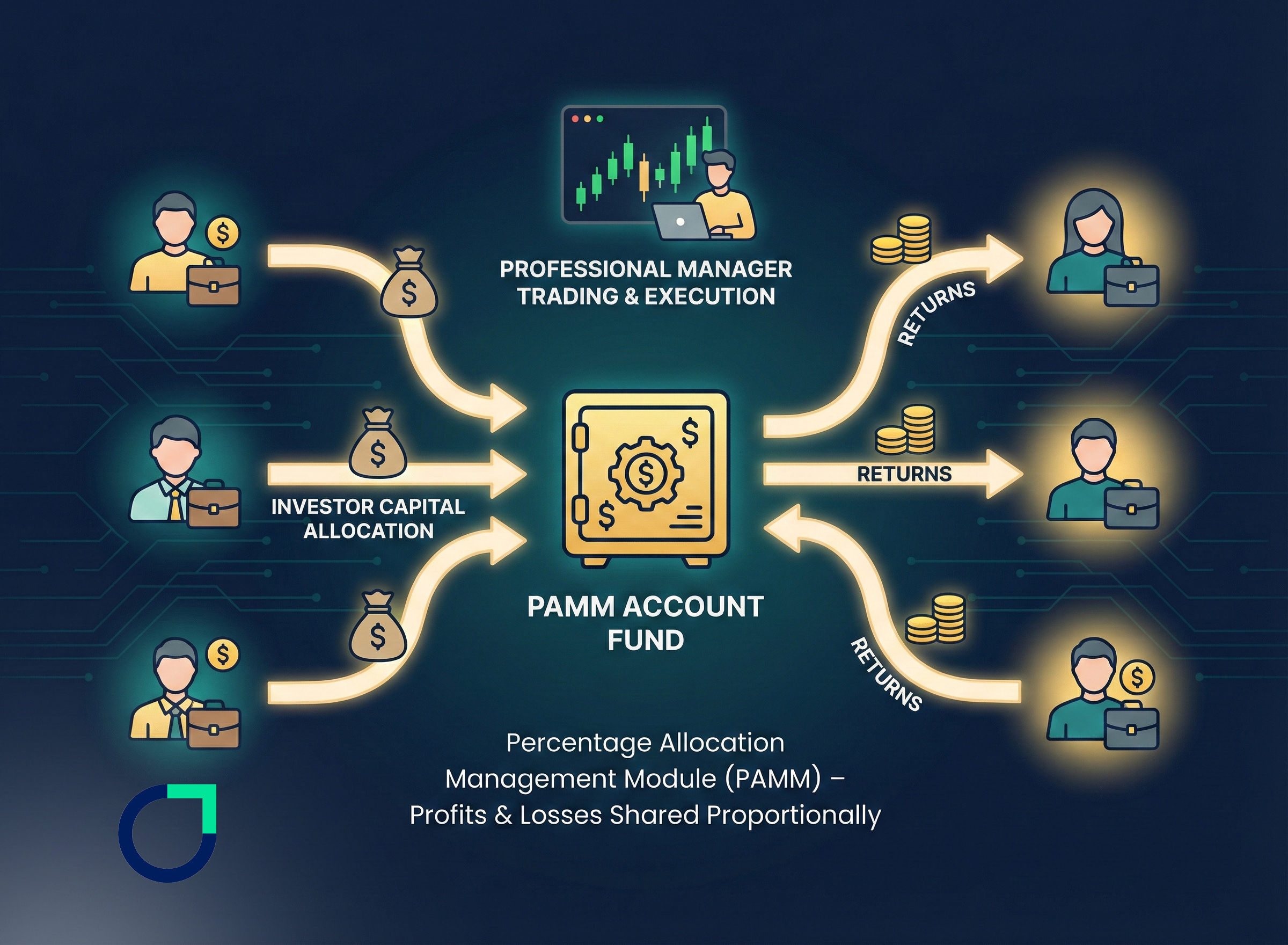
PAMM means percent allocation management module, which isn’t very complicated; the concept is actually rather simple’. With PAMM you can pool your money together with other investors to have a money manager manage and trade your combined investment.’ All of the profits/losses are taken from the total amount of money traded in the pool (PAMM); and therefore each individual investor will evenly share in all the gains/losses based on how much each person contributed to the total amount of the daily PAMM (or per share ratio).
So when someone talks about pamm account forex, they’re referring to a structured way of investing in Forex through a managed allocation system rather than trading individually.
What Is a Forex PAMM Account?
A forex pamm account is a type of managed Forex investment account where investors place funds under the control of an experienced trader, often called a money manager.
Instead of opening your own trades, you choose a manager based on their performance history, risk profile, and strategy. Once you invest, your funds are combined with others and traded as part of a larger pool.
The key difference from traditional managed accounts is proportional allocation. Every trade result — whether profit or loss — is distributed automatically based on each investor’s percentage contribution.
This makes the system transparent and mathematically fair.
How Does a PAMM Account Work?
Understanding the process step by step makes everything clearer.
Step 1: Investors Deposit Funds
Investors deposit their capital into a broker-supported PAMM structure. They select a money manager whose trading history and risk level align with their goals.
Each investor’s contribution is recorded precisely.
Step 2: Funds Are Combined into a Trading Pool
All investor funds are combined into a central trading account. This creates one large trading balance managed by the selected trader.
Step 3: Manager Executes Trades
The money manager trades the pooled capital according to their strategy. This may include day trading, swing trading, or even techniques like Hedging in Forex, depending on their approach.
The manager’s own capital is usually included in the pool, which aligns incentives and builds trust.
Step 4: Profit and Loss Distribution
If the account generates profit, it is distributed proportionally.
If losses occur, those are also shared proportionally.
Everything is calculated automatically by the broker’s PAMM system, ensuring fairness and transparency.
Key Participants in a PAMM Structure
A PAMM system involves three main roles.
The Forex Broker
The broker provides the technical infrastructure that supports the PAMM system. They calculate allocations, process deposits, and ensure transparent reporting.
Well-known brokers such as Otet Markets offer structured account types and reporting systems that support managed models.
The Money Manager
A manager of funds, or “money manager,” is tasked with executing trading orders on behalf of clients. Generally, a manager of funds will provide performance histories to prospective clients in order for those investors to assess the managers’ completed returns prior to making an investment.
Money managers are usually compensated on a performance basis (i.e., through performance fees), rather than through a fixed salary.
The Investors
Investors are the sources of capital.
Investors do not place trade orders themselves, but they can monitor the performance of their investment and withdraw funds under the terms of the investment agreement and reallocate their capital if they want to.
Practical Example of PAMM Profit Distribution
Let’s simplify it.
Imagine three investors:
- Investor A deposits $5,000
- Investor B deposits $3,000
- Investor C deposits $2,000
The total pool equals $10,000.
If the manager generates a 10% return, the account grows to $11,000.
The $1,000 profit is distributed proportionally:
- Investor A receives $500
- Investor B receives $300
- Investor C receives $200
The same formula applies in reverse if there is a loss.
That proportional distribution is the core principle of PAMM trading.
PAMM Fees Explained
PAMM structures typically involve performance-based fees.
Managers often charge a percentage of profits rather than a flat fee. This aligns incentives — if the manager doesn’t perform well, they don’t earn much.
There may also be broker fees or spreads applied to trades.
It’s important to review the fee structure carefully before committing to any pamm investment.
Transparency in fees often reflects professionalism.
Benefits of Forex PAMM Accounts
Professional Management
Investors gain exposure to experienced traders without managing trades themselves.
Passive Participation
You don’t need to monitor charts daily. Your role becomes strategic rather than tactical.
Transparent Allocation
Profits and losses are calculated automatically and proportionally.
Diversification Opportunities
You can allocate funds across multiple managers to spread risk.
Scalability
Both small and larger investors can participate, depending on broker requirements.
Risks and Disadvantages of PAMM Accounts
Market Risk
Even professional traders can lose money.
Manager Risk
Past performance does not guarantee future results.
Limited Control
Investors cannot control individual trade decisions.
Fee Impact
Performance fees reduce net returns.
Emotional Misalignment
Some investors panic during drawdowns and withdraw prematurely.
Understanding these risks is crucial before committing capital.

PAMM vs MAM
Here’s a comparison:
| Feature | PAMM | MAM |
| Allocation Method | Percentage-based | Lot-based or customizable |
| Investor Control | Limited | Slightly more flexible |
| Trade Execution | Centralized | Distributed |
| Complexity | Simpler | More advanced |
| Typical Users | Retail investors | Professional managers |
Both structures aim to manage pooled funds, but PAMM is generally easier for passive investors to understand.
How to Start Investing in a PAMM Account
First, choose a regulated broker offering PAMM services.
Next step is to deposit funds into your account with your chosen pam manager.
Check on your managers performance regularly but do not make investment decisions based solely on immediate market reactions.
Knowledge of this type of account structure and function will help you in making sound investments rather then just pursuing the highest profit potential.
How to Become a PAMM Money Manager
When you are an experienced trader, you have the potential to manage an account.
You must have a successful trading history, a disciplined approach to risk management, and be transparent about your trading activities.
Brokers may ask for proof of your trading history and some may also require a minimum trade size.
Most of the compensation that a manager receives will come from performance fees; therefore, consistency is much more important than a few large winning trades on occasion.
Like any other profession, developing your reputation in this industry is a long-term process.
Is a Forex PAMM Account Right for You?
A forex pamm account may suit investors who:
- Want exposure to Forex without active trading
- Prefer structured allocation systems
- Understand market risk
- Are comfortable with performance-based fees
However, it may not suit those who:
- Want full control over trades
- Cannot tolerate drawdowns
- Expect guaranteed returns
PAMM is a structured investment model, not a shortcut to guaranteed income.
Conclusion
Utilizing a Forex Pamm Account offers investors access to the foreign exchange market without requiring them to trade directly. This type of investment involves combining professional oversight, proportionate total participation, as well as an automated method for distributing profits among investors in a visible manner through usage of a Forex Pamm Account.
There are risks associated with this type of investment, just like any investment, however with adequate research, setting appropriate expectations for returns on your investment, and due diligence when choosing your manager there can be many advantages to using a Forex Pamm Account as an investment option as opposed to trading on your own.
Always be conscious of how Forex Pamm Accounts operate and review your individual financial objectives prior to investing with one of these accounts.
FAQ
What is PAMM meaning?
The Percent Allocation Management Module distributes gains and losses among participants according to the percentage of total funds that they each own in relation to all other participants in the pool of managed investment capital.
What is the minimum capital required to start a PAMM account?
Minimum capital depends on the broker and the manager. Some allow small deposits, while others require larger allocations.
Do I need Forex experience to PAMM investment?
No direct trading experience is required, but understanding market risk is strongly recommended.
Which platforms support PAMM accounts (MT4/MT5)?
Many brokers support PAMM structures on MT4 or MT5 environments, and some also integrate additional systems alongside models similar to What Is Copy Trading for broader managed investment options.
Share
Hot topics
Best Time to Trade Gold (XAU/USD) in Forex
Introduction If you’ve ever observed gold move during a significant news release, you understand that timing is extremely important. Gold can be calm for hours before exploding with momentum. For...
Read more


Submit comment
Your email address will not be published. Required fields are marked *